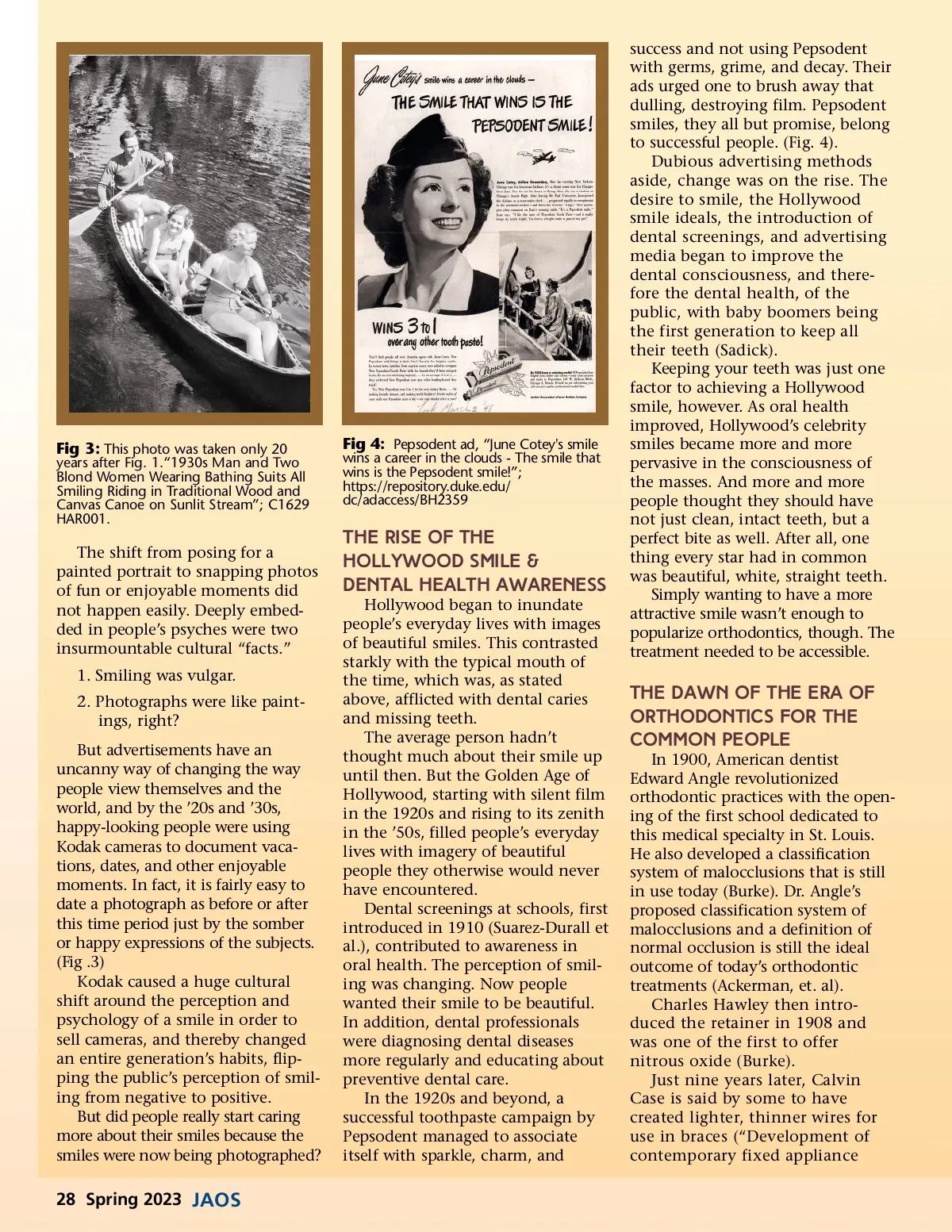
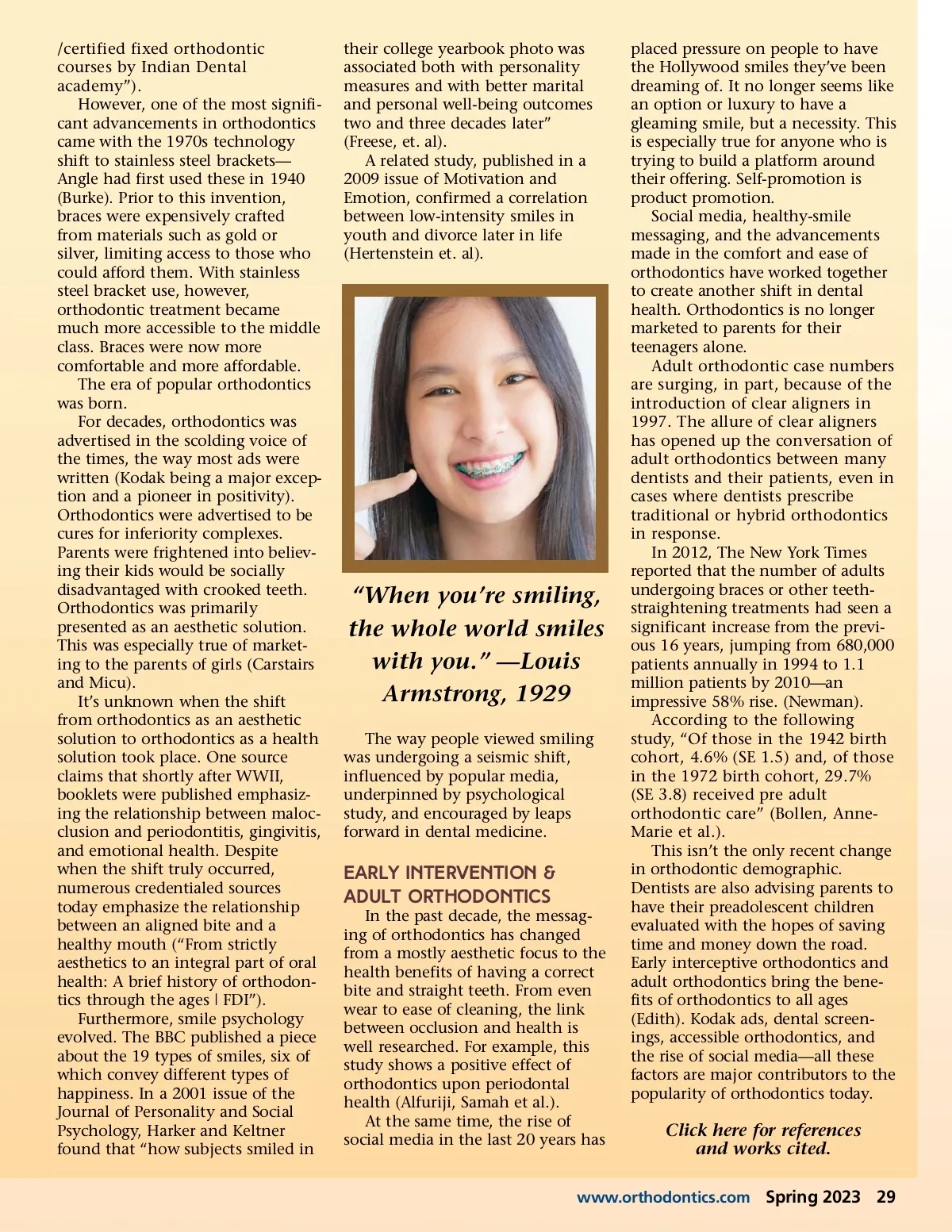
Fig 3: This photo was taken only 20 Fig 4: Pepsodent ad, “June Cotey's smile years after Fig. 1.“1930s Man and Two Blond Women Wearing Bathing Suits All Smiling Riding in Traditional Wood and Canvas Canoe on Sunlit Stream”; C1629 HAR001. wins a career in the clouds -The smile that wins is the Pepsodent smile!”; https://repository.duke.edu/ dc/adaccess/BH2359 The shift from posing for a painted portrait to snapping photos of fun or enjoyable moments did not happen easily. Deeply embed-ded in people’s psyches were two insurmountable cultural “facts.” 1. Smiling was vulgar. 2. Photographs were like paint-ings, right? But advertisements have an uncanny way of changing the way people view themselves and the world, and by the ’20s and ’30s, happy-looking people were using Kodak cameras to document vaca-tions, dates, and other enjoyable moments. In fact, it is fairly easy to date a photograph as before or after this time period just by the somber or happy expressions of the subjects. (Fig .3) Kodak caused a huge cultural shift around the perception and psychology of a smile in order to sell cameras, and thereby changed an entire generation’s habits, flip-ping the public’s perception of smil-ing from negative to positive. But did people really start caring more about their smiles because the smiles were now being photographed? The Rise of the Hollywood Smile & Dental Health Awareness Hollywood began to inundate people’s everyday lives with images of beautiful smiles. This contrasted starkly with the typical mouth of the time, which was, as stated above, afflicted with dental caries and missing teeth. The average person hadn’t thought much about their smile up until then. But the Golden Age of Hollywood, starting with silent film in the 1920s and rising to its zenith in the ’50s, filled people’s everyday lives with imagery of beautiful people they otherwise would never have encountered. Dental screenings at schools, first introduced in 1910 (Suarez-Durall et al.), contributed to awareness in oral health. The perception of smil-ing was changing. Now people wanted their smile to be beautiful. In addition, dental professionals were diagnosing dental diseases more regularly and educating about preventive dental care. In the 1920s and beyond, a successful toothpaste campaign by Pepsodent managed to associate itself with sparkle, charm, and success and not using Pepsodent with germs, grime, and decay. Their ads urged one to brush away that dulling, destroying film. Pepsodent smiles, they all but promise, belong to successful people. (Fig. 4). Dubious advertising methods aside, change was on the rise. The desire to smile, the Hollywood smile ideals, the introduction of dental screenings, and advertising media began to improve the dental consciousness, and there-fore the dental health, of the public, with baby boomers being the first generation to keep all their teeth (Sadick). Keeping your teeth was just one factor to achieving a Hollywood smile, however. As oral health improved, Hollywood’s celebrity smiles became more and more pervasive in the consciousness of the masses. And more and more people thought they should have not just clean, intact teeth, but a perfect bite as well. After all, one thing every star had in common was beautiful, white, straight teeth. Simply wanting to have a more attractive smile wasn’t enough to popularize orthodontics, though. The treatment needed to be accessible. The Dawn of the Era of Orthodontics for the Common People In 1900, American dentist Edward Angle revolutionized orthodontic practices with the open-ing of the first school dedicated to this medical specialty in St. Louis. He also developed a classification system of malocclusions that is still in use today (Burke). Dr. Angle’s proposed classification system of malocclusions and a definition of normal occlusion is still the ideal outcome of today’s orthodontic treatments (Ackerman, et. al). Charles Hawley then intro-duced the retainer in 1908 and was one of the first to offer nitrous oxide (Burke). Just nine years later, Calvin Case is said by some to have created lighter, thinner wires for use in braces (“Development of contemporary fixed appliance 28 Spring 2023 JAOS
Journal of the American Orthodontic Society Spring 2023: Page 28