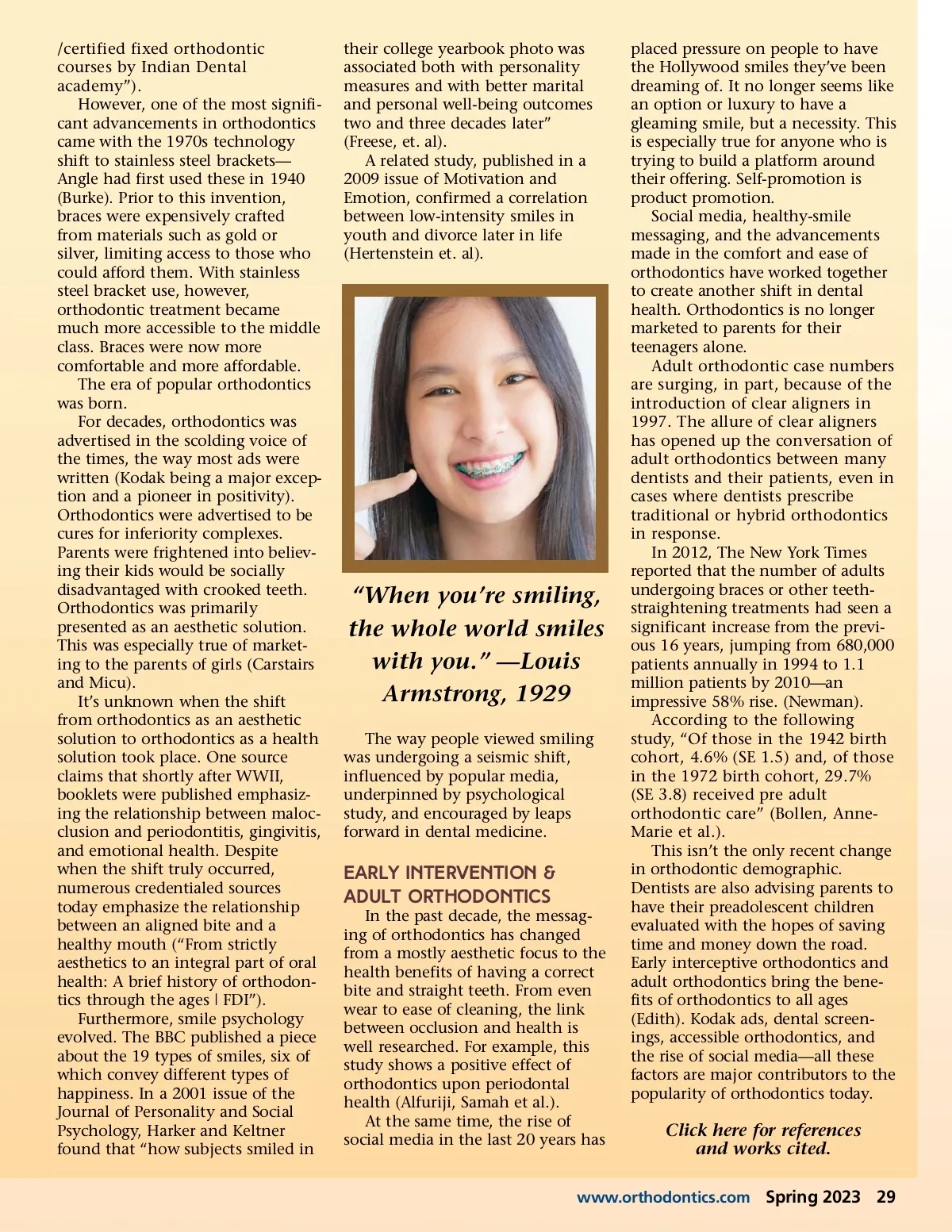
/certified fixed orthodontic courses by Indian Dental academy”). However, one of the most signifi-cant advancements in orthodontics came with the 1970s technology shift to stainless steel brackets— Angle had first used these in 1940 (Burke). Prior to this invention, braces were expensively crafted from materials such as gold or silver, limiting access to those who could afford them. With stainless steel bracket use, however, orthodontic treatment became much more accessible to the middle class. Braces were now more comfortable and more affordable. The era of popular orthodontics was born. For decades, orthodontics was advertised in the scolding voice of the times, the way most ads were written (Kodak being a major excep-tion and a pioneer in positivity). Orthodontics were advertised to be cures for inferiority complexes. Parents were frightened into believ-ing their kids would be socially disadvantaged with crooked teeth. Orthodontics was primarily presented as an aesthetic solution. This was especially true of market-ing to the parents of girls (Carstairs and Micu). It’s unknown when the shift from orthodontics as an aesthetic solution to orthodontics as a health solution took place. One source claims that shortly after WWII, booklets were published emphasiz-ing the relationship between maloc-clusion and periodontitis, gingivitis, and emotional health. Despite when the shift truly occurred, numerous credentialed sources today emphasize the relationship between an aligned bite and a healthy mouth (“From strictly aesthetics to an integral part of oral health: A brief history of orthodon-tics through the ages | FDI”). Furthermore, smile psychology evolved. The BBC published a piece about the 19 types of smiles, six of which convey different types of happiness. In a 2001 issue of the Journal of Personality and Social Psychology, Harker and Keltner found that “how subjects smiled in their college yearbook photo was associated both with personality measures and with better marital and personal well-being outcomes two and three decades later” (Freese, et. al). A related study, published in a 2009 issue of Motivation and Emotion, confirmed a correlation between low-intensity smiles in youth and divorce later in life (Hertenstein et. al). “When you’re smiling, the whole world smiles with you.” —Louis Armstrong, 1929 The way people viewed smiling was undergoing a seismic shift, influenced by popular media, underpinned by psychological study, and encouraged by leaps forward in dental medicine. Early Intervention & Adult Orthodontics In the past decade, the messag-ing of orthodontics has changed from a mostly aesthetic focus to the health benefits of having a correct bite and straight teeth. From even wear to ease of cleaning, the link between occlusion and health is well researched. For example, this study shows a positive effect of orthodontics upon periodontal health (Alfuriji, Samah et al.). At the same time, the rise of social media in the last 20 years has placed pressure on people to have the Hollywood smiles they’ve been dreaming of. It no longer seems like an option or luxury to have a gleaming smile, but a necessity. This is especially true for anyone who is trying to build a platform around their offering. Self-promotion is product promotion. Social media, healthy-smile messaging, and the advancements made in the comfort and ease of orthodontics have worked together to create another shift in dental health. Orthodontics is no longer marketed to parents for their teenagers alone. Adult orthodontic case numbers are surging, in part, because of the introduction of clear aligners in 1997. The allure of clear aligners has opened up the conversation of adult orthodontics between many dentists and their patients, even in cases where dentists prescribe traditional or hybrid orthodontics in response. In 2012, The New York Times reported that the number of adults undergoing braces or other teeth-straightening treatments had seen a significant increase from the previ-ous 16 years, jumping from 680,000 patients annually in 1994 to 1.1 million patients by 2010—an impressive 58% rise. (Newman). According to the following study, “Of those in the 1942 birth cohort, 4.6% (SE 1.5) and, of those in the 1972 birth cohort, 29.7% (SE 3.8) received pre adult orthodontic care” (Bollen, Anne-Marie et al.). This isn’t the only recent change in orthodontic demographic. Dentists are also advising parents to have their preadolescent children evaluated with the hopes of saving time and money down the road. Early interceptive orthodontics and adult orthodontics bring the bene-fits of orthodontics to all ages (Edith). Kodak ads, dental screen-ings, accessible orthodontics, and the rise of social media—all these factors are major contributors to the popularity of orthodontics today. Click here for references and works cited. Spring 2023 29 www.orthodontics.com
Journal of the American Orthodontic Society Spring 2023: Page 29