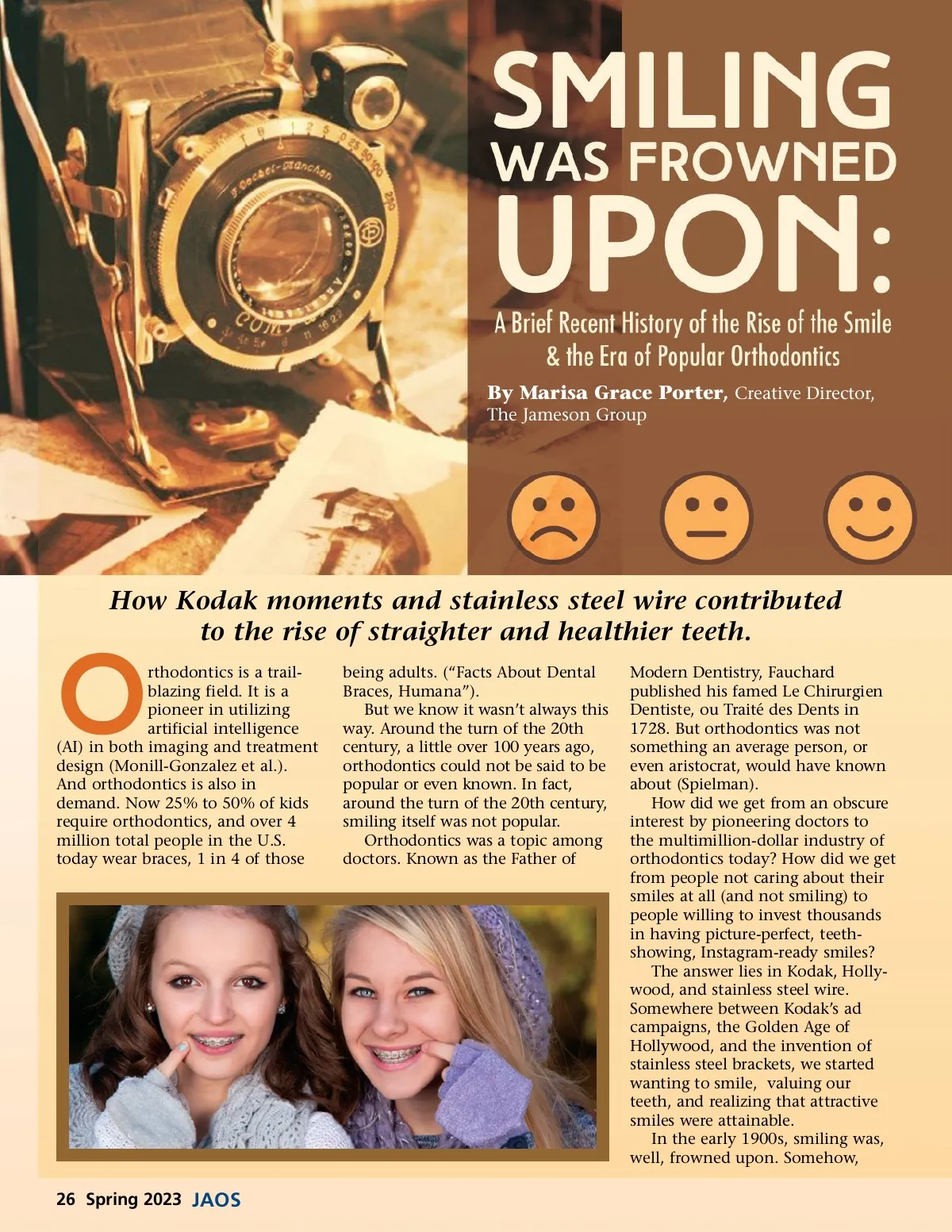
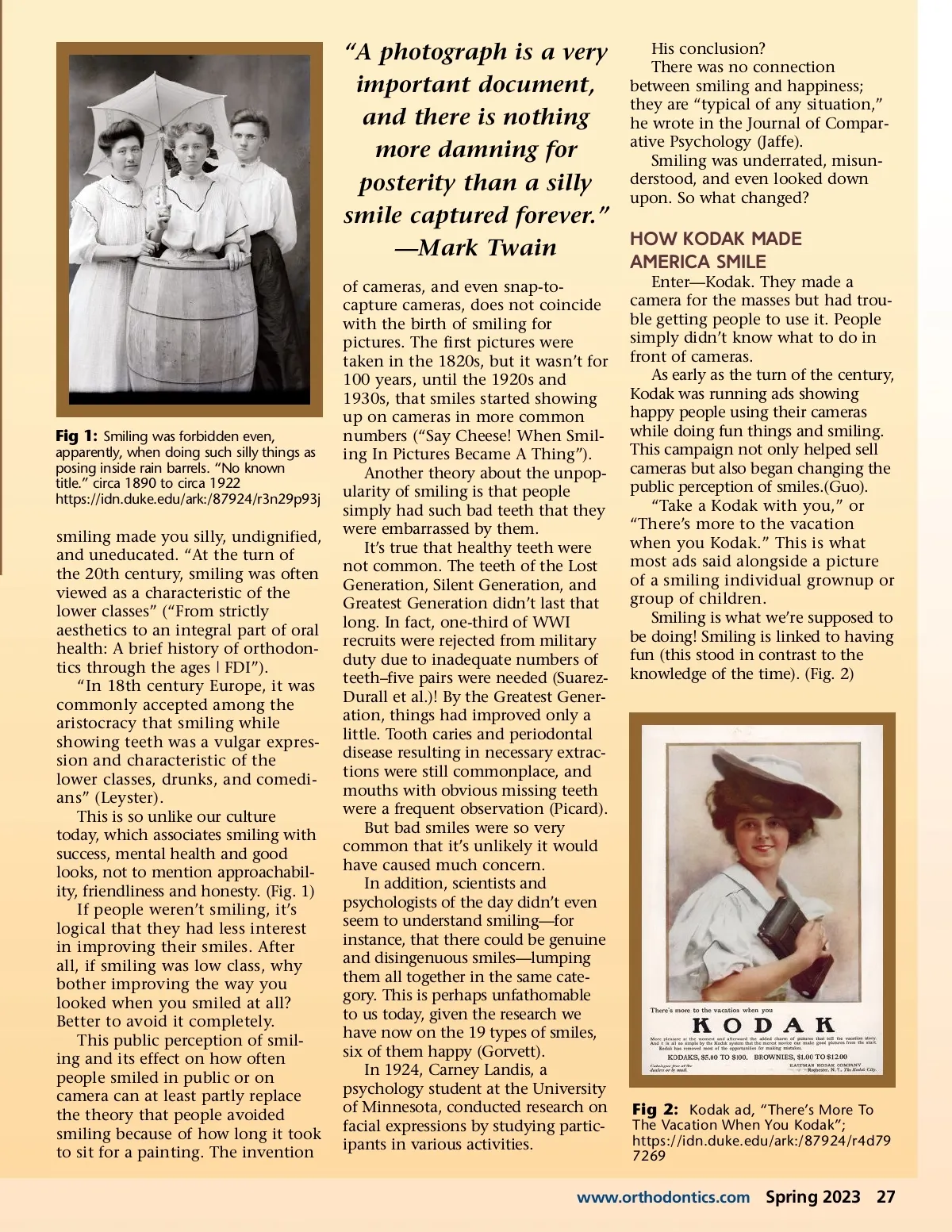
“A photograph is a very important document, and there is nothing more damning for posterity than a silly smile captured forever.” —Mark Twain of cameras, and even snap-to-capture cameras, does not coincide with the birth of smiling for pictures. The first pictures were taken in the 1820s, but it wasn’t for 100 years, until the 1920s and 1930s, that smiles started showing up on cameras in more common numbers (“Say Cheese! When Smil-ing In Pictures Became A Thing”). Another theory about the unpop-ularity of smiling is that people simply had such bad teeth that they were embarrassed by them. It’s true that healthy teeth were not common. The teeth of the Lost Generation, Silent Generation, and Greatest Generation didn’t last that long. In fact, one-third of WWI recruits were rejected from military duty due to inadequate numbers of teeth–five pairs were needed (Suarez-Durall et al.)! By the Greatest Gener-ation, things had improved only a little. Tooth caries and periodontal disease resulting in necessary extrac-tions were still commonplace, and mouths with obvious missing teeth were a frequent observation (Picard). But bad smiles were so very common that it’s unlikely it would have caused much concern. In addition, scientists and psychologists of the day didn’t even seem to understand smiling—for instance, that there could be genuine and disingenuous smiles—lumping them all together in the same cate-gory. This is perhaps unfathomable to us today, given the research we have now on the 19 types of smiles, six of them happy (Gorvett). In 1924, Carney Landis, a psychology student at the University of Minnesota, conducted research on facial expressions by studying partic-ipants in various activities. His conclusion? There was no connection between smiling and happiness; they are “typical of any situation,” he wrote in the Journal of Compar-ative Psychology (Jaffe). Smiling was underrated, misun-derstood, and even looked down upon. So what changed? How Kodak Made America Smile Enter—Kodak. They made a camera for the masses but had trou-ble getting people to use it. People simply didn’t know what to do in front of cameras. As early as the turn of the century, Kodak was running ads showing happy people using their cameras while doing fun things and smiling. This campaign not only helped sell cameras but also began changing the public perception of smiles.(Guo). “Take a Kodak with you,” or “There’s more to the vacation when you Kodak.” This is what most ads said alongside a picture of a smiling individual grownup or group of children. Smiling is what we’re supposed to be doing! Smiling is linked to having fun (this stood in contrast to the knowledge of the time). (Fig. 2) Fig 1: Smiling was forbidden even, apparently, when doing such silly things as posing inside rain barrels. “No known title.” circa 1890 to circa 1922 https://idn.duke.edu/ark:/87924/r3n29p93j smiling made you silly, undignified, and uneducated. “At the turn of the 20th century, smiling was often viewed as a characteristic of the lower classes” (“From strictly aesthetics to an integral part of oral health: A brief history of orthodon-tics through the ages | FDI”). “In 18th century Europe, it was commonly accepted among the aristocracy that smiling while showing teeth was a vulgar expres-sion and characteristic of the lower classes, drunks, and comedi-ans” (Leyster). This is so unlike our culture today, which associates smiling with success, mental health and good looks, not to mention approachabil-ity, friendliness and honesty. (Fig. 1) If people weren’t smiling, it’s logical that they had less interest in improving their smiles. After all, if smiling was low class, why bother improving the way you looked when you smiled at all? Better to avoid it completely. This public perception of smil-ing and its effect on how often people smiled in public or on camera can at least partly replace the theory that people avoided smiling because of how long it took to sit for a painting. The invention Fig 2: Kodak ad, “There’s More To The Vacation When You Kodak”; https://idn.duke.edu/ark:/87924/r4d79 7269 www.orthodontics.com Spring 2023 27
Journal of the American Orthodontic Society Spring 2023: Page 27