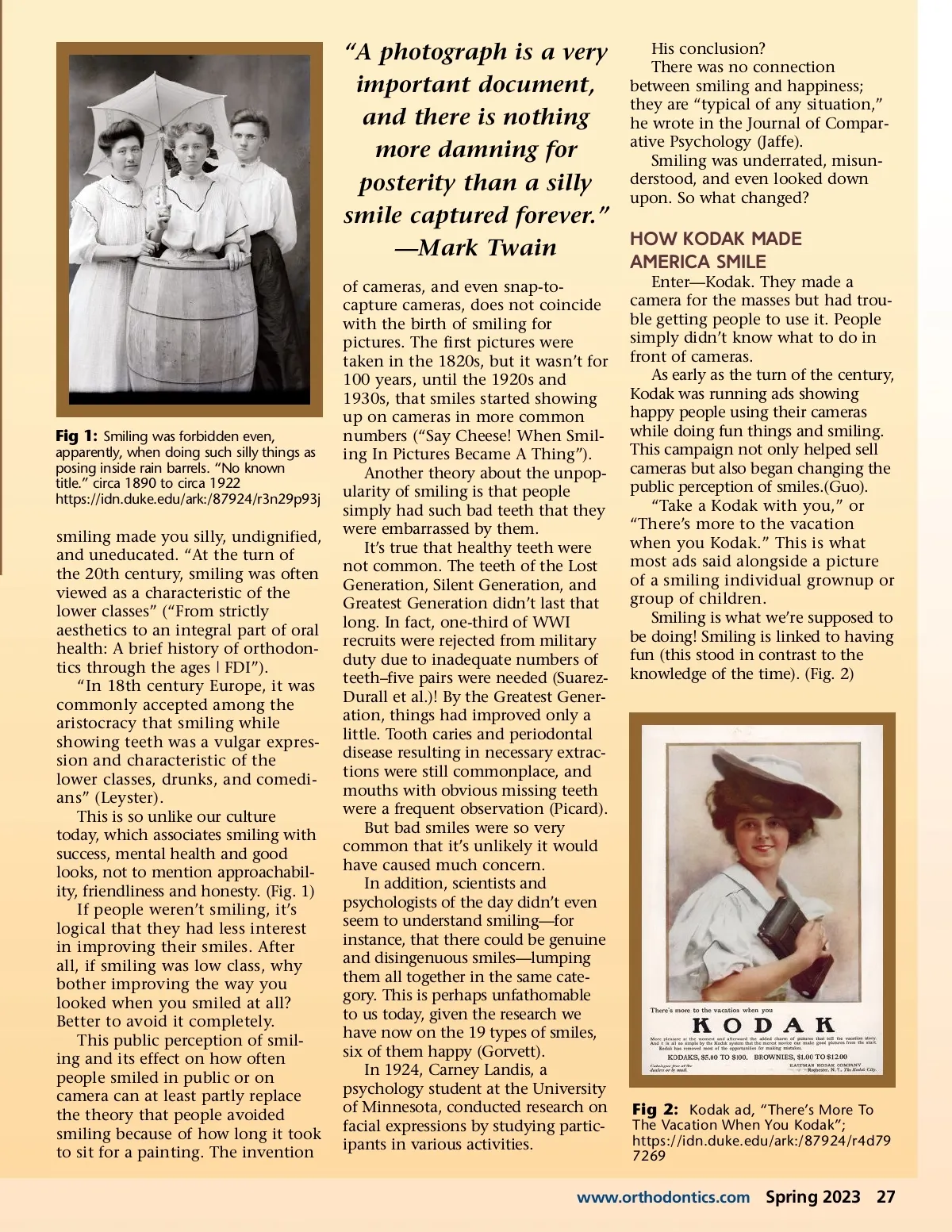
By Marisa Grace Porter, Creative Director, The Jameson Group How Kodak moments and stainless steel wire contributed to the rise of straighter and healthier teeth. O rthodontics is a trail-blazing field. It is a pioneer in utilizing artificial intelligence (AI) in both imaging and treatment design (Monill-Gonzalez et al.). And orthodontics is also in demand. Now 25% to 50% of kids require orthodontics, and over 4 million total people in the U.S. today wear braces, 1 in 4 of those being adults. (“Facts About Dental Braces, Humana”). But we know it wasn’t always this way. Around the turn of the 20th century, a little over 100 years ago, orthodontics could not be said to be popular or even known. In fact, around the turn of the 20th century, smiling itself was not popular. Orthodontics was a topic among doctors. Known as the Father of Modern Dentistry, Fauchard published his famed Le Chirurgien Dentiste, ou Traité des Dents in 1728. But orthodontics was not something an average person, or even aristocrat, would have known about (Spielman). How did we get from an obscure interest by pioneering doctors to the multimillion-dollar industry of orthodontics today? How did we get from people not caring about their smiles at all (and not smiling) to people willing to invest thousands in having picture-perfect, teeth-showing, Instagram-ready smiles? The answer lies in Kodak, Holly-wood, and stainless steel wire. Somewhere between Kodak’s ad campaigns, the Golden Age of Hollywood, and the invention of stainless steel brackets, we started wanting to smile, valuing our teeth, and realizing that attractive smiles were attainable. In the early 1900s, smiling was, well, frowned upon. Somehow, 26 Spring 2023 JAOS
Journal of the American Orthodontic Society Spring 2023: Page 26