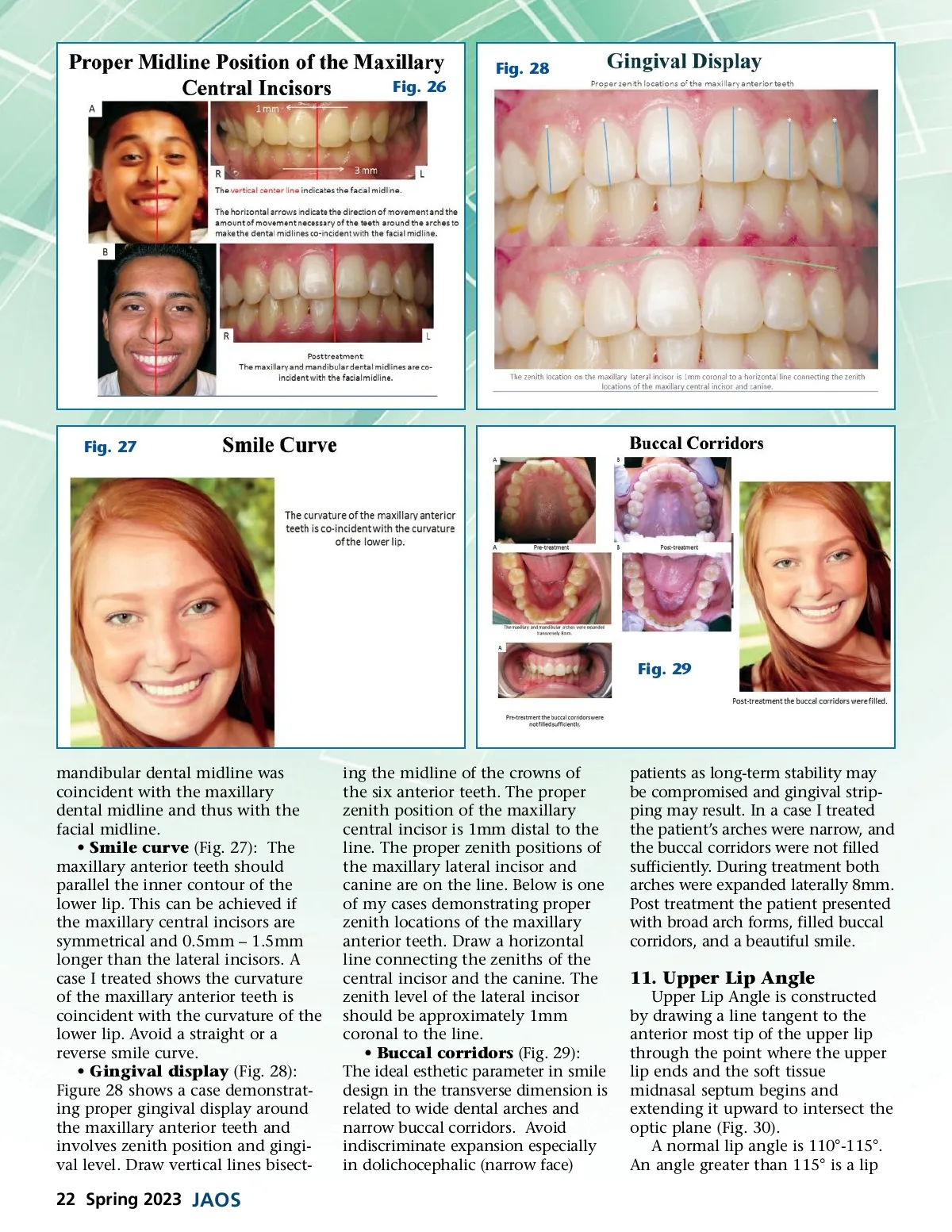
Fig. 28 Fig. 26 Fig. 27 Fig. 29 mandibular dental midline was coincident with the maxillary dental midline and thus with the facial midline. • Smile curve (Fig. 27): The maxillary anterior teeth should parallel the inner contour of the lower lip. This can be achieved if the maxillary central incisors are symmetrical and 0.5mm – 1.5mm longer than the lateral incisors. A case I treated shows the curvature of the maxillary anterior teeth is coincident with the curvature of the lower lip. Avoid a straight or a reverse smile curve. • Gingival display (Fig. 28): Figure 28 shows a case demonstrat-ing proper gingival display around the maxillary anterior teeth and involves zenith position and gingi-val level. Draw vertical lines bisect-ing the midline of the crowns of the six anterior teeth. The proper zenith position of the maxillary central incisor is 1mm distal to the line. The proper zenith positions of the maxillary lateral incisor and canine are on the line. Below is one of my cases demonstrating proper zenith locations of the maxillary anterior teeth. Draw a horizontal line connecting the zeniths of the central incisor and the canine. The zenith level of the lateral incisor should be approximately 1mm coronal to the line. • Buccal corridors (Fig. 29): The ideal esthetic parameter in smile design in the transverse dimension is related to wide dental arches and narrow buccal corridors. Avoid indiscriminate expansion especially in dolichocephalic (narrow face) patients as long-term stability may be compromised and gingival strip-ping may result. In a case I treated the patient’s arches were narrow, and the buccal corridors were not filled sufficiently. During treatment both arches were expanded laterally 8mm. Post treatment the patient presented with broad arch forms, filled buccal corridors, and a beautiful smile. 11. Upper Lip Angle Upper Lip Angle is constructed by drawing a line tangent to the anterior most tip of the upper lip through the point where the upper lip ends and the soft tissue midnasal septum begins and extending it upward to intersect the optic plane (Fig. 30). A normal lip angle is 110°-115°. An angle greater than 115° is a lip 22 Spring 2023 JAOS
Journal of the American Orthodontic Society Spring 2023: Page 22