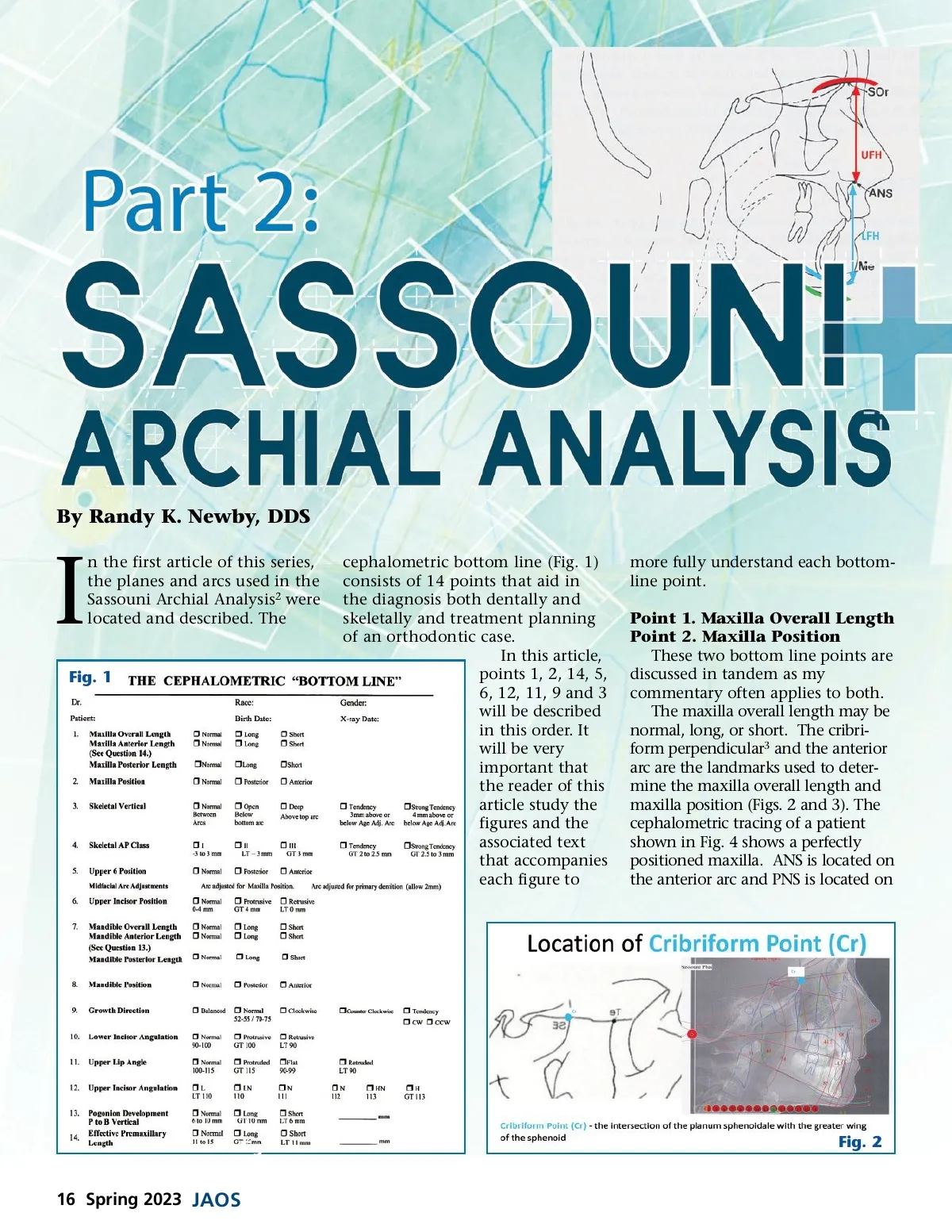
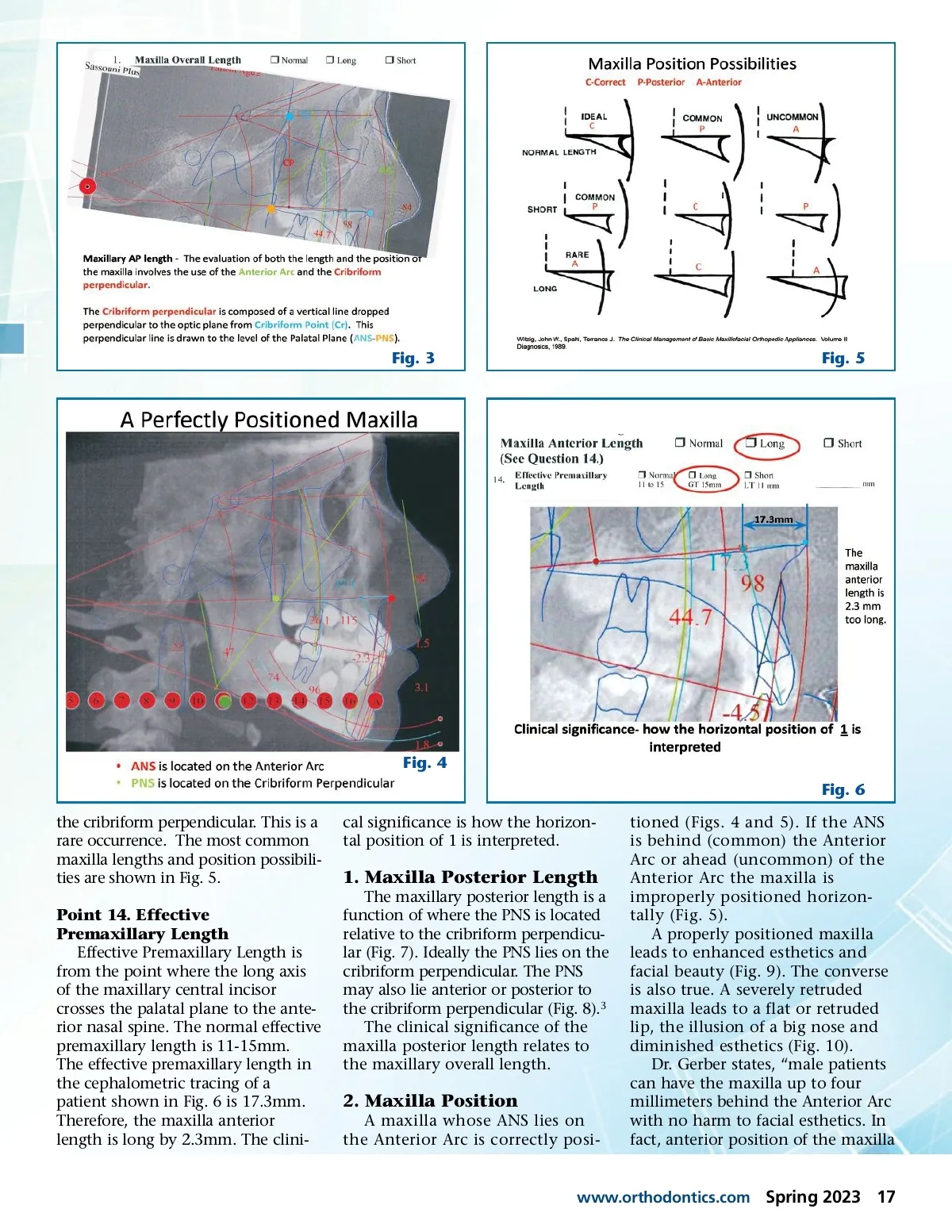
Fig. 3 Fig. 5 Fig. 4 Fig. 6 the cribriform perpendicular. This is a rare occurrence. The most common maxilla lengths and position possibili-ties are shown in Fig. 5. Point 14. Effective Premaxillary Length Effective Premaxillary Length is from the point where the long axis of the maxillary central incisor crosses the palatal plane to the ante-rior nasal spine. The normal effective premaxillary length is 11-15mm. The effective premaxillary length in the cephalometric tracing of a patient shown in Fig. 6 is 17.3mm. Therefore, the maxilla anterior length is long by 2.3mm. The clini-cal significance is how the horizon-tal position of 1 is interpreted. tioned (Figs. 4 and 5). If the ANS is behind (common) the Anterior Arc or ahead (uncommon) of the Anterior Arc the maxilla is improperly positioned horizon-tally (Fig. 5). A properly positioned maxilla leads to enhanced esthetics and facial beauty (Fig. 9). The converse is also true. A severely retruded maxilla leads to a flat or retruded lip, the illusion of a big nose and diminished esthetics (Fig. 10). Dr. Gerber states, “male patients can have the maxilla up to four millimeters behind the Anterior Arc with no harm to facial esthetics. In fact, anterior position of the maxilla 1. Maxilla Posterior Length The maxillary posterior length is a function of where the PNS is located relative to the cribriform perpendicu-lar (Fig. 7). Ideally the PNS lies on the cribriform perpendicular. The PNS may also lie anterior or posterior to the cribriform perpendicular (Fig. 8). 3 The clinical significance of the maxilla posterior length relates to the maxillary overall length. 2. Maxilla Position A maxilla whose ANS lies on the Anterior Arc is correctly posi-www.orthodontics.com Spring 2023 17
Journal of the American Orthodontic Society Spring 2023: Page 17