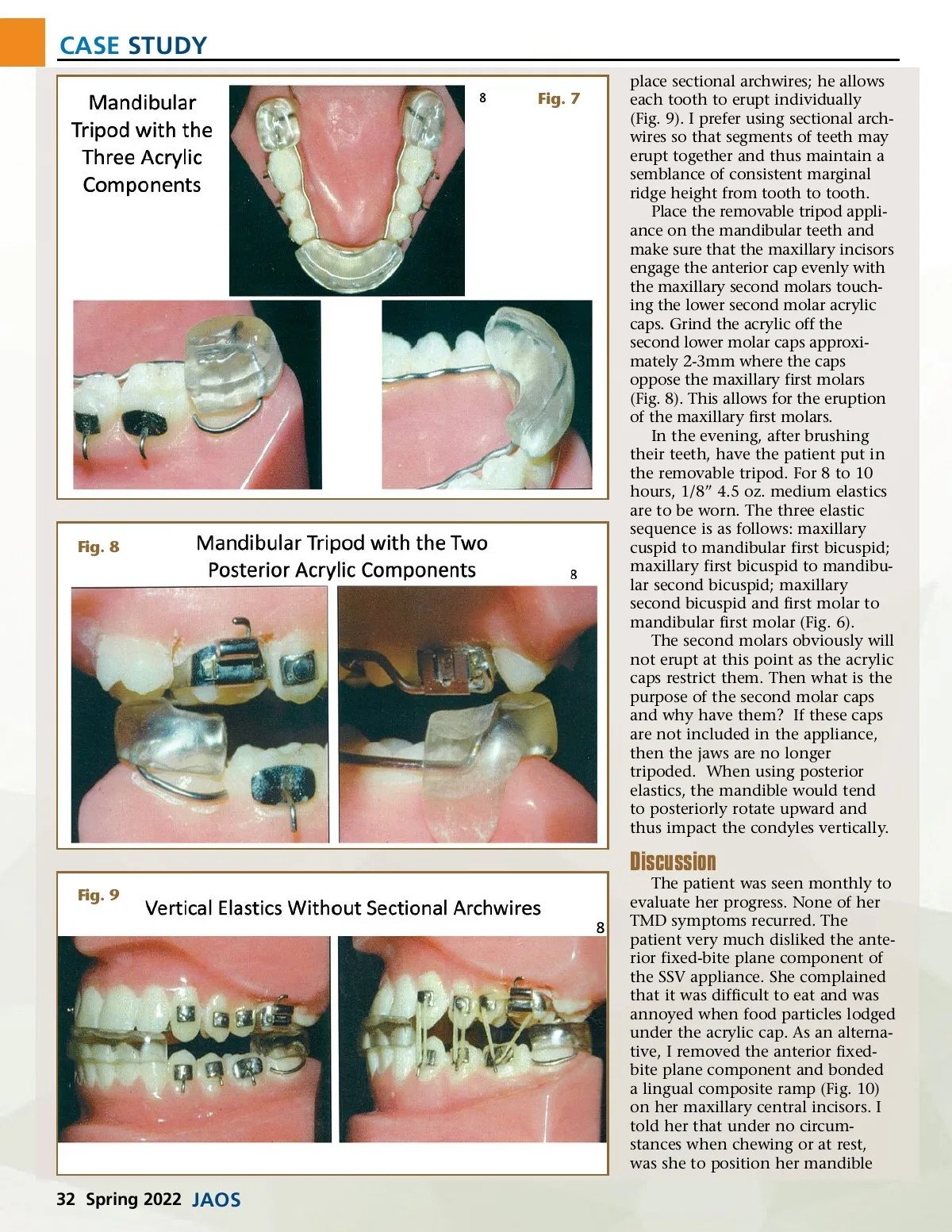
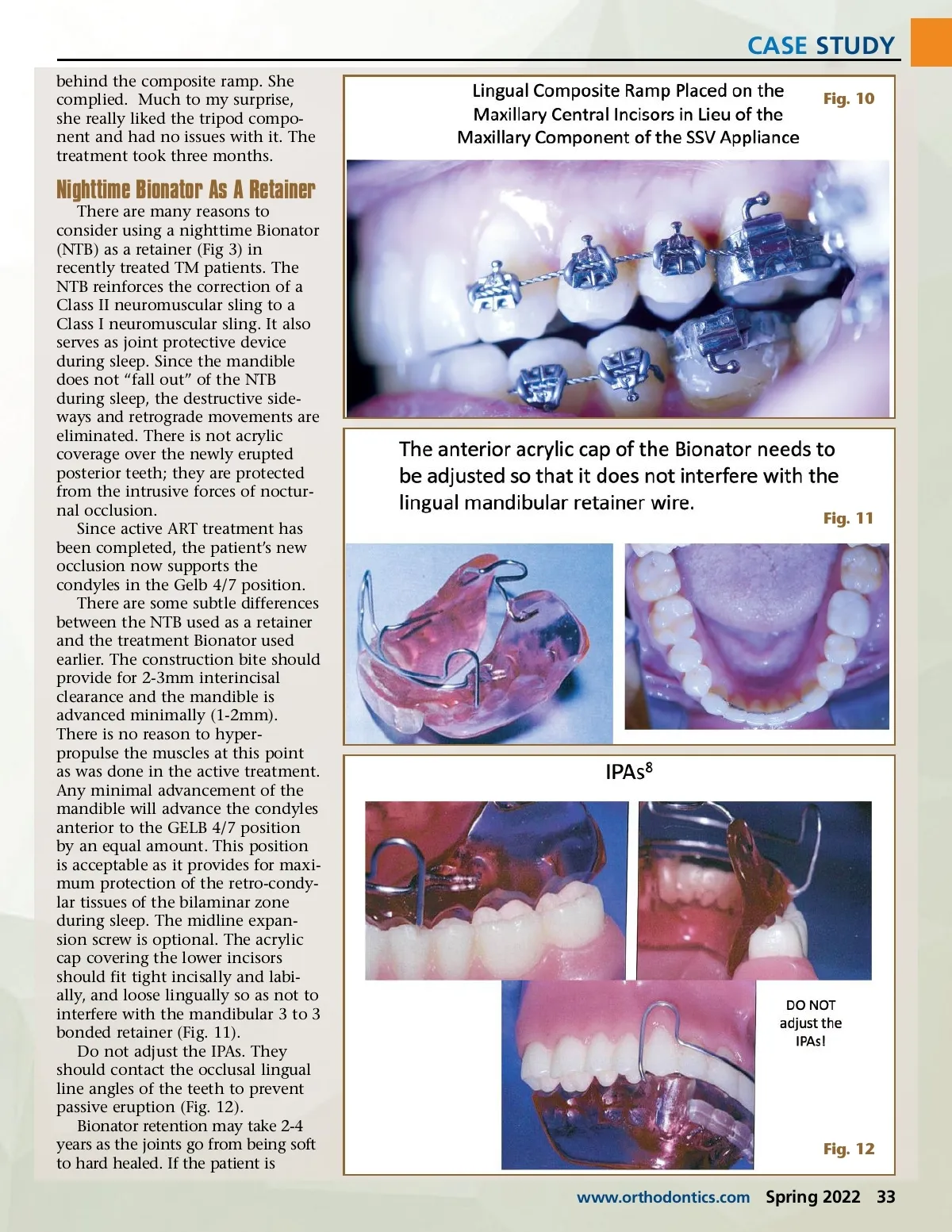
CASE STUDY Fig. 7 place sectional archwires; he allows each tooth to erupt individually (Fig. 9). I prefer using sectional arch-wires so that segments of teeth may erupt together and thus maintain a semblance of consistent marginal ridge height from tooth to tooth. Place the removable tripod appli-ance on the mandibular teeth and make sure that the maxillary incisors engage the anterior cap evenly with the maxillary second molars touch-ing the lower second molar acrylic caps. Grind the acrylic off the second lower molar caps approxi-mately 2-3mm where the caps oppose the maxillary first molars (Fig. 8). This allows for the eruption of the maxillary first molars. In the evening, after brushing their teeth, have the patient put in the removable tripod. For 8 to 10 hours, 1/8” 4.5 oz. medium elastics are to be worn. The three elastic sequence is as follows: maxillary cuspid to mandibular first bicuspid; maxillary first bicuspid to mandibu-lar second bicuspid; maxillary second bicuspid and first molar to mandibular first molar (Fig. 6). The second molars obviously will not erupt at this point as the acrylic caps restrict them. Then what is the purpose of the second molar caps and why have them? If these caps are not included in the appliance, then the jaws are no longer tripoded. When using posterior elastics, the mandible would tend to posteriorly rotate upward and thus impact the condyles vertically. Fig. 8 Discussion Fig. 9 The patient was seen monthly to evaluate her progress. None of her TMD symptoms recurred. The patient very much disliked the ante-rior fixed-bite plane component of the SSV appliance. She complained that it was difficult to eat and was annoyed when food particles lodged under the acrylic cap. As an alterna-tive, I removed the anterior fixed-bite plane component and bonded a lingual composite ramp (Fig. 10) on her maxillary central incisors. I told her that under no circum-stances when chewing or at rest, was she to position her mandible 32 Spring 2022 JAOS
Journal of the American Orthodontic Society Spring 2022: Page 32