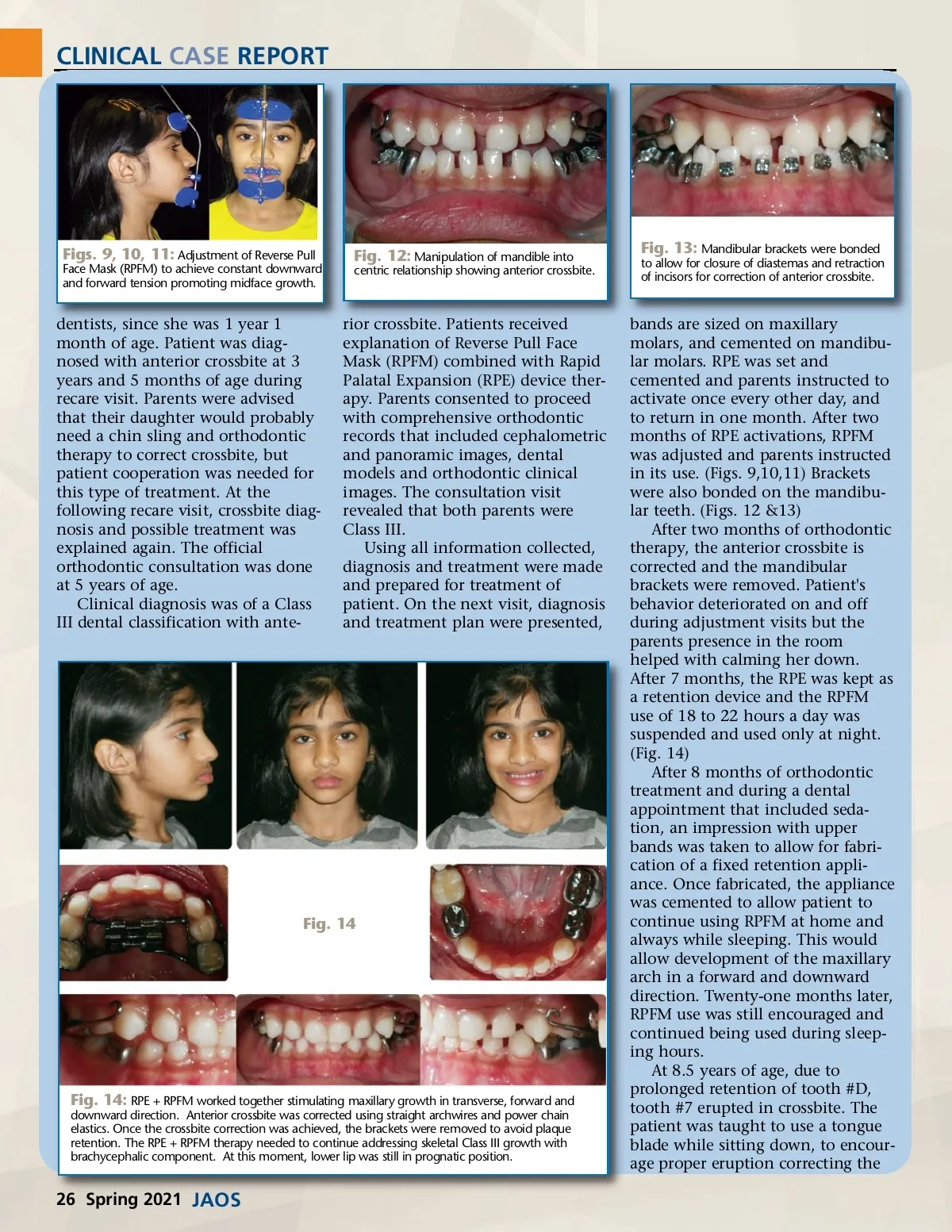
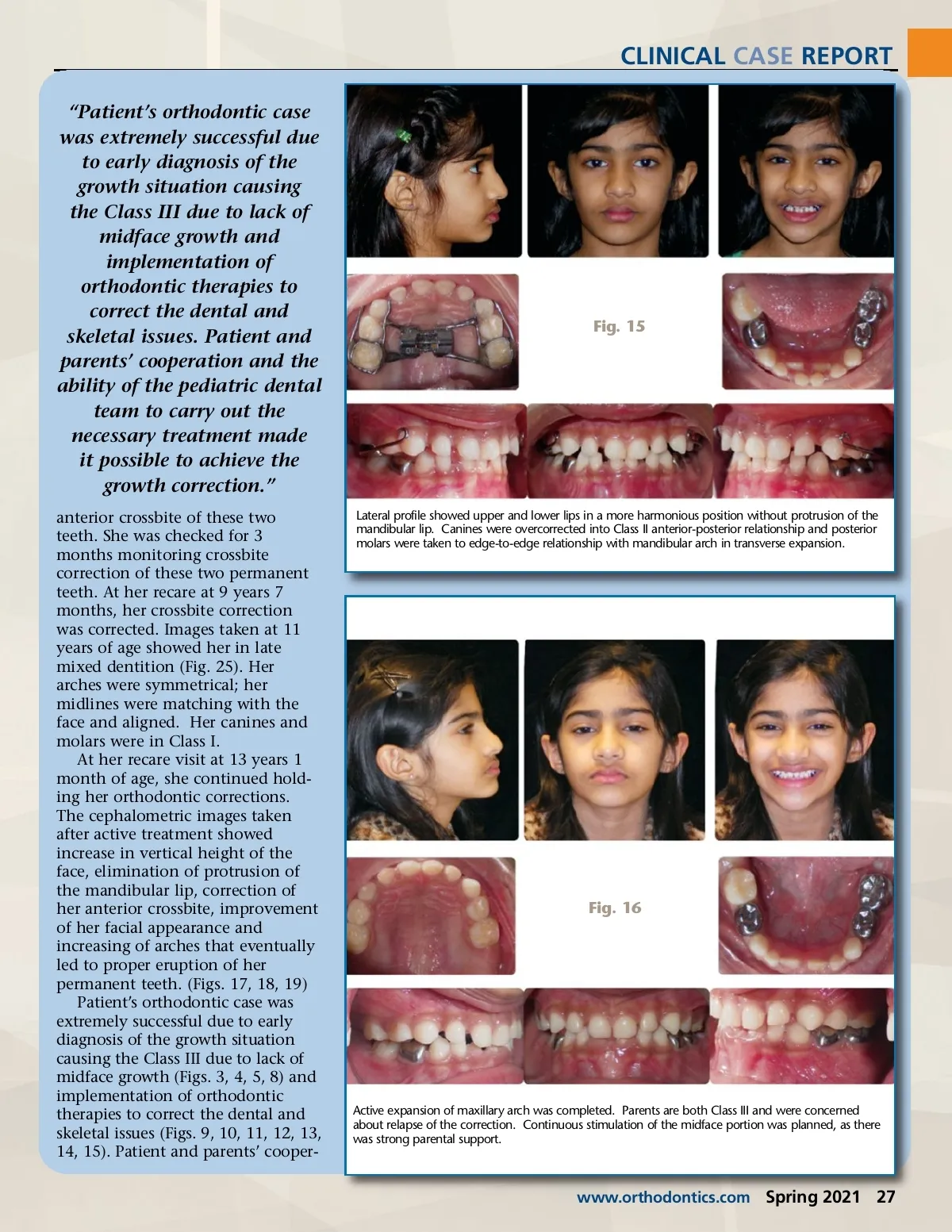
CLINICAL CASE REPORT “Patient’s orthodontic case was extremely successful due to early diagnosis of the growth situation causing the Class III due to lack of midface growth and implementation of orthodontic therapies to correct the dental and skeletal issues. Patient and parents’ cooperation and the ability of the pediatric dental team to carry out the necessary treatment made it possible to achieve the growth correction.” anterior crossbite of these two teeth. She was checked for 3 months monitoring crossbite correction of these two permanent teeth. At her recare at 9 years 7 months, her crossbite correction was corrected. Images taken at 11 years of age showed her in late mixed dentition (Fig. 25). Her arches were symmetrical; her midlines were matching with the face and aligned. Her canines and molars were in Class I. At her recare visit at 13 years 1 month of age, she continued hold-ing her orthodontic corrections. The cephalometric images taken after active treatment showed increase in vertical height of the face, elimination of protrusion of the mandibular lip, correction of her anterior crossbite, improvement of her facial appearance and increasing of arches that eventually led to proper eruption of her permanent teeth. (Figs. 17, 18, 19) Patient’s orthodontic case was extremely successful due to early diagnosis of the growth situation causing the Class III due to lack of midface growth (Figs. 3, 4, 5, 8) and implementation of orthodontic therapies to correct the dental and skeletal issues (Figs. 9, 10, 11, 12, 13, 14, 15). Patient and parents’ cooper-Fig. 15 Lateral profile showed upper and lower lips in a more harmonious position without protrusion of the mandibular lip. Canines were overcorrected into Class II anterior-posterior relationship and posterior molars were taken to edge-to-edge relationship with mandibular arch in transverse expansion. Fig. 16 Active expansion of maxillary arch was completed. Parents are both Class III and were concerned about relapse of the correction. Continuous stimulation of the midface portion was planned, as there was strong parental support. www.orthodontics.com Spring 2021 27
Journal of the American Orthodontic Society Spring 2021: Page 27