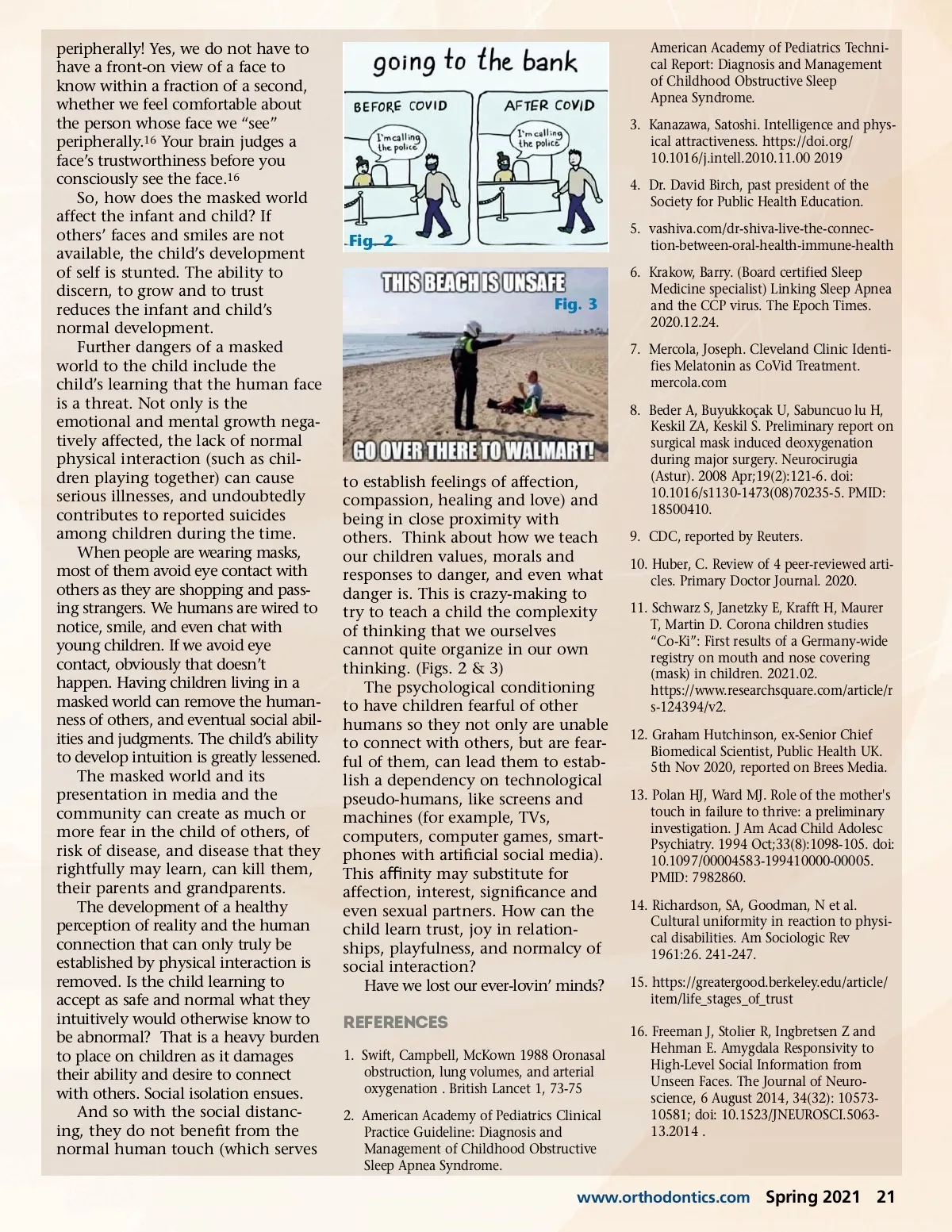
peripherally! Yes, we do not have to have a front-on view of a face to know within a fraction of a second, whether we feel comfortable about the person whose face we “see” peripherally. 16 Your brain judges a face’s trustworthiness before you consciously see the face. 16 So, how does the masked world affect the infant and child? If others’ faces and smiles are not available, the child’s development of self is stunted. The ability to discern, to grow and to trust reduces the infant and child’s normal development. Further dangers of a masked world to the child include the child’s learning that the human face is a threat. Not only is the emotional and mental growth nega-tively affected, the lack of normal physical interaction (such as chil-dren playing together) can cause serious illnesses, and undoubtedly contributes to reported suicides among children during the time. When people are wearing masks, most of them avoid eye contact with others as they are shopping and pass-ing strangers. We humans are wired to notice, smile, and even chat with young children. If we avoid eye contact, obviously that doesn’t happen. Having children living in a masked world can remove the human-ness of others, and eventual social abil-ities and judgments. The child’s ability to develop intuition is greatly lessened. The masked world and its presentation in media and the community can create as much or more fear in the child of others, of risk of disease, and disease that they rightfully may learn, can kill them, their parents and grandparents. The development of a healthy perception of reality and the human connection that can only truly be established by physical interaction is removed. Is the child learning to accept as safe and normal what they intuitively would otherwise know to be abnormal? That is a heavy burden to place on children as it damages their ability and desire to connect with others. Social isolation ensues. And so with the social distanc-ing, they do not benefit from the normal human touch (which serves American Academy of Pediatrics Techni-cal Report: Diagnosis and Management of Childhood Obstructive Sleep Apnea Syndrome. 3. Kanazawa, Satoshi. Intelligence and phys-ical attractiveness. https://doi.org/ 10.1016/j.intell.2010.11.00 2019 4. Dr. David Birch, past president of the Society for Public Health Education. Fig. 2 5. vashiva.com/dr-shiva-live-the-connec-tion-between-oral-health-immune-health 6. Krakow, Barry. (Board certified Sleep Medicine specialist) Linking Sleep Apnea and the CCP virus. The Epoch Times. 2020.12.24. 7. Mercola, Joseph. Cleveland Clinic Identi-fies Melatonin as CoVid Treatment. mercola.com 8. Beder A, Buyukkoçak U, Sabuncuo lu H, Keskil ZA, Keskil S. Preliminary report on surgical mask induced deoxygenation during major surgery. Neurocirugia (Astur). 2008 Apr;19(2):121-6. doi: 10.1016/s1130-1473(08)70235-5. PMID: 18500410. 9. CDC, reported by Reuters. 10. Huber, C. Review of 4 peer-reviewed arti-cles. Primary Doctor Journal. 2020. 11. Schwarz S, Janetzky E, Krafft H, Maurer T, Martin D. Corona children studies “Co-Ki”: First results of a Germany-wide registry on mouth and nose covering (mask) in children. 2021.02. https://www.researchsquare.com/article/r s-124394/v2. 12. Graham Hutchinson, ex-Senior Chief Biomedical Scientist, Public Health UK. 5th Nov 2020, reported on Brees Media. 13. Polan HJ, Ward MJ. Role of the mother's touch in failure to thrive: a preliminary investigation. J Am Acad Child Adolesc Psychiatry. 1994 Oct;33(8):1098-105. doi: 10.1097/00004583-199410000-00005. PMID: 7982860. 14. Richardson, SA, Goodman, N et al. Cultural uniformity in reaction to physi-cal disabilities. Am Sociologic Rev 1961:26. 241-247. 15. https://greatergood.berkeley.edu/article/ item/life_stages_of_trust 16. Freeman J, Stolier R, Ingbretsen Z and Hehman E. Amygdala Responsivity to High-Level Social Information from Unseen Faces. The Journal of Neuro-science, 6 August 2014, 34(32): 10573-10581; doi: 10.1523/JNEUROSCI.5063-13.2014 . Fig. 3 to establish feelings of affection, compassion, healing and love) and being in close proximity with others. Think about how we teach our children values, morals and responses to danger, and even what danger is. This is crazy-making to try to teach a child the complexity of thinking that we ourselves cannot quite organize in our own thinking. (Figs. 2 & 3) The psychological conditioning to have children fearful of other humans so they not only are unable to connect with others, but are fear-ful of them, can lead them to estab-lish a dependency on technological pseudo-humans, like screens and machines (for example, TVs, computers, computer games, smart-phones with artificial social media). This a ffi nity may substitute for affection, interest, significance and even sexual partners. How can the child learn trust, joy in relation-ships, playfulness, and normalcy of social interaction? Have we lost our ever-lovin’ minds? References 1. Swift, Campbell, McKown 1988 Oronasal obstruction, lung volumes, and arterial oxygenation . British Lancet 1, 73-75 2. American Academy of Pediatrics Clinical Practice Guideline: Diagnosis and Management of Childhood Obstructive Sleep Apnea Syndrome. www.orthodontics.com Spring 2021 21
Journal of the American Orthodontic Society Spring 2021: Page 21