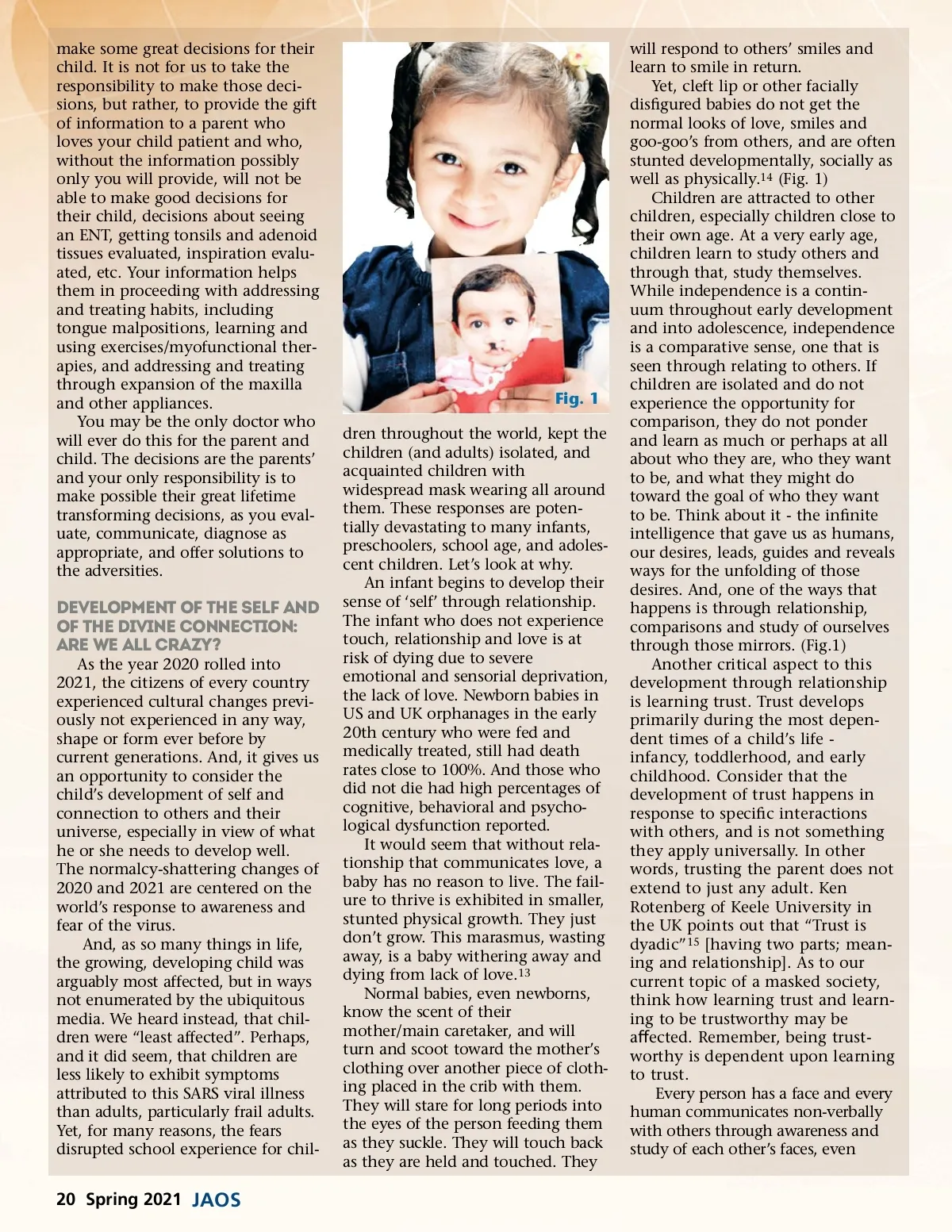
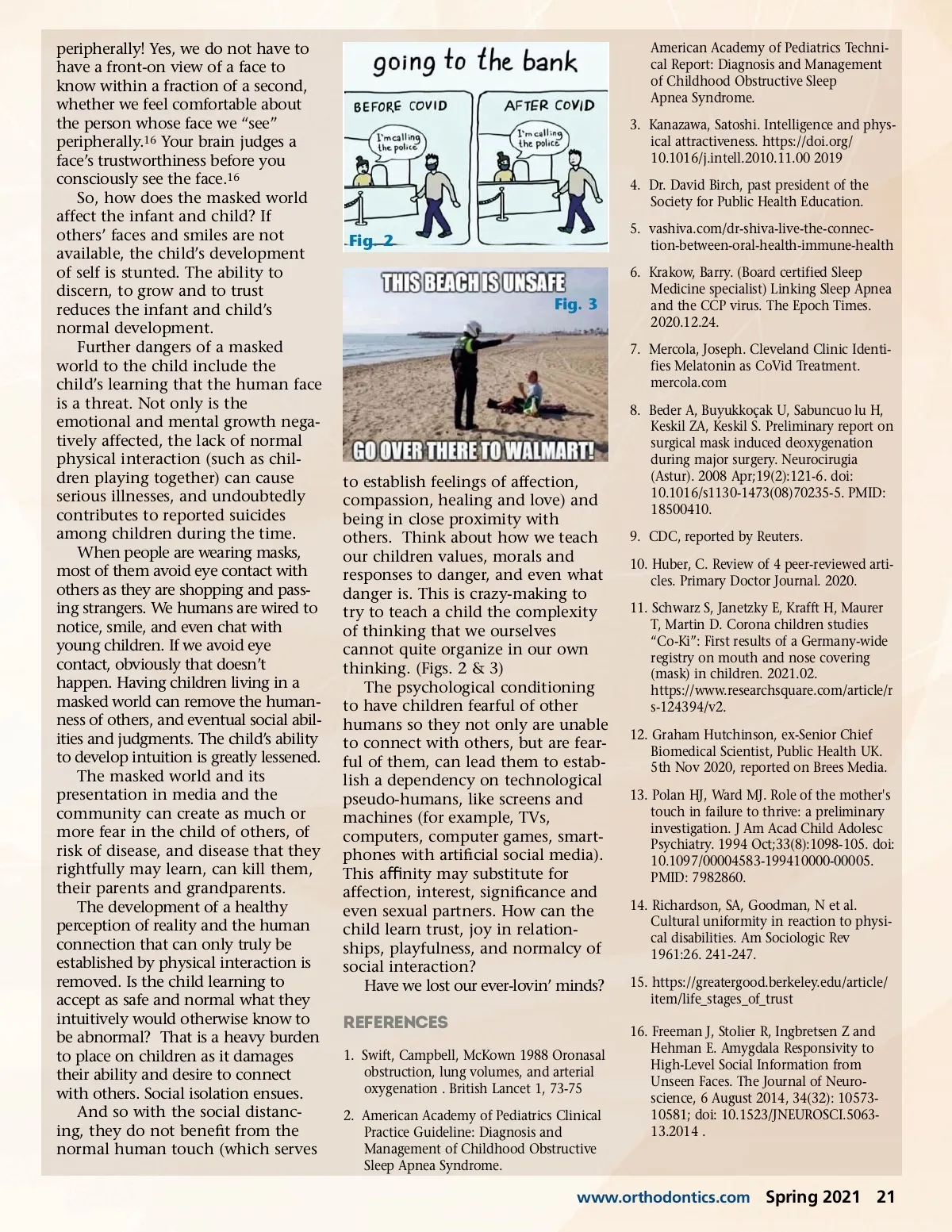
make some great decisions for their child. It is not for us to take the responsibility to make those deci-sions, but rather, to provide the gift of information to a parent who loves your child patient and who, without the information possibly only you will provide, will not be able to make good decisions for their child, decisions about seeing an ENT, getting tonsils and adenoid tissues evaluated, inspiration evalu-ated, etc. Your information helps them in proceeding with addressing and treating habits, including tongue malpositions, learning and using exercises/myofunctional ther-apies, and addressing and treating through expansion of the maxilla and other appliances. You may be the only doctor who will ever do this for the parent and child. The decisions are the parents’ and your only responsibility is to make possible their great lifetime transforming decisions, as you eval-uate, communicate, diagnose as appropriate, and offer solutions to the adversities. Fig. 1 dren throughout the world, kept the children (and adults) isolated, and acquainted children with widespread mask wearing all around them. These responses are poten-tially devastating to many infants, preschoolers, school age, and adoles-cent children. Let’s look at why. An infant begins to develop their sense of ‘self’ through relationship. The infant who does not experience touch, relationship and love is at risk of dying due to severe emotional and sensorial deprivation, the lack of love. Newborn babies in US and UK orphanages in the early 20th century who were fed and medically treated, still had death rates close to 100%. And those who did not die had high percentages of cognitive, behavioral and psycho-logical dysfunction reported. It would seem that without rela-tionship that communicates love, a baby has no reason to live. The fail-ure to thrive is exhibited in smaller, stunted physical growth. They just don’t grow. This marasmus, wasting away, is a baby withering away and dying from lack of love. 13 Normal babies, even newborns, know the scent of their mother/main caretaker, and will turn and scoot toward the mother’s clothing over another piece of cloth-ing placed in the crib with them. They will stare for long periods into the eyes of the person feeding them as they suckle. They will touch back as they are held and touched. They Development of the Self and of the Divine Connection: Are We All Crazy? As the year 2020 rolled into 2021, the citizens of every country experienced cultural changes previ-ously not experienced in any way, shape or form ever before by current generations. And, it gives us an opportunity to consider the child’s development of self and connection to others and their universe, especially in view of what he or she needs to develop well. The normalcy-shattering changes of 2020 and 2021 are centered on the world’s response to awareness and fear of the virus. And, as so many things in life, the growing, developing child was arguably most affected, but in ways not enumerated by the ubiquitous media. We heard instead, that chil-dren were “least affected”. Perhaps, and it did seem, that children are less likely to exhibit symptoms attributed to this SARS viral illness than adults, particularly frail adults. Yet, for many reasons, the fears disrupted school experience for chil-will respond to others’ smiles and learn to smile in return. Yet, cleft lip or other facially disfigured babies do not get the normal looks of love, smiles and goo-goo’s from others, and are often stunted developmentally, socially as well as physically. 14 (Fig. 1) Children are attracted to other children, especially children close to their own age. At a very early age, children learn to study others and through that, study themselves. While independence is a contin-uum throughout early development and into adolescence, independence is a comparative sense, one that is seen through relating to others. If children are isolated and do not experience the opportunity for comparison, they do not ponder and learn as much or perhaps at all about who they are, who they want to be, and what they might do toward the goal of who they want to be. Think about it -the infinite intelligence that gave us as humans, our desires, leads, guides and reveals ways for the unfolding of those desires. And, one of the ways that happens is through relationship, comparisons and study of ourselves through those mirrors. (Fig.1) Another critical aspect to this development through relationship is learning trust. Trust develops primarily during the most depen-dent times of a child’s life -infancy, toddlerhood, and early childhood. Consider that the development of trust happens in response to specific interactions with others, and is not something they apply universally. In other words, trusting the parent does not extend to just any adult. Ken Rotenberg of Keele University in the UK points out that “Trust is dyadic” 15 [having two parts; mean-ing and relationship]. As to our current topic of a masked society, think how learning trust and learn-ing to be trustworthy may be a ff ected. Remember, being trust-worthy is dependent upon learning to trust. Every person has a face and every human communicates non-verbally with others through awareness and study of each other’s faces, even 20 Spring 2021 JAOS
Journal of the American Orthodontic Society Spring 2021: Page 20