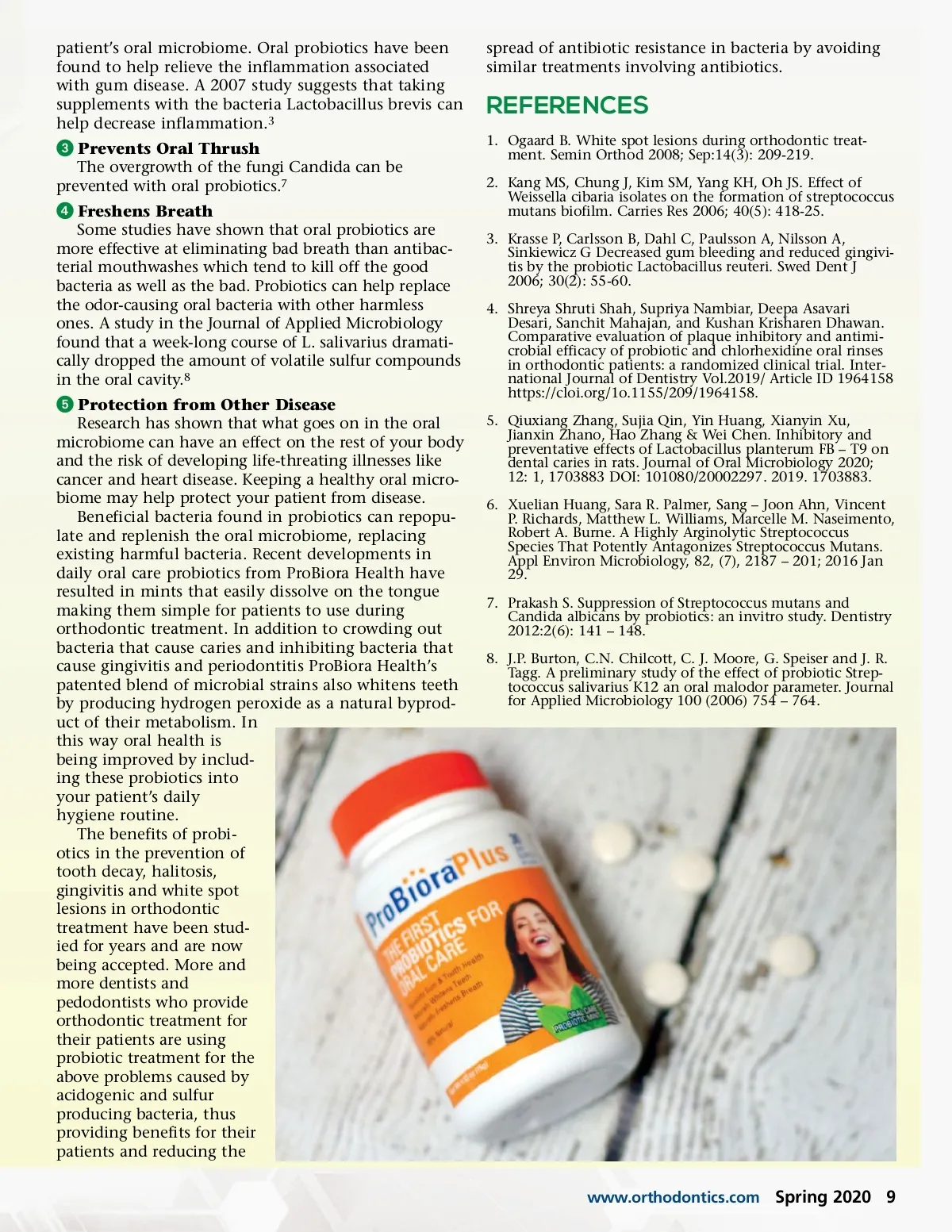
patient’s oral microbiome. Oral probiotics have been found to help relieve the inflammation associated with gum disease. A 2007 study suggests that taking supplements with the bacteria Lactobacillus brevis can help decrease inflammation. 3 spread of antibiotic resistance in bacteria by avoiding similar treatments involving antibiotics. REFERENCES 1. Ogaard B. White spot lesions during orthodontic treat-ment. Semin Orthod 2008; Sep:14(3): 209-219. 2. Kang MS, Chung J, Kim SM, Yang KH, Oh JS. Effect of Weissella cibaria isolates on the formation of streptococcus mutans biofilm. Carries Res 2006; 40(5): 418-25. 3. Krasse P, Carlsson B, Dahl C, Paulsson A, Nilsson A, Sinkiewicz G Decreased gum bleeding and reduced gingivi-tis by the probiotic Lactobacillus reuteri. Swed Dent J 2006; 30(2): 55-60. 4. Shreya Shruti Shah, Supriya Nambiar, Deepa Asavari Desari, Sanchit Mahajan, and Kushan Krisharen Dhawan. Comparative evaluation of plaque inhibitory and antimi-crobial efficacy of probiotic and chlorhexidine oral rinses in orthodontic patients: a randomized clinical trial. Inter-national Journal of Dentistry Vol.2019/ Article ID 1964158 https://cloi.org/1o.1155/209/1964158. 5. Qiuxiang Zhang, Sujia Qin, Yin Huang, Xianyin Xu, Jianxin Zhano, Hao Zhang & Wei Chen. Inhibitory and preventative effects of Lactobacillus planterum FB – T9 on dental caries in rats. Journal of Oral Microbiology 2020; 12: 1, 1703883 DOI: 101080/20002297. 2019. 1703883. 6. Xuelian Huang, Sara R. Palmer, Sang – Joon Ahn, Vincent P. Richards, Matthew L. Williams, Marcelle M. Naseimento, Robert A. Burne. A Highly Arginolytic Streptococcus Species That Potently Antagonizes Streptococcus Mutans. Appl Environ Microbiology, 82, (7), 2187 – 201; 2016 Jan 29. 7. Prakash S. Suppression of Streptococcus mutans and Candida albicans by probiotics: an invitro study. Dentistry 2012:2(6): 141 – 148. 8. J.P. Burton, C.N. Chilcott, C. J. Moore, G. Speiser and J. R. Tagg. A preliminary study of the effect of probiotic Strep-tococcus salivarius K12 an oral malodor parameter. Journal for Applied Microbiology 100 (2006) 754 – 764. ᕣ Prevents Oral Thrush The overgrowth of the fungi Candida can be prevented with oral probiotics. 7 ᕤ Freshens Breath Some studies have shown that oral probiotics are more effective at eliminating bad breath than antibac-terial mouthwashes which tend to kill off the good bacteria as well as the bad. Probiotics can help replace the odor-causing oral bacteria with other harmless ones. A study in the Journal of Applied Microbiology found that a week-long course of L. salivarius dramati-cally dropped the amount of volatile sulfur compounds in the oral cavity. 8 ᕥ Protection from Other Disease Research has shown that what goes on in the oral microbiome can have an effect on the rest of your body and the risk of developing life-threating illnesses like cancer and heart disease. Keeping a healthy oral micro-biome may help protect your patient from disease. Beneficial bacteria found in probiotics can repopu-late and replenish the oral microbiome, replacing existing harmful bacteria. Recent developments in daily oral care probiotics from ProBiora Health have resulted in mints that easily dissolve on the tongue making them simple for patients to use during orthodontic treatment. In addition to crowding out bacteria that cause caries and inhibiting bacteria that cause gingivitis and periodontitis ProBiora Health’s patented blend of microbial strains also whitens teeth by producing hydrogen peroxide as a natural byprod-uct of their metabolism. In this way oral health is being improved by includ-ing these probiotics into your patient’s daily hygiene routine. The benefits of probi-otics in the prevention of tooth decay, halitosis, gingivitis and white spot lesions in orthodontic treatment have been stud-ied for years and are now being accepted. More and more dentists and pedodontists who provide orthodontic treatment for their patients are using probiotic treatment for the above problems caused by acidogenic and sulfur producing bacteria, thus providing benefits for their patients and reducing the www.orthodontics.com Spring 2020 9
Journal of the American Orthodontic Society Spring 2020: Page 9