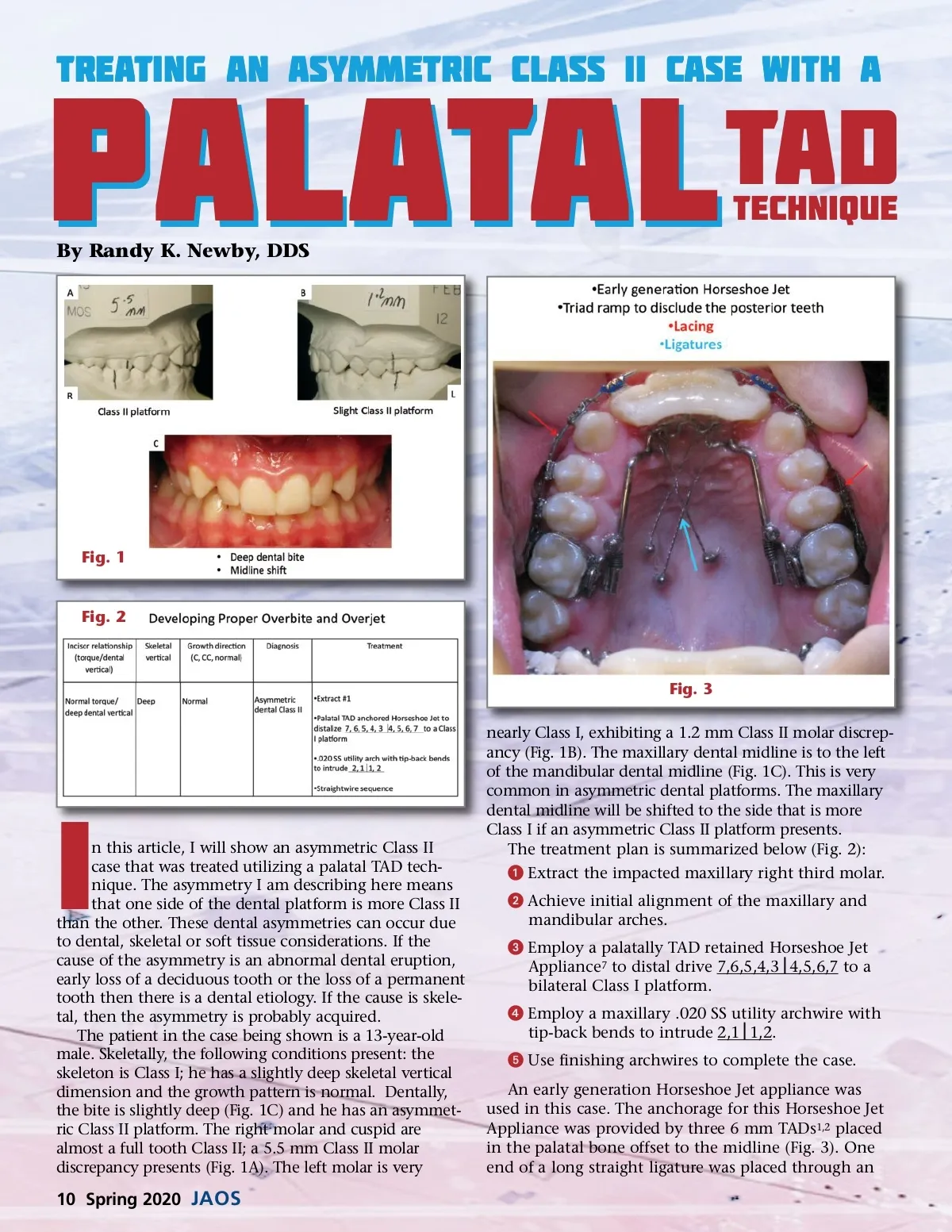
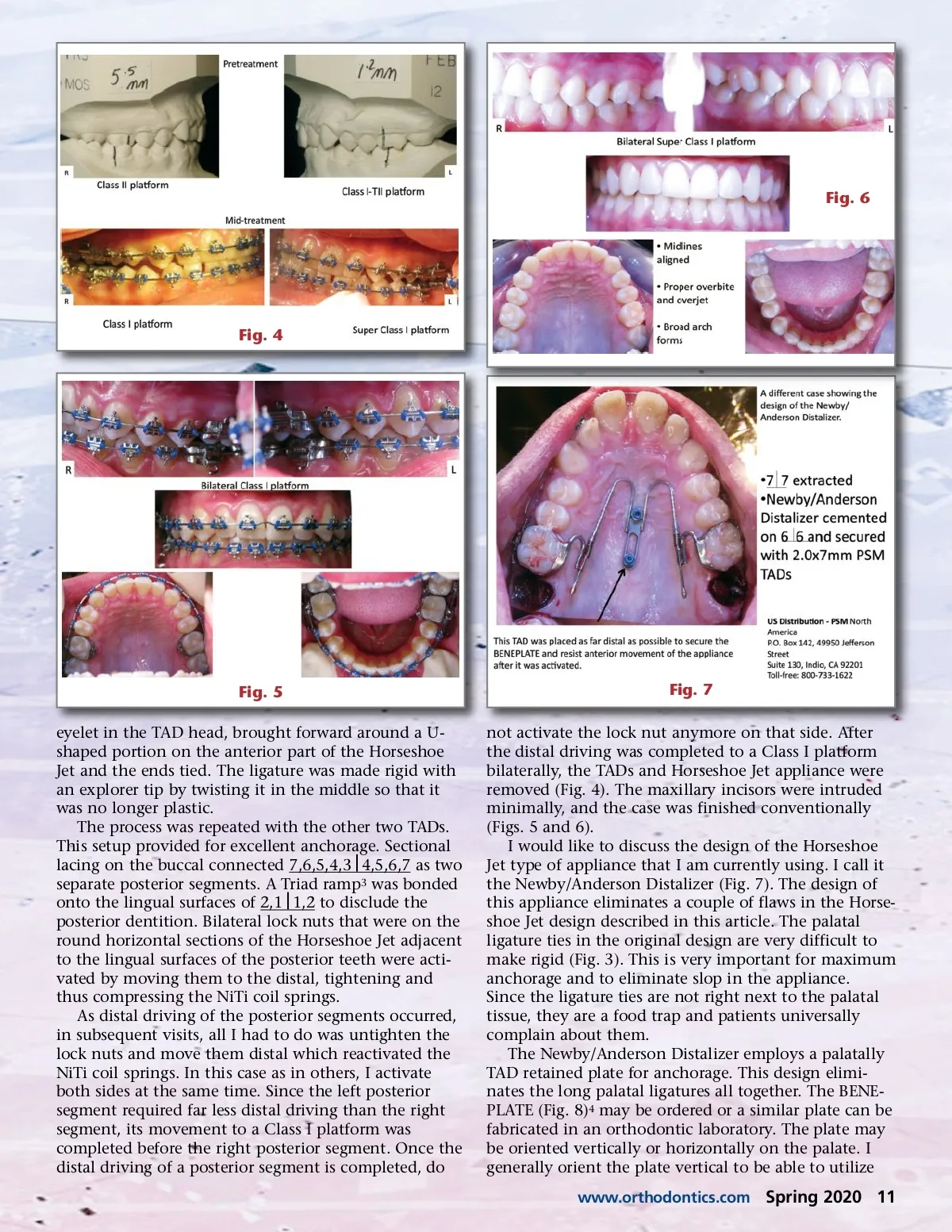
Treating an Asymmetric Class II CASE with a Palatal By Randy K. Newby, DDS Fig. 1 Fig. 2 Fig. 3 TAD Technique n this article, I will show an asymmetric Class II case that was treated utilizing a palatal TAD tech-nique. The asymmetry I am describing here means that one side of the dental platform is more Class II than the other. These dental asymmetries can occur due to dental, skeletal or soft tissue considerations. If the cause of the asymmetry is an abnormal dental eruption, early loss of a deciduous tooth or the loss of a permanent tooth then there is a dental etiology. If the cause is skele-tal, then the asymmetry is probably acquired. The patient in the case being shown is a 13-year-old male. Skeletally, the following conditions present: the skeleton is Class I; he has a slightly deep skeletal vertical dimension and the growth pattern is normal. Dentally, the bite is slightly deep (Fig. 1C) and he has an asymmet-ric Class II platform. The right molar and cuspid are almost a full tooth Class II; a 5.5 mm Class II molar discrepancy presents (Fig. 1A). The left molar is very I nearly Class I, exhibiting a 1.2 mm Class II molar discrep-ancy (Fig. 1B). The maxillary dental midline is to the left of the mandibular dental midline (Fig. 1C). This is very common in asymmetric dental platforms. The maxillary dental midline will be shifted to the side that is more Class I if an asymmetric Class II platform presents. The treatment plan is summarized below (Fig. 2): ᕡ Extract the impacted maxillary right third molar. ᕢ Achieve initial alignment of the maxillary and mandibular arches. ᕣ Employ a palatally TAD retained Horseshoe Jet Appliance 7 to distal drive 7,6,5,4,3 4,5,6,7 to a bilateral Class I platform. ᕤ Employ a maxillary .020 SS utility archwire with tip-back bends to intrude 2,1 1,2. ᕥ Use finishing archwires to complete the case. An early generation Horseshoe Jet appliance was used in this case. The anchorage for this Horseshoe Jet Appliance was provided by three 6 mm TADs 1,2 placed in the palatal bone offset to the midline (Fig. 3). One end of a long straight ligature was placed through an 10 Spring 2020 JAOS
Journal of the American Orthodontic Society Spring 2020: Page 10