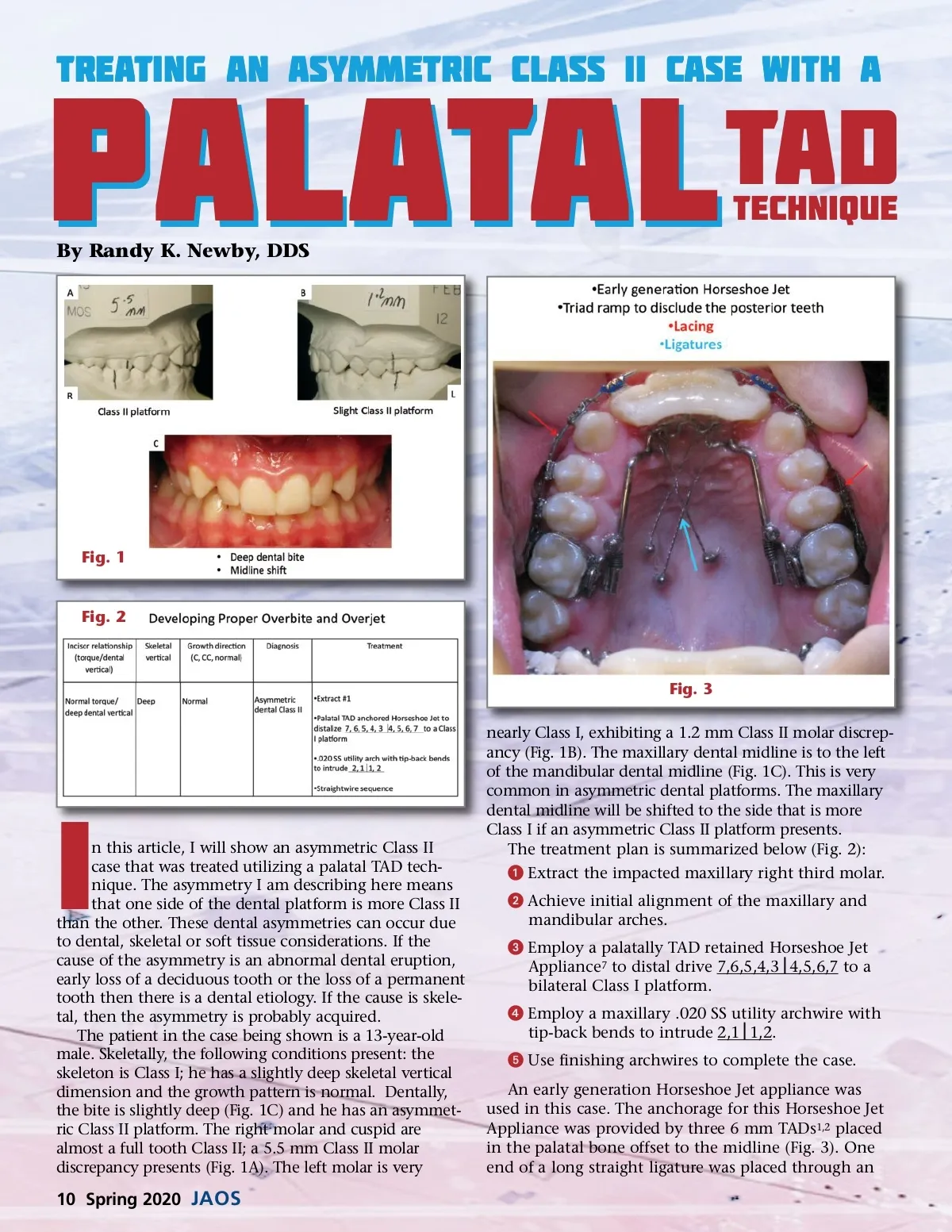
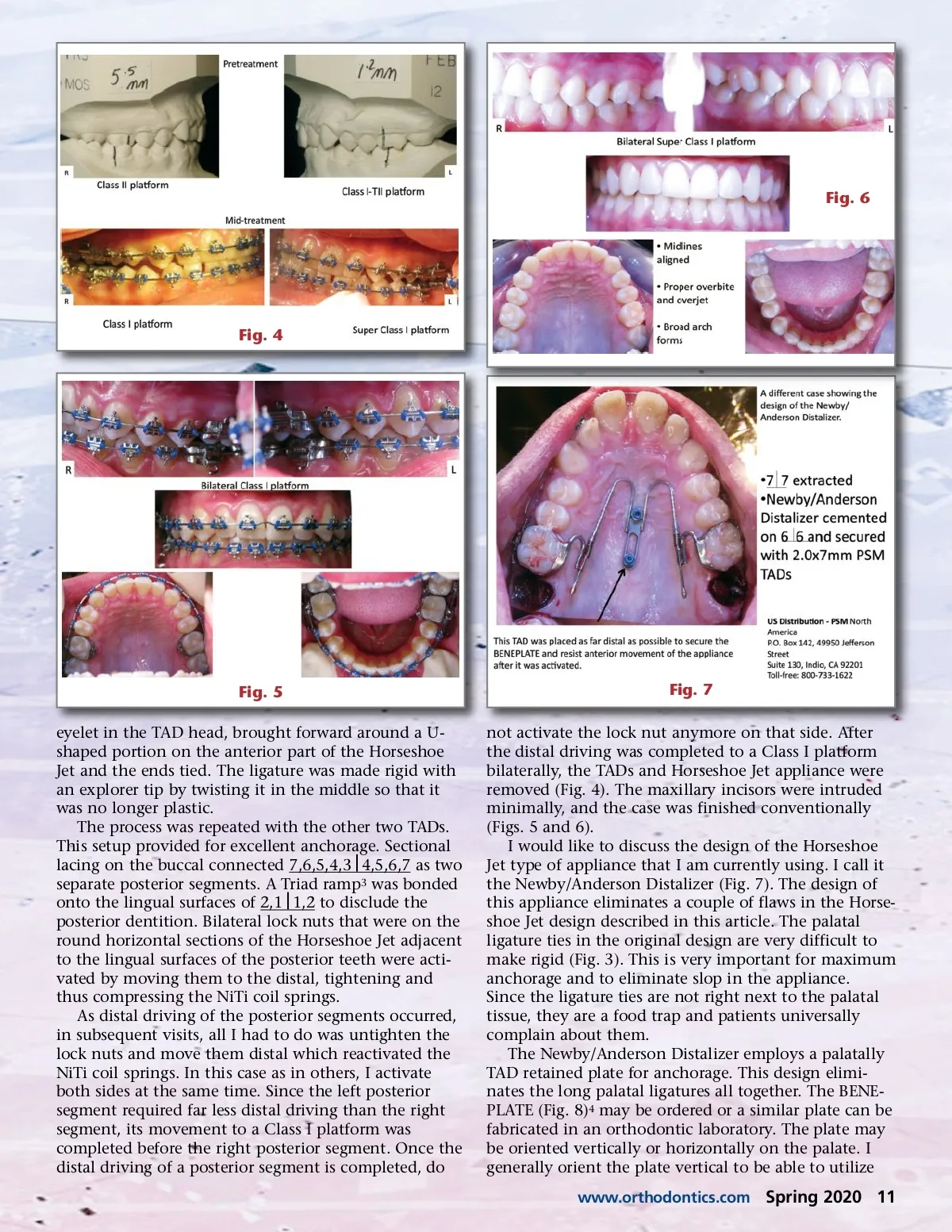
Fig. 6 Fig. 4 Fig. 5 eyelet in the TAD head, brought forward around a U-shaped portion on the anterior part of the Horseshoe Jet and the ends tied. The ligature was made rigid with an explorer tip by twisting it in the middle so that it was no longer plastic. The process was repeated with the other two TADs. This setup provided for excellent anchorage. Sectional lacing on the buccal connected 7,6,5,4,3 4,5,6,7 as two separate posterior segments. A Triad ramp 3 was bonded onto the lingual surfaces of 2,1 1,2 to disclude the posterior dentition. Bilateral lock nuts that were on the round horizontal sections of the Horseshoe Jet adjacent to the lingual surfaces of the posterior teeth were acti-vated by moving them to the distal, tightening and thus compressing the NiTi coil springs. As distal driving of the posterior segments occurred, in subsequent visits, all I had to do was untighten the lock nuts and move them distal which reactivated the NiTi coil springs. In this case as in others, I activate both sides at the same time. Since the left posterior segment required far less distal driving than the right segment, its movement to a Class I platform was completed before the right posterior segment. Once the distal driving of a posterior segment is completed, do Fig. 7 not activate the lock nut anymore on that side. After the distal driving was completed to a Class I platform bilaterally, the TADs and Horseshoe Jet appliance were removed (Fig. 4). The maxillary incisors were intruded minimally, and the case was finished conventionally (Figs. 5 and 6). I would like to discuss the design of the Horseshoe Jet type of appliance that I am currently using. I call it the Newby/Anderson Distalizer (Fig. 7). The design of this appliance eliminates a couple of flaws in the Horse-shoe Jet design described in this article. The palatal ligature ties in the original design are very difficult to make rigid (Fig. 3). This is very important for maximum anchorage and to eliminate slop in the appliance. Since the ligature ties are not right next to the palatal tissue, they are a food trap and patients universally complain about them. The Newby/Anderson Distalizer employs a palatally TAD retained plate for anchorage. This design elimi-nates the long palatal ligatures all together. The BENE-PLATE (Fig. 8) 4 may be ordered or a similar plate can be fabricated in an orthodontic laboratory. The plate may be oriented vertically or horizontally on the palate. I generally orient the plate vertical to be able to utilize www.orthodontics.com Spring 2020 11
Journal of the American Orthodontic Society Spring 2020: Page 11