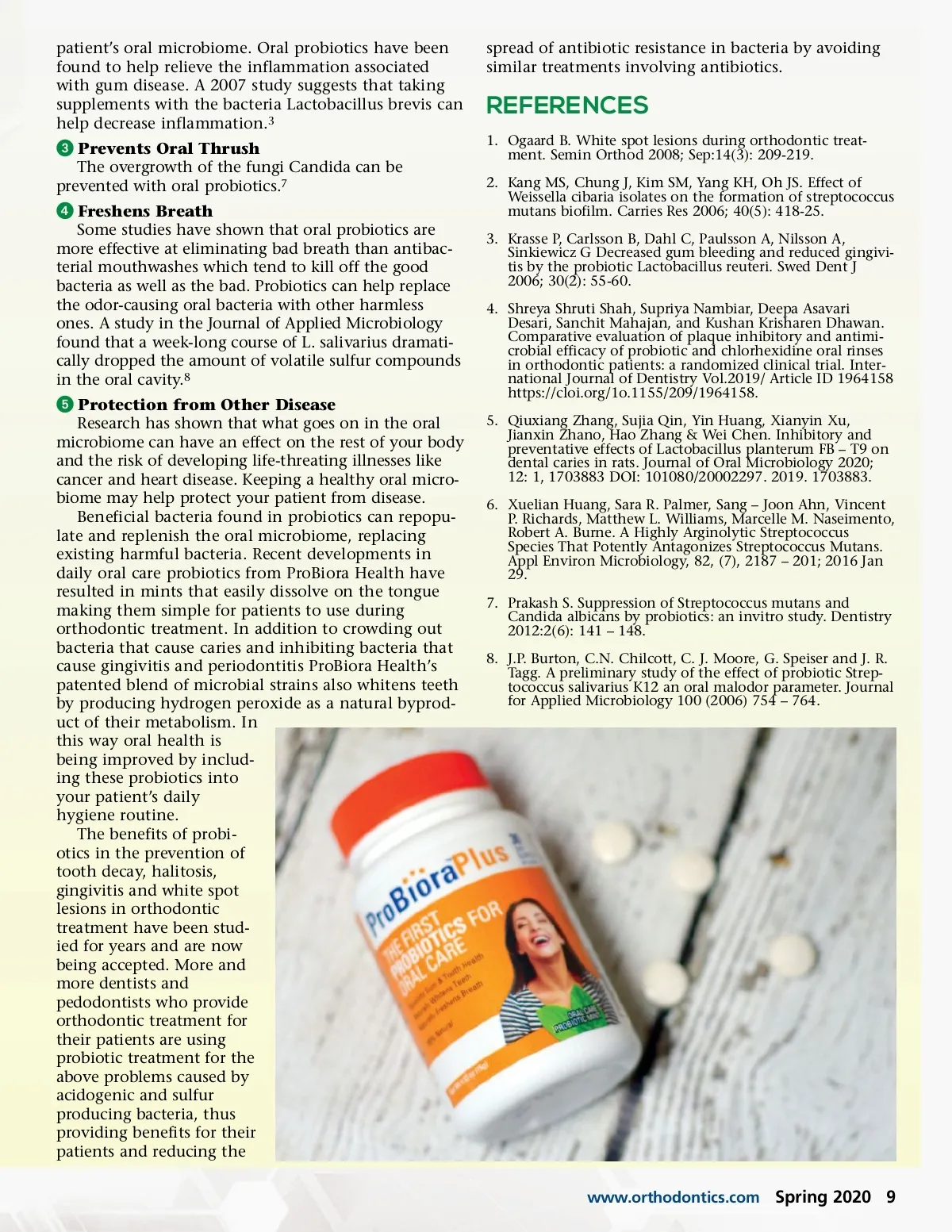
By Greg Cannizzo, DDS, CDE, JAOS Editor t has been known for quite some time that fixed brackets, bands, wires and a large number of fixed oral appliances used in orthodontic treatment are convenient and favorable areas for the retention of food and the buildup of plaque and biofilm. Since oral hygiene becomes more difficult during orthodontic treatment these appliances become the perfect environ-ment for the growth of microorganisms which can cause tooth decay, gingivitis and white spot lesions. These bacterial ecosystems can be removed with brushing and flossing and the damage caused by these microorganisms can be mitigated by using fluoride, varnishes, toothpastes and sealants. Yet their effective-ness is only observed when these aids are regularly used. This disadvantage has led researchers to explore the use of oral probiotics as an adjunct to reducing gum bleeding and gingivitis as well as white spots, decay and bad breath during orthodontic treatment. Oral probiotics focus on bacteria that are important to the oral microbiome. They usually come in the form of lozenges or chewable tablets. Although the mouth is colonized by 200 to 300 bacterial species, the two main microorganisms that cause tooth decay are Strep-tococcus mutans (S. mutans) and Lactobacillus. These two organisms play a large role in initial tooth decay and white spot lesions. Levels of acidogenic bacteria, present in the plaque, notably Streptococcus mutans, are higher in orthodontic patients than in nonorthodontic patients. 1 Higher levels of acidogenic bacteria and increased amounts of retained plaque help to cause demineralization and white spot lesions around brackets, bands and appliances. Recent studies suggest that the use of probiotic products in orthodon-tic patients may reduce salivary S mutans and Lacto-bacillus levels in patients. 2 An additional study published in the Swedish Dental Journal discovered a probiotic that reduced gum bleeding in patients with I moderate to severe gingivitis. 3 And an additional recent study has shown that probiotics, when used with patients who are undergoing orthodontic treat-ment, are as effective as chlorhexidine as an agent to control plaque. 4 Probiotics work by targeting the pathogens responsi-ble for many oral health issues. Probiotics with bacterium that can antagonize S. mutans and inhibit biofilm formation can reduce the viability of the biofilm and thus reduce the population of S.mutans by preventing these pathogens from getting a foothold. 5 Specifically, the friendly bacteria prevent pathogens from getting that necessary foothold by boasting the patient’s immune system and hindering pathogens from binding to the bodies tissues. Probiotics can also kill or curtail the growth of pathogens by providing agents that make it harder for them to live and thrive. Plaque buildup on brackets and teeth is the most common cause of cavities and white spots. Ultimately if your patient’s oral microbiome is healthy enough, there will be enough good bacteria to keep any harmful bacteria in check. Thus, a number of benefits of using oral probiotics while having orthodontic treatment can be found and reported. ᕡ Oral Probiotics Reduce Plaque As mentioned earlier plaque buildup on your patient’s teeth is the most common cause of cavities. Sometimes brushing and flossing is not enough to get rid of it. An oral probiotic with Streptococcus A12 in it was shown in a 2016 study that it could help reduce plaque buildup. 6 ᕢ Reduce Gingivitis Gingivitis is the precursor to gum disease, another major concern to oral health. The probiotic Lacto-bacillus reuteri can help to destroy the microbes that cause gingivitis bringing a healthier balance to your 8 Spring 2020 JAOS
Journal of the American Orthodontic Society Spring 2020: Page 8