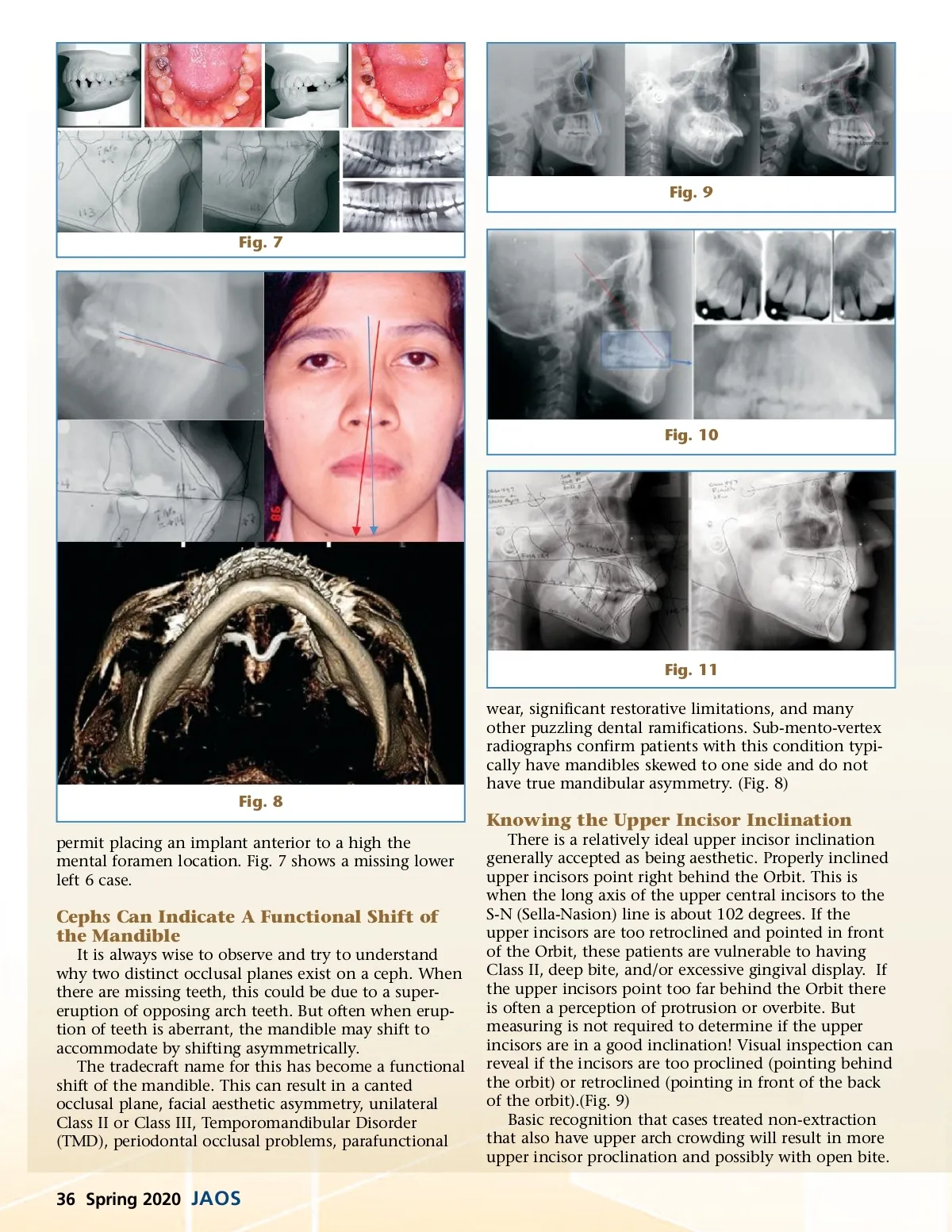
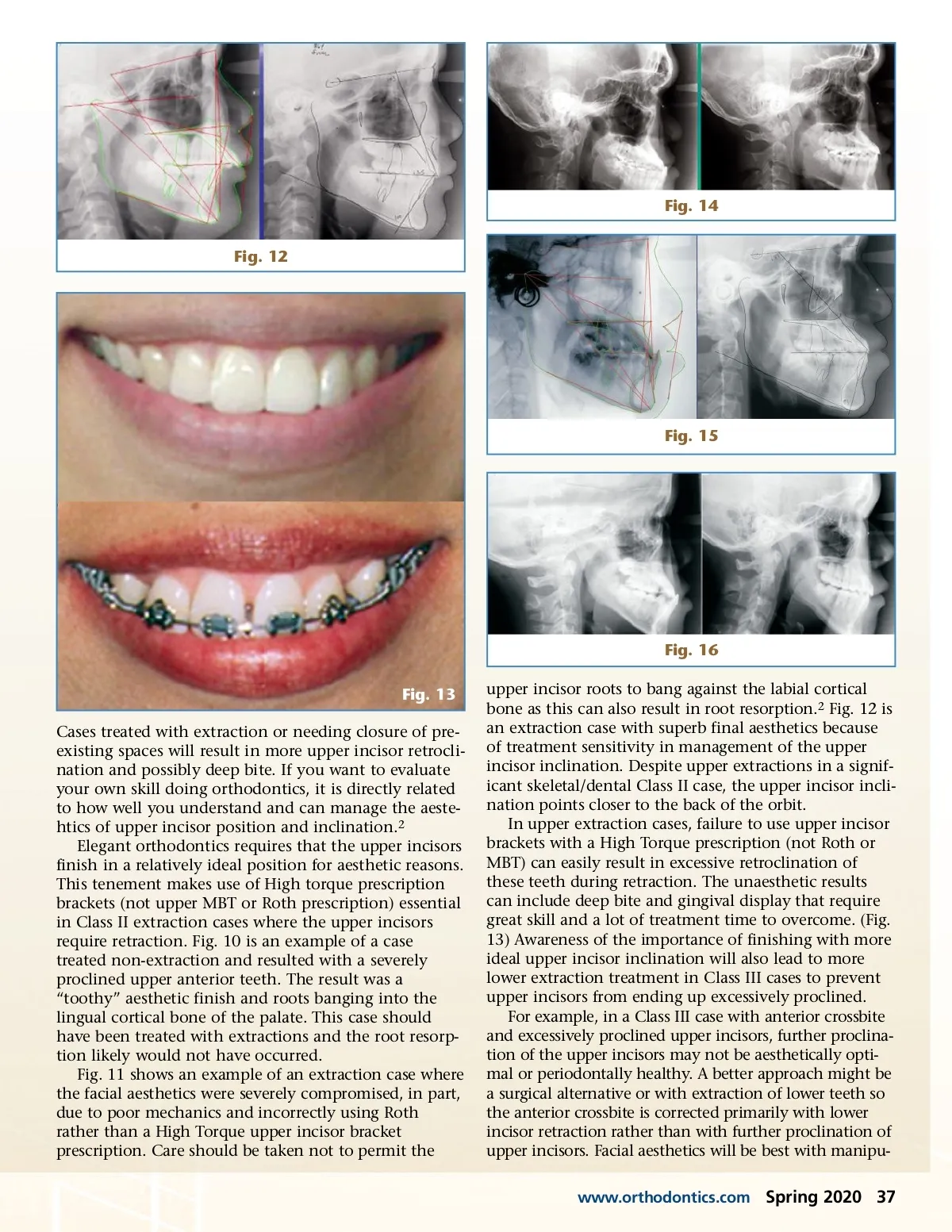
Fig. 14 Fig. 12 Fig. 15 Fig. 16 Fig. 13 Cases treated with extraction or needing closure of pre-existing spaces will result in more upper incisor retrocli-nation and possibly deep bite. If you want to evaluate your own skill doing orthodontics, it is directly related to how well you understand and can manage the aeste-htics of upper incisor position and inclination. 2 Elegant orthodontics requires that the upper incisors finish in a relatively ideal position for aesthetic reasons. This tenement makes use of High torque prescription brackets (not upper MBT or Roth prescription) essential in Class II extraction cases where the upper incisors require retraction. Fig. 10 is an example of a case treated non-extraction and resulted with a severely proclined upper anterior teeth. The result was a “toothy” aesthetic finish and roots banging into the lingual cortical bone of the palate. This case should have been treated with extractions and the root resorp-tion likely would not have occurred. Fig. 11 shows an example of an extraction case where the facial aesthetics were severely compromised, in part, due to poor mechanics and incorrectly using Roth rather than a High Torque upper incisor bracket prescription. Care should be taken not to permit the upper incisor roots to bang against the labial cortical bone as this can also result in root resorption. 2 Fig. 12 is an extraction case with superb final aesthetics because of treatment sensitivity in management of the upper incisor inclination. Despite upper extractions in a signif-icant skeletal/dental Class II case, the upper incisor incli-nation points closer to the back of the orbit. In upper extraction cases, failure to use upper incisor brackets with a High Torque prescription (not Roth or MBT) can easily result in excessive retroclination of these teeth during retraction. The unaesthetic results can include deep bite and gingival display that require great skill and a lot of treatment time to overcome. (Fig. 13) Awareness of the importance of finishing with more ideal upper incisor inclination will also lead to more lower extraction treatment in Class III cases to prevent upper incisors from ending up excessively proclined. For example, in a Class III case with anterior crossbite and excessively proclined upper incisors, further proclina-tion of the upper incisors may not be aesthetically opti-mal or periodontally healthy. A better approach might be a surgical alternative or with extraction of lower teeth so the anterior crossbite is corrected primarily with lower incisor retraction rather than with further proclination of upper incisors. Facial aesthetics will be best with manipu-www.orthodontics.com Spring 2020 37
Journal of the American Orthodontic Society Spring 2020: Page 37