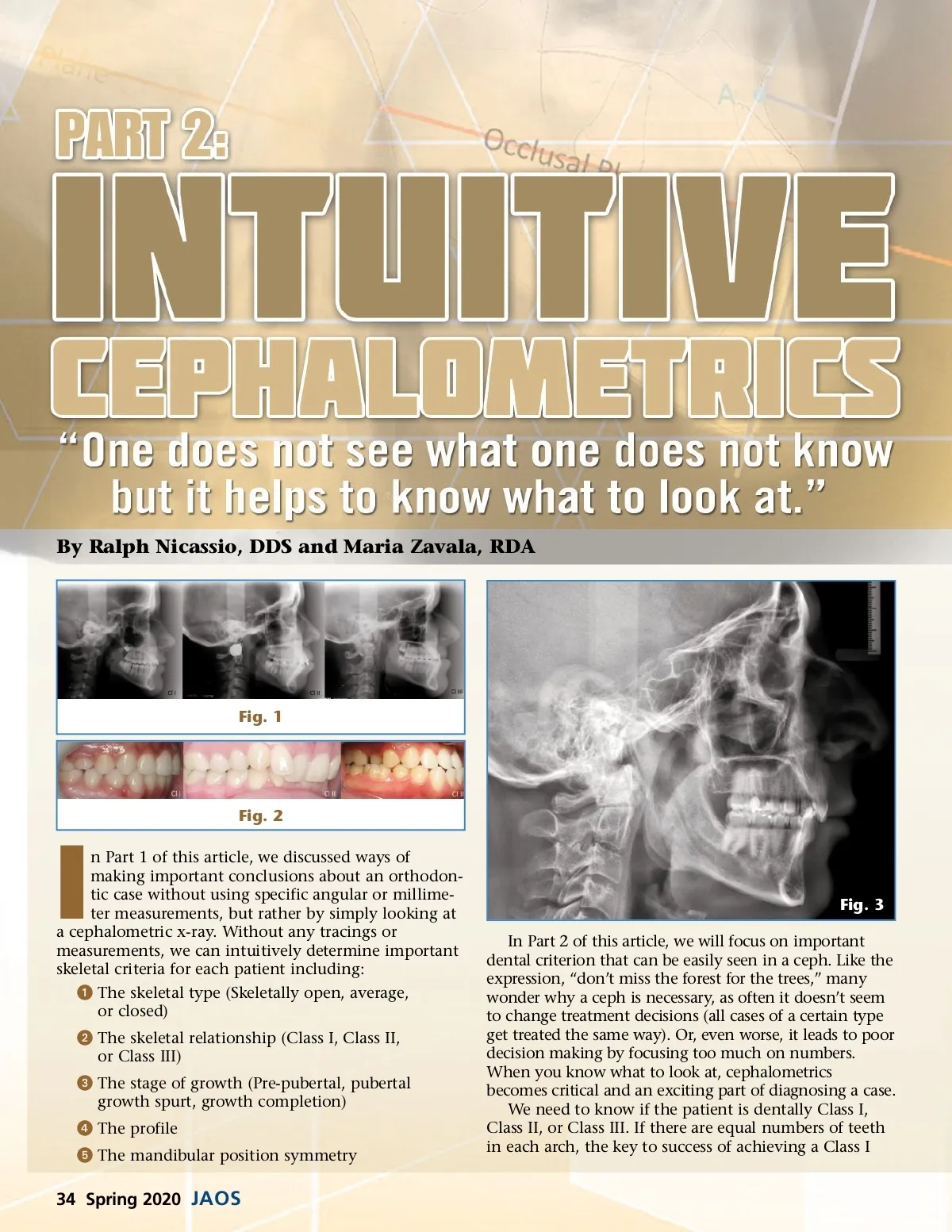
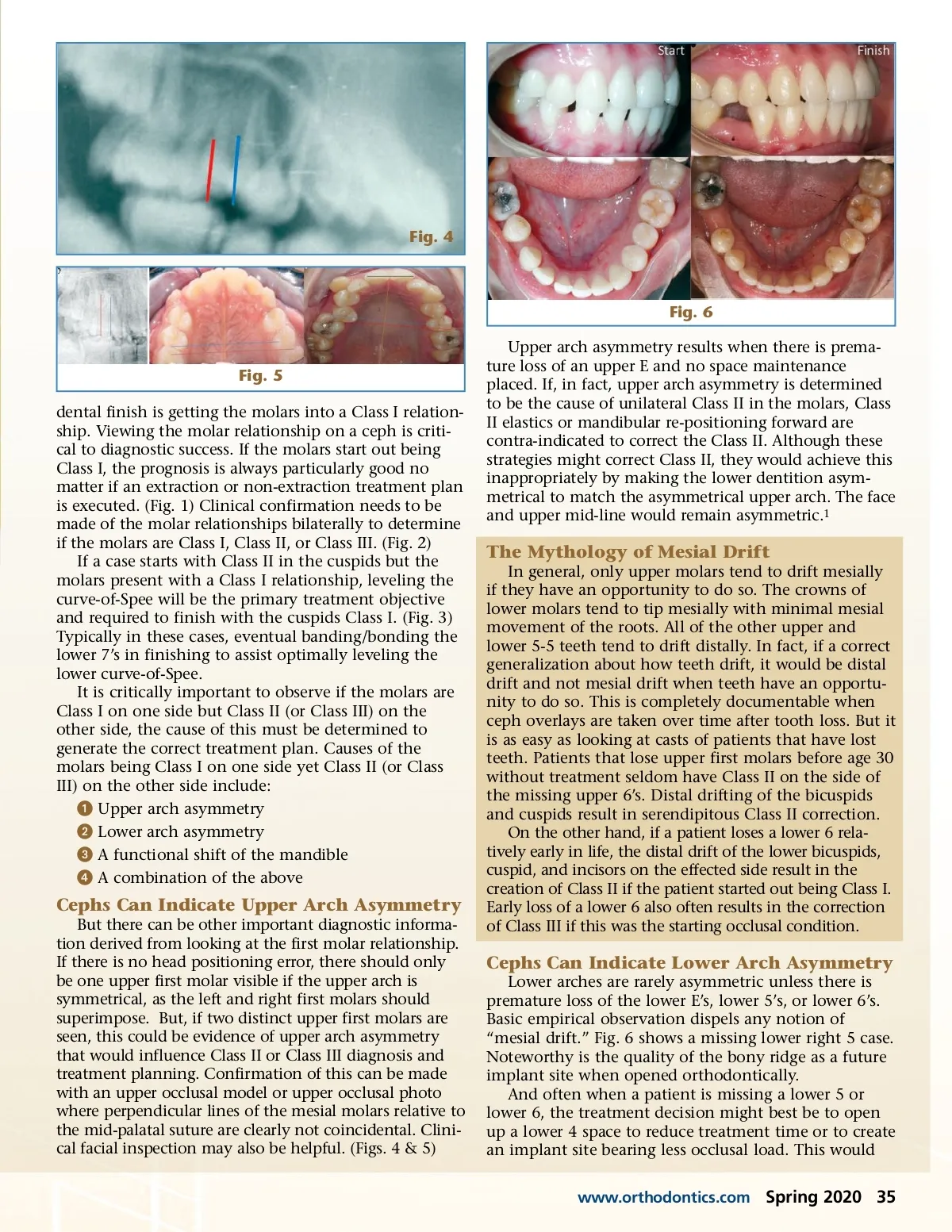
By Ralph Nicassio, DDS and Maria Zavala, RDA Fig. 1 Fig. 2 I n Part 1 of this article, we discussed ways of making important conclusions about an orthodon-tic case without using specific angular or millime-ter measurements, but rather by simply looking at a cephalometric x-ray. Without any tracings or measurements, we can intuitively determine important skeletal criteria for each patient including: ᕡ The skeletal type (Skeletally open, average, or closed) ᕢ The skeletal relationship (Class I, Class II, or Class III) ᕣ The stage of growth (Pre-pubertal, pubertal growth spurt, growth completion) ᕤ The profile ᕥ The mandibular position symmetry Fig. 3 In Part 2 of this article, we will focus on important dental criterion that can be easily seen in a ceph. Like the expression, “don’t miss the forest for the trees,” many wonder why a ceph is necessary, as often it doesn’t seem to change treatment decisions (all cases of a certain type get treated the same way). Or, even worse, it leads to poor decision making by focusing too much on numbers. When you know what to look at, cephalometrics becomes critical and an exciting part of diagnosing a case. We need to know if the patient is dentally Class I, Class II, or Class III. If there are equal numbers of teeth in each arch, the key to success of achieving a Class I 34 Spring 2020 JAOS
Journal of the American Orthodontic Society Spring 2020: Page 34