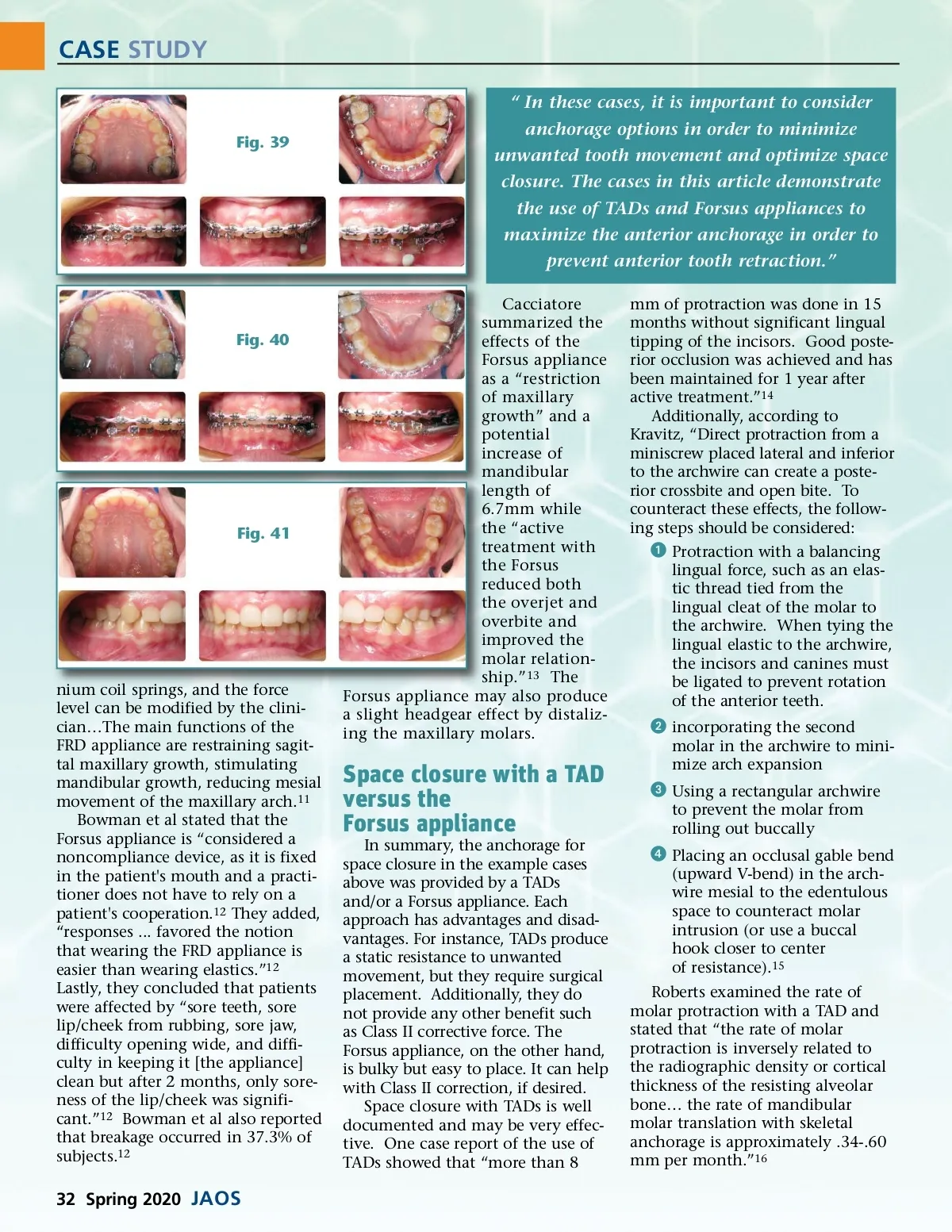
CASE STUDY The TAD may be placed mesial or distal to the first premolar. If the TAD is placed mesial to the first premolar, the anchorage is indirect. The force is then activated between the first premolar and molar with the expectation of minimal retrac-tion of the premolar. Jang stated that “an indirect anchorage system can be used effectively in adjunctive orthodontic treatment…less than 1 mm of movement of the indirect anchor tooth is anticipated…” 17 In contrast to the anchorage provided by TADs, auxiliary anchorage may be provided by inter-arch mechanics. For instance, the Forsus appliance may be used to produce a mesial force on the lower first premolar. The reciprocal force produced by the Forsus is a distalizing force on the maxillary posterior teeth. Chhibber et al described a case of space closure in the mandible using a Forsus appli-ance for anchorage. They stated “we hypothesize that when the distal force on the anterior segment leads to retraction of the mandibular anterior teeth (anchor-age loss), the Forsus appliance that was placed passively becomes active, thereby exerting a mesially directed force on the mandibular anterior teeth offsetting the retrac-tive force and thereby preventing anchorage loss.” 18 unwanted tooth movement and optimize space closure. The cases in this article demonstrate the use of TADs and Forsus appliances to maximize the anterior anchorage in order to prevent anterior tooth retraction. TADs and Forsus appli-ances, therefore, are valuable but very different options for anchor-age, with comparative attributes and different successes. 9. Ahmed V KS, Rooban T, Krish-naswamy NR, Mani K, Kalladka G. Root damage and repair in patients with temporary skeletal anchorage devices. Am J Orthod Dentofac Orthop. 2012. doi:10.1016/ j.ajodo.2011.11.014 10. 3M. ForsusTM Fatigue Resistant Device Treatment Guide. https://multimedia.3m.com/mws/me dia/823065O/forsus-fatigue-resistant-device-treatment-guide.pdf. 11. Atik E, Kocadereli I. Treatment of Class II division 2 malocclusion using the forsus fatigue resistance device and 5-year follow-up. Case Rep Dent. 2016;2016. doi:10.1155/2016/ 3168312 12. Bowman AC, Saltaji H, Flores-Mir C, Preston B, Tabbaa S. Patient experi-ences with the Forsus Fatigue Resis-tant Device. Angle Orthod. 2013. doi:10.2319/081112-647.1 13. Cacciatore G, Ghislanzoni LTH, Alvetro L, Giuntini V, Franchi L. Treatment and posttreatment effects induced by the Forsus appliance: A controlled clinical study. Angle Orthod. 2014. doi:10.2319/112613-867.1 14. Nagaraj K, Upadhyay M, Yadav S. Titanium screw anchorage for protraction of mandibular second molars into first molar extraction sites. Am J Orthod Dentofac Orthop. 2008. doi:10.1016/j.ajodo. 2006.09.055 15. Kravitz ND, Jolley T. Mandibular molar protraction with temporary anchorage devices. J Clin Orthod. 2008. 16. Roberts WE, Helm FR, Marshall KJ, Gongloff RK. Rigid endosseous implants for orthodontic and ortho-pedic anchorage. Angle Orthod. 1989. doi:10.1043/0003-3219(1989)059<0247:REIFOA>2.0.C O;2 17. Jang W, Choi YJ, Hwang S, Chung CJ, Kim KH. Anchorage loss assess-ment of the indirect anchor tooth during adjunctive orthodontic treat-ment. Am J Orthod Dentofac Orthop. 2019. doi:10.1016/ j.ajodo.2018.04.027 18. Chhibber A, Upadhyay M. Anchor-age reinforcement with a fixed func-tional appliance during protraction of the mandibular second molars into the first molar extraction sites. Am J Orthod Dentofac Orthop. 2015. doi:10.1016/ j.ajodo.2015.02.029 References 1. Bjerklin K, Bennett J. The long-term survival of lower second primary molars in subjects with agenesis of the premolars. Eur J Orthod. 2000. doi:10.1093/ejo/22.3.245 2. Thilander B, Myrberg N. The preva-lence of malocclusion in Swedish schoolchildren. Eur J Oral Sci. 1973. doi:10.1111/j.1600-0722.1973.tb01489.x 3. Bjerklin K, Al-Najjar M, Kårestedt H, Andrén A. Agenesis of mandibular second premolars with retained primary molars. A longitudinal radiographic study of 99 subjects from 12 years of age to adulthood. Eur J Orthod. 2008. doi:10.1093/ ejo/cjn027 4. Mamopoulou A, Hägg U, Schröder U, Hansen K. Agenesis of mandibular second premolars. Spontaneous space closure after extraction ther-apy: A 4-year follow-up. Eur J Orthod. 1996. doi:10.1093/ejo/ 18.6.589 5. Kokich VG, Kokich VO. Congenitally missing mandibular second premo-lars: Clinical options. Am J Orthod Dentofac Orthop. 2006. doi:10.1016/j.ajodo.2006.05.025 6. Zimmer B, Schelper I, Seifi-Shirvan-deh N. Localized orthodontic space closure for unilateral aplasia of lower second premolars. Eur J Orthod. 2007. doi:10.1093/ejo/cjm009 7. Schätzle M, Männchen R, Zwahlen M, Lang NP. Survival and failure rates of orthodontic temporary anchorage devices: A systematic review. Clin Oral Implants Res. 2009. doi:10.1111/j.1600-0501.2009.01754.x 8. Cope JB. Temporary anchorage devices in orthodontics: A paradigm shift. Semin Orthod. 2005. doi:10.1053/j.sodo.2004.11.002 Recommendations An in vivo comparative study of the two anchorage methods -the TAD and the Forsus appliance -may elicit the risks and benefits of each method. A comparative study may further help determine the indica-tions for each method. Conclusion Congenitally missing premolars are important dental findings in children. The orthodontic treat-ment plan for patients with congenitally missing premolars may include extraction of the primary molars and orthodontic space closure. In these cases, it is important to consider anchorage options in order to minimize www.orthodontics.com Spring 2020 33
Journal of the American Orthodontic Society Spring 2020: Page 33