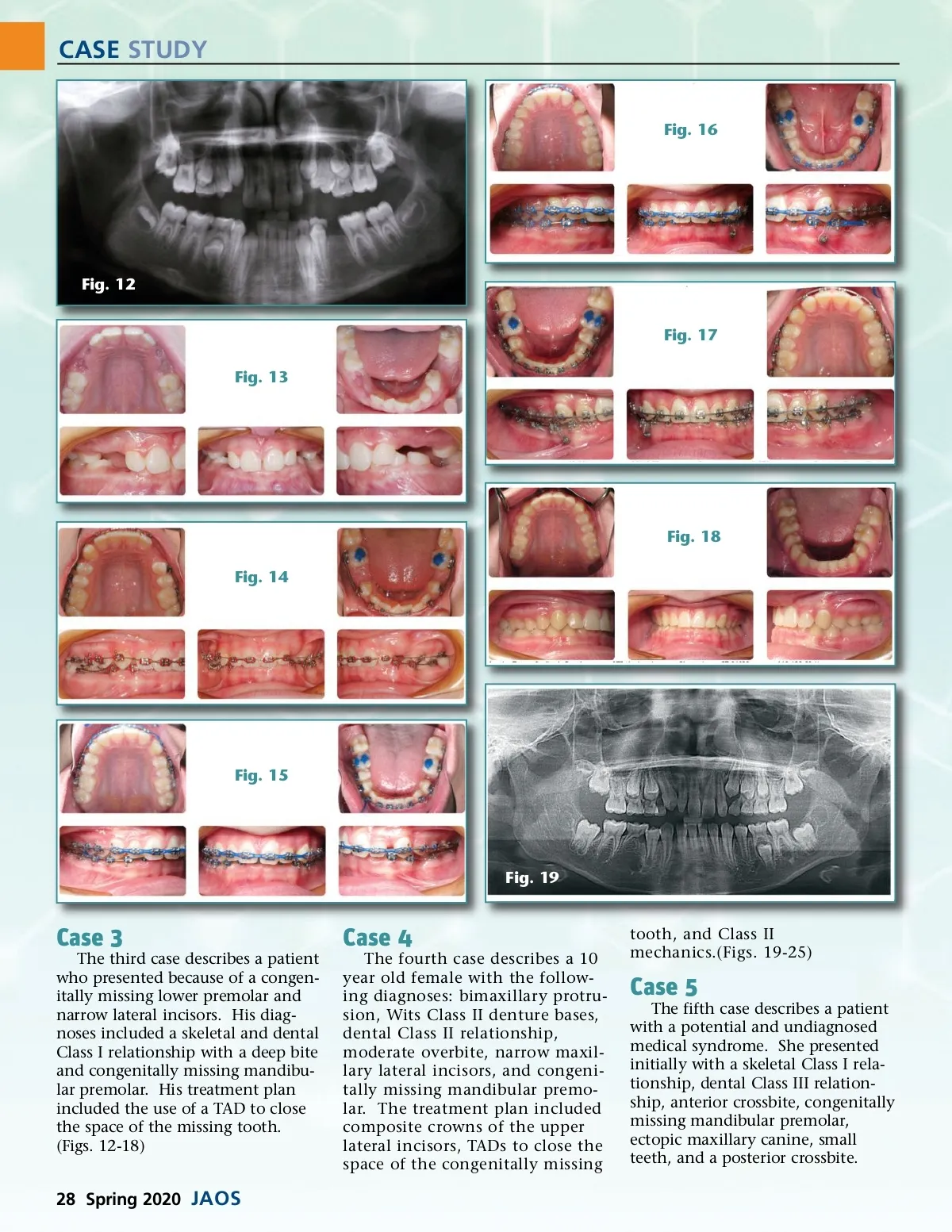
CASE STUDY Fig. 20 Fig. 24 Fig. 25 Fig. 21 Fig. 22 Fig. 23 Fig. 26 Fig. 27 “Congenitally missing premolars are common in children. Studies in Sweden showed agenesis rates of 2.8% and 3.3%. Additionally, in another study of a Swedish population, Thilander and Myrberg found a prevalence rate of 6-8%.” Her treatment plan included eventual extraction of the primary molars in order to retract the lower incisors and correct for her Class III malocclusion. (Figs. 26-34) Case 6 The sixth case describes a 12 year old female patient who initially had a skeletal Class II malocclusion with mandibular retrognathism, dental Class II malocclusion, deep bite, congenitally missing mandibular premolar, and ectopic maxillary premolars. Her treatment plan included exposure of the upper premolars and a TAD to close the mandibular space. In her case, it was decided to add a Forsus appliance towards the end of space closure to assist in provid-ing anchorage and to correct her Class II malocclusion. (Figs. 35-41) Discussion Congenitally missing premolars are common in children. Studies in Sweden showed agenesis rates of www.orthodontics.com Spring 2020 29
Journal of the American Orthodontic Society Spring 2020: Page 29