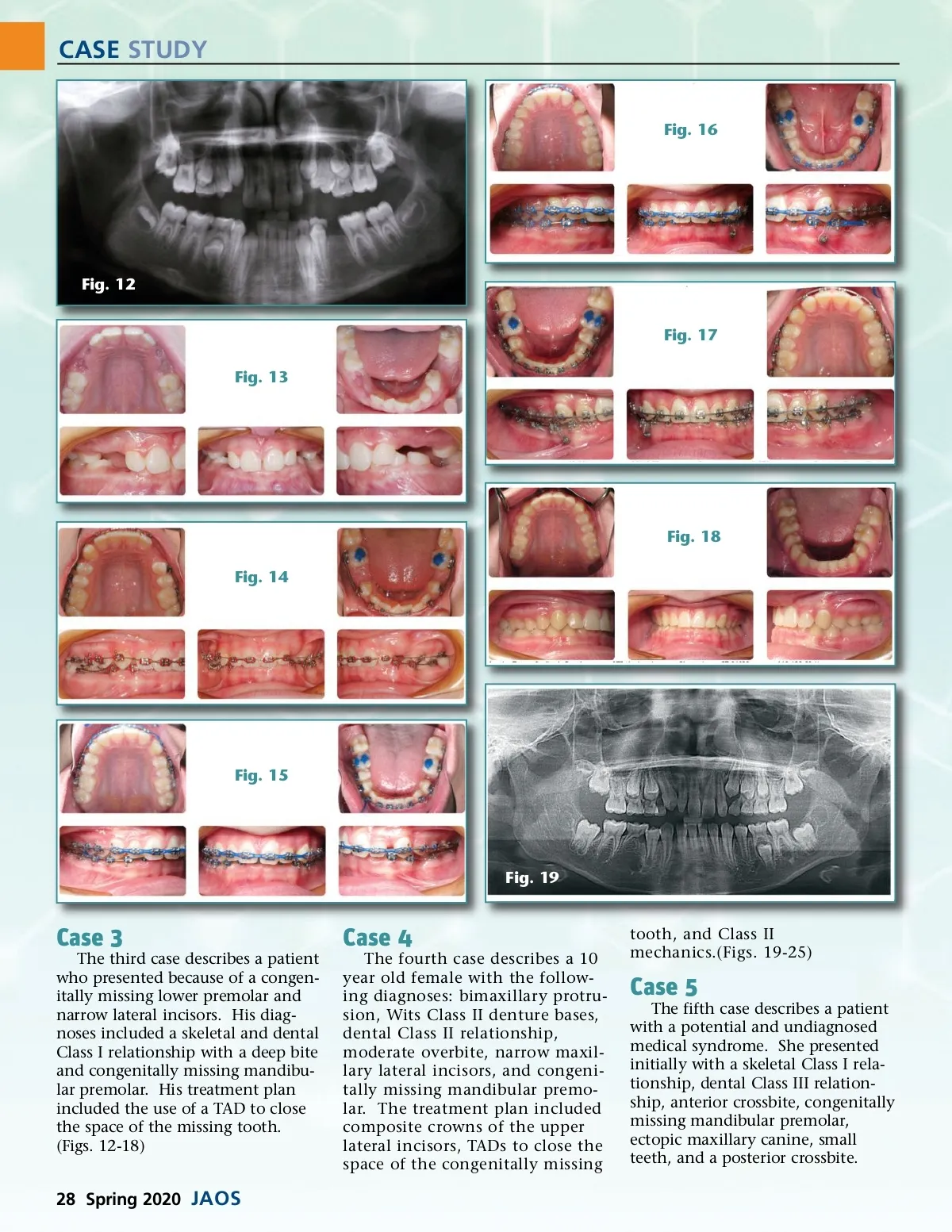
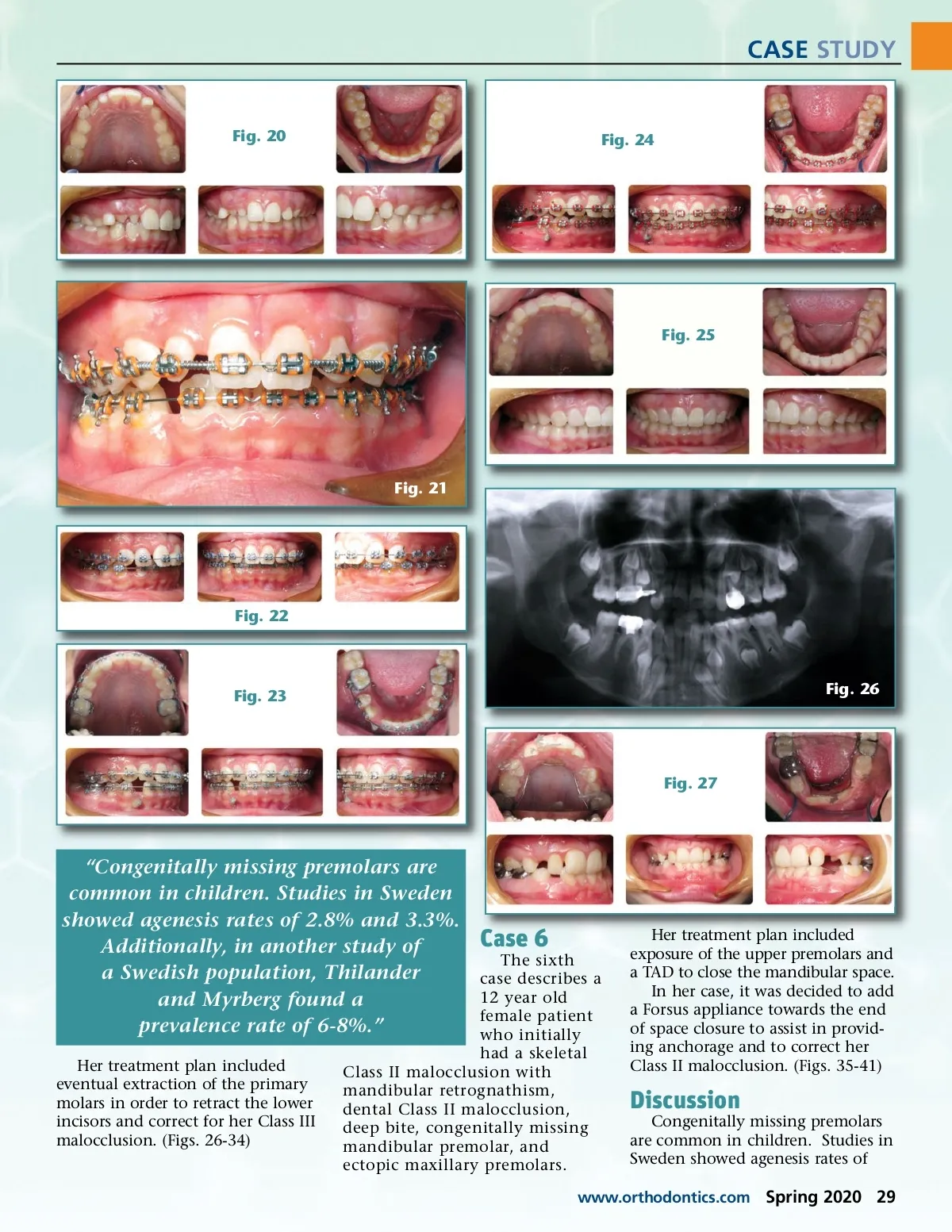
CASE STUDY Fig. 16 Fig. 12 Fig. 17 Fig. 13 Fig. 18 Fig. 14 Fig. 15 Fig. 19 Case 3 The third case describes a patient who presented because of a congen-itally missing lower premolar and narrow lateral incisors. His diag-noses included a skeletal and dental Class I relationship with a deep bite and congenitally missing mandibu-lar premolar. His treatment plan included the use of a TAD to close the space of the missing tooth. (Figs. 12-18) Case 4 The fourth case describes a 10 year old female with the follow-ing diagnoses: bimaxillary protru-sion, Wits Class II denture bases, dental Class II relationship, moderate overbite, narrow maxil-lary lateral incisors, and congeni-tally missing mandibular premo-lar. The treatment plan included composite crowns of the upper lateral incisors, TADs to close the space of the congenitally missing tooth, and Class II mechanics.(Figs. 19-25) Case 5 The fifth case describes a patient with a potential and undiagnosed medical syndrome. She presented initially with a skeletal Class I rela-tionship, dental Class III relation-ship, anterior crossbite, congenitally missing mandibular premolar, ectopic maxillary canine, small teeth, and a posterior crossbite. 28 Spring 2020 JAOS
Journal of the American Orthodontic Society Spring 2020: Page 28