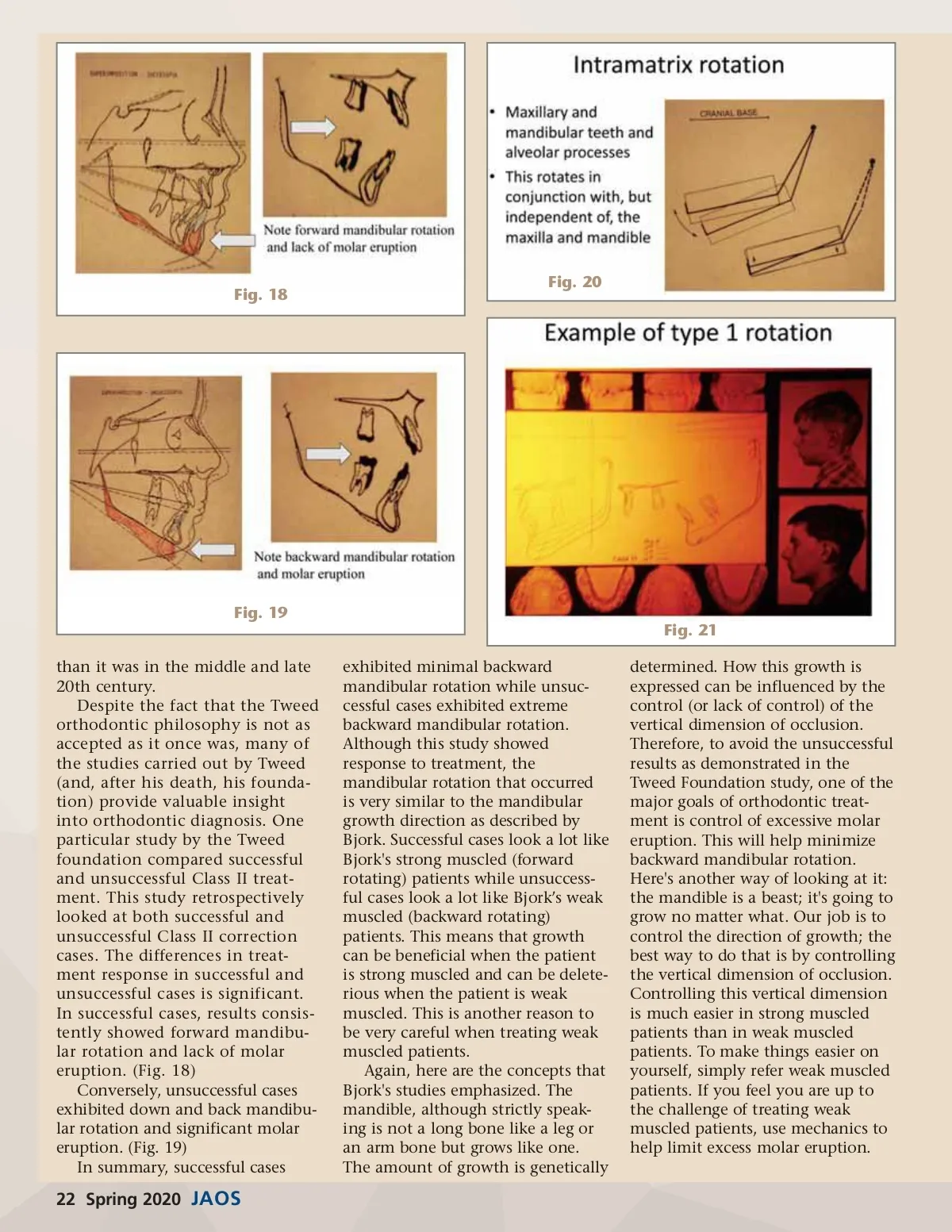
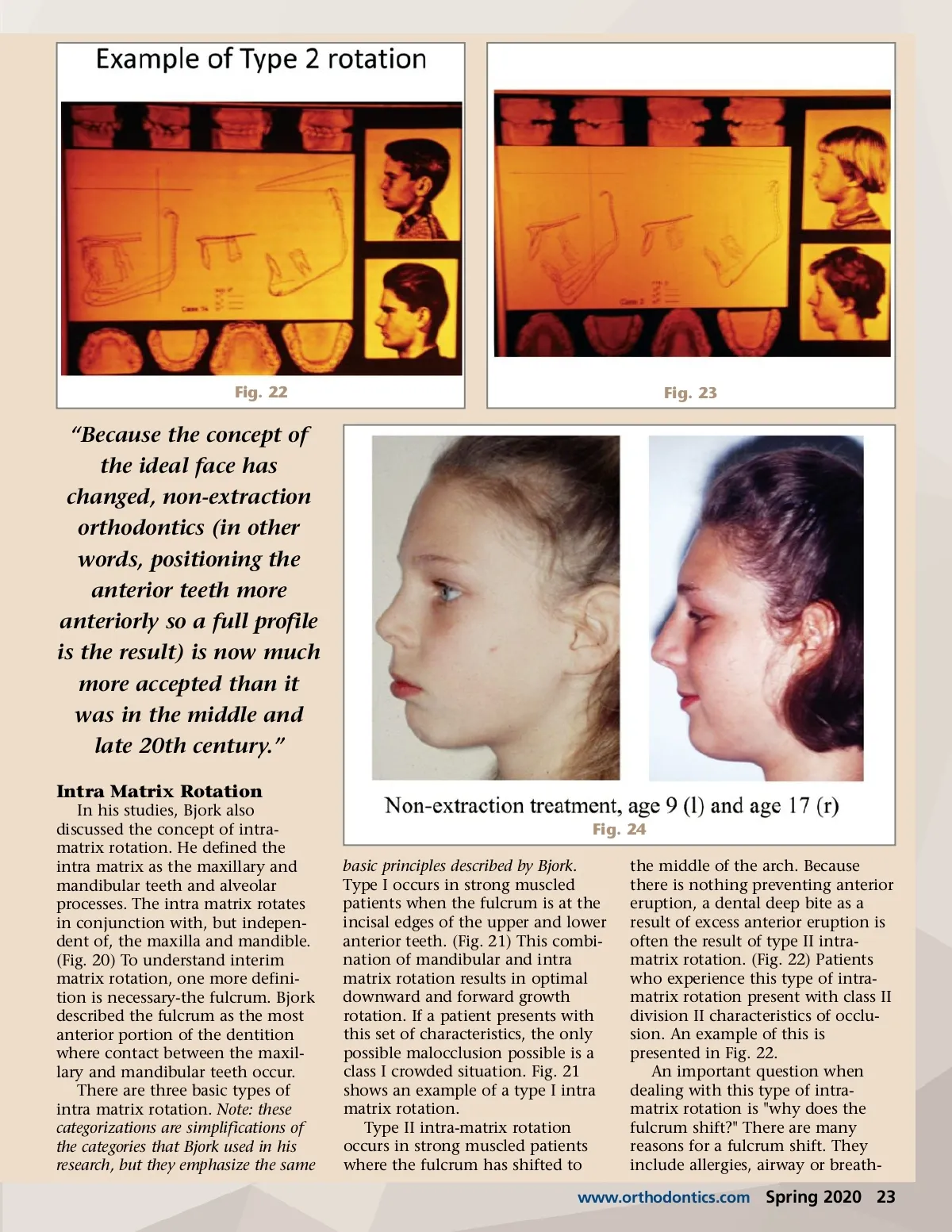
Fig. 22 Fig. 23 “Because the concept of the ideal face has changed, non-extraction orthodontics (in other words, positioning the anterior teeth more anteriorly so a full profile is the result) is now much more accepted than it was in the middle and late 20th century.” Intra Matrix Rotation In his studies, Bjork also discussed the concept of intra-matrix rotation. He defined the intra matrix as the maxillary and mandibular teeth and alveolar processes. The intra matrix rotates in conjunction with, but indepen-dent of, the maxilla and mandible. (Fig. 20) To understand interim matrix rotation, one more defini-tion is necessary-the fulcrum. Bjork described the fulcrum as the most anterior portion of the dentition where contact between the maxil-lary and mandibular teeth occur. There are three basic types of intra matrix rotation. Note: these categorizations are simplifications of the categories that Bjork used in his research, but they emphasize the same Fig. 24 basic principles described by Bjork. Type I occurs in strong muscled patients when the fulcrum is at the incisal edges of the upper and lower anterior teeth. (Fig. 21) This combi-nation of mandibular and intra matrix rotation results in optimal downward and forward growth rotation. If a patient presents with this set of characteristics, the only possible malocclusion possible is a class I crowded situation. Fig. 21 shows an example of a type I intra matrix rotation. Type II intra-matrix rotation occurs in strong muscled patients where the fulcrum has shifted to the middle of the arch. Because there is nothing preventing anterior eruption, a dental deep bite as a result of excess anterior eruption is often the result of type II intra-matrix rotation. (Fig. 22) Patients who experience this type of intra-matrix rotation present with class II division II characteristics of occlu-sion. An example of this is presented in Fig. 22. An important question when dealing with this type of intra-matrix rotation is "why does the fulcrum shift?" There are many reasons for a fulcrum shift. They include allergies, airway or breath-www.orthodontics.com Spring 2020 23
Journal of the American Orthodontic Society Spring 2020: Page 23