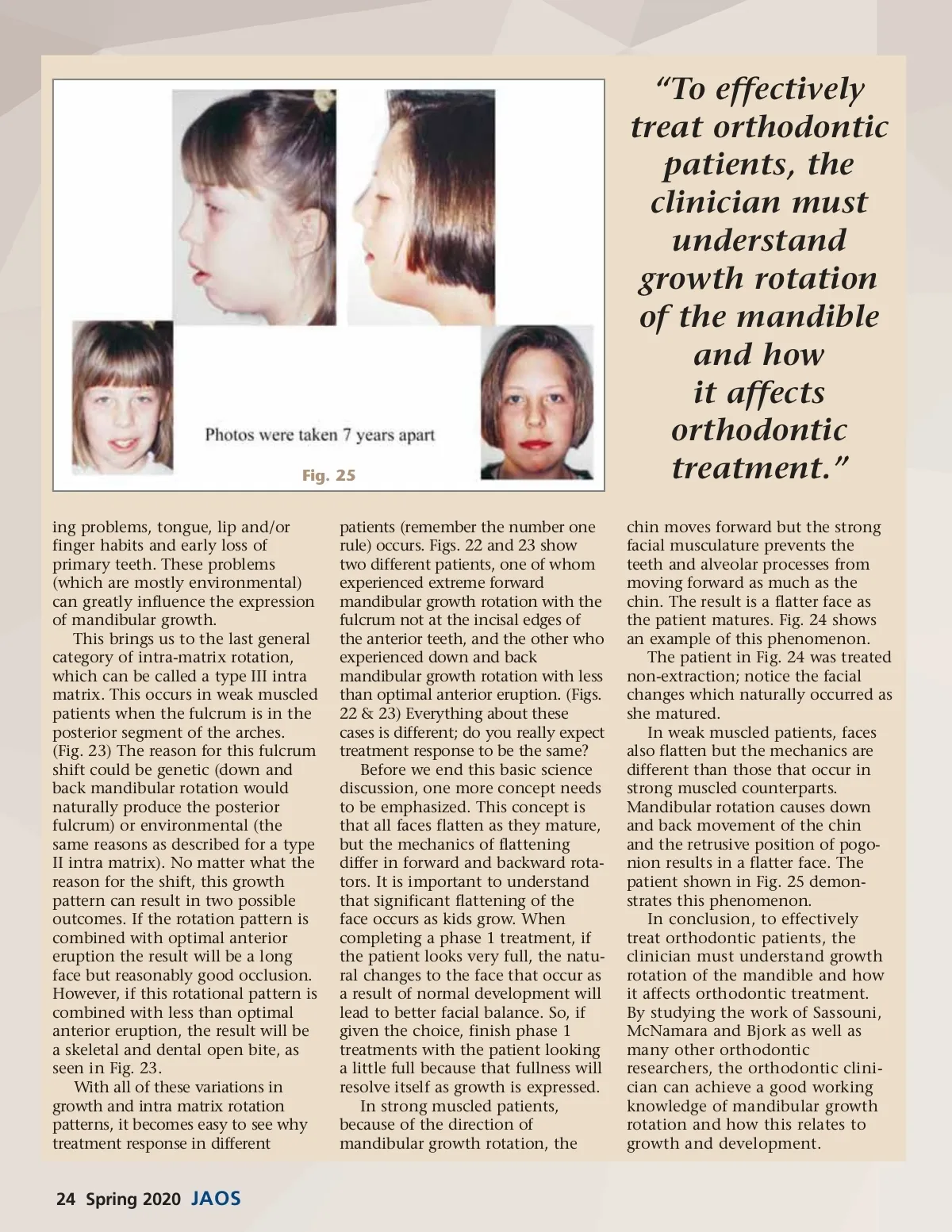
Fig. 25 ing problems, tongue, lip and/or finger habits and early loss of primary teeth. These problems (which are mostly environmental) can greatly influence the expression of mandibular growth. This brings us to the last general category of intra-matrix rotation, which can be called a type III intra matrix. This occurs in weak muscled patients when the fulcrum is in the posterior segment of the arches. (Fig. 23) The reason for this fulcrum shift could be genetic (down and back mandibular rotation would naturally produce the posterior fulcrum) or environmental (the same reasons as described for a type II intra matrix). No matter what the reason for the shift, this growth pattern can result in two possible outcomes. If the rotation pattern is combined with optimal anterior eruption the result will be a long face but reasonably good occlusion. However, if this rotational pattern is combined with less than optimal anterior eruption, the result will be a skeletal and dental open bite, as seen in Fig. 23. With all of these variations in growth and intra matrix rotation patterns, it becomes easy to see why treatment response in different patients (remember the number one rule) occurs. Figs. 22 and 23 show two different patients, one of whom experienced extreme forward mandibular growth rotation with the fulcrum not at the incisal edges of the anterior teeth, and the other who experienced down and back mandibular growth rotation with less than optimal anterior eruption. (Figs. 22 & 23) Everything about these cases is different; do you really expect treatment response to be the same? Before we end this basic science discussion, one more concept needs to be emphasized. This concept is that all faces flatten as they mature, but the mechanics of flattening differ in forward and backward rota-tors. It is important to understand that significant flattening of the face occurs as kids grow. When completing a phase 1 treatment, if the patient looks very full, the natu-ral changes to the face that occur as a result of normal development will lead to better facial balance. So, if given the choice, finish phase 1 treatments with the patient looking a little full because that fullness will resolve itself as growth is expressed. In strong muscled patients, because of the direction of mandibular growth rotation, the “To effectively treat orthodontic patients, the clinician must understand growth rotation of the mandible and how it affects orthodontic treatment.” chin moves forward but the strong facial musculature prevents the teeth and alveolar processes from moving forward as much as the chin. The result is a flatter face as the patient matures. Fig. 24 shows an example of this phenomenon. The patient in Fig. 24 was treated non-extraction; notice the facial changes which naturally occurred as she matured. In weak muscled patients, faces also flatten but the mechanics are different than those that occur in strong muscled counterparts. Mandibular rotation causes down and back movement of the chin and the retrusive position of pogo-nion results in a flatter face. The patient shown in Fig. 25 demon-strates this phenomenon. In conclusion, to effectively treat orthodontic patients, the clinician must understand growth rotation of the mandible and how it affects orthodontic treatment. By studying the work of Sassouni, McNamara and Bjork as well as many other orthodontic researchers, the orthodontic clini-cian can achieve a good working knowledge of mandibular growth rotation and how this relates to growth and development. 24 Spring 2020 JAOS
Journal of the American Orthodontic Society Spring 2020: Page 24