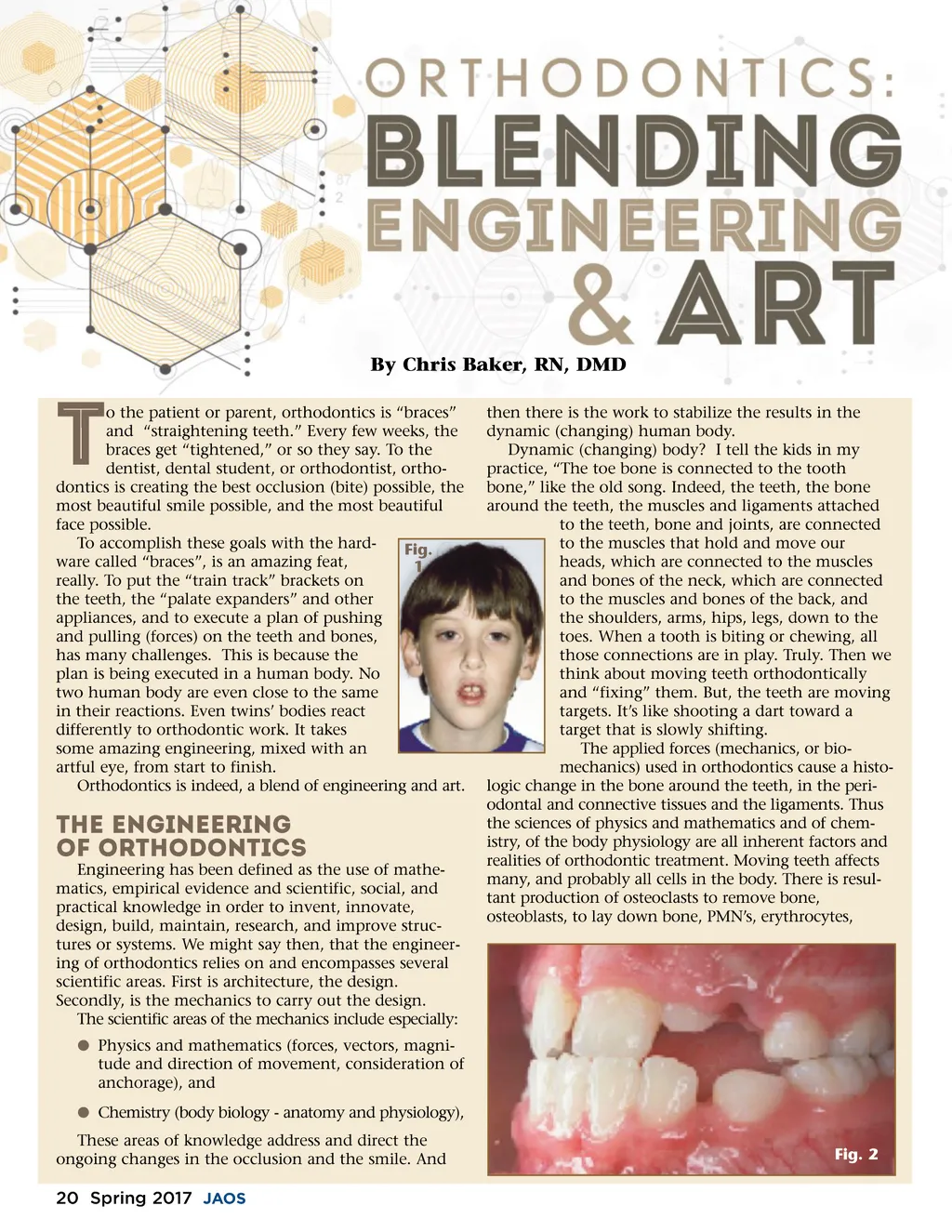
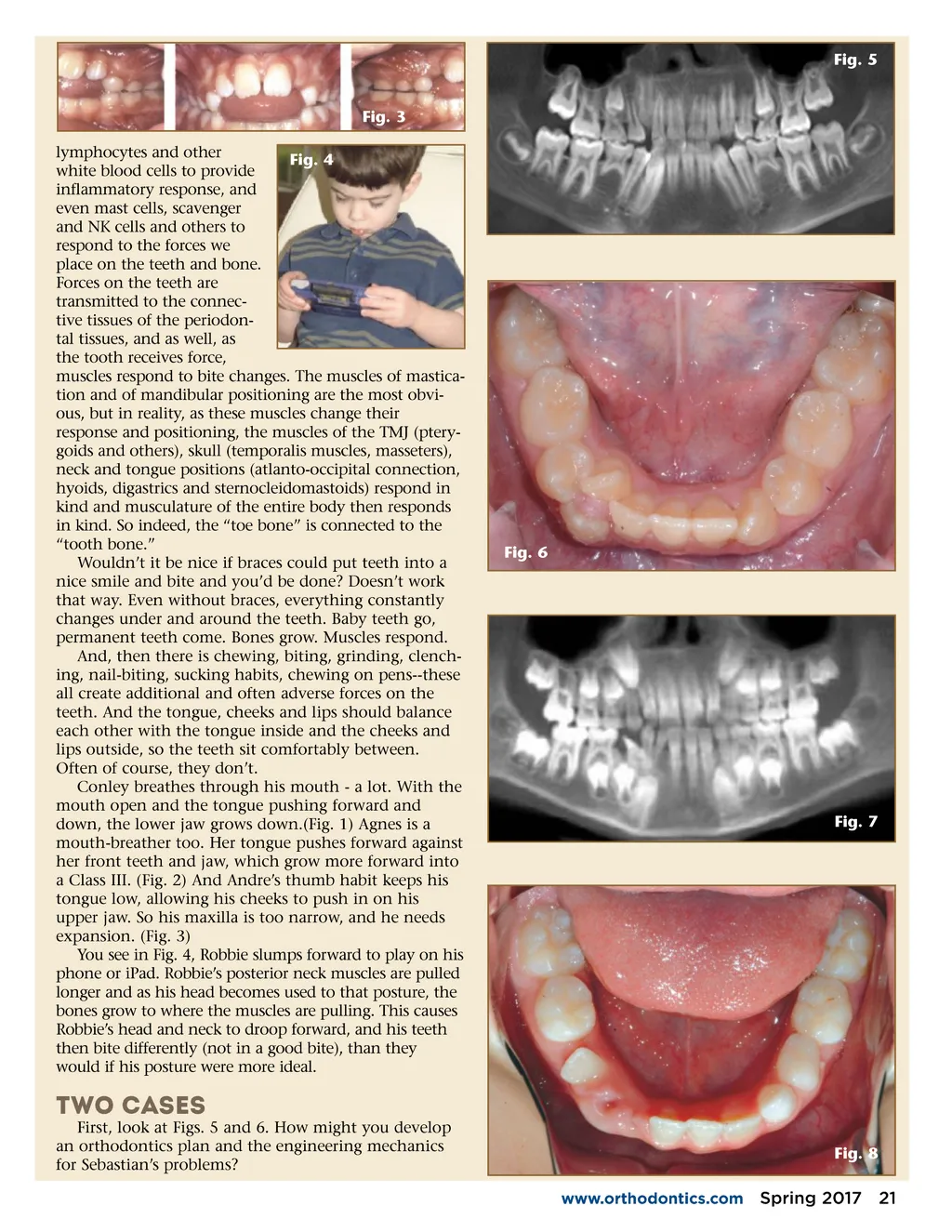
By Chris Baker, RN, DMD T o the patient or parent, orthodontics is “braces” and “straightening teeth.” Every few weeks, the braces get “tightened,” or so they say. To the dentist, dental student, or orthodontist, ortho-dontics is creating the best occlusion (bite) possible, the most beautiful smile possible, and the most beautiful face possible. To accomplish these goals with the hard-Fig. ware called “braces”, is an amazing feat, 1 really. To put the “train track” brackets on the teeth, the “palate expanders” and other appliances, and to execute a plan of pushing and pulling (forces) on the teeth and bones, has many challenges. This is because the plan is being executed in a human body. No two human body are even close to the same in their reactions. Even twins’ bodies react differently to orthodontic work. It takes some amazing engineering, mixed with an artful eye, from start to finish. Orthodontics is indeed, a blend of engineering and art. The Engineering of Orthodontics Engineering has been defined as the use of mathe-matics, empirical evidence and scientific, social, and practical knowledge in order to invent, innovate, design, build, maintain, research, and improve struc-tures or systems. We might say then, that the engineer-ing of orthodontics relies on and encompasses several scientific areas. First is architecture, the design. Secondly, is the mechanics to carry out the design. The scientific areas of the mechanics include especially: b Physics and mathematics (forces, vectors, magni-tude and direction of movement, consideration of anchorage), and b Chemistry (body biology -anatomy and physiology), These areas of knowledge address and direct the ongoing changes in the occlusion and the smile. And then there is the work to stabilize the results in the dynamic (changing) human body. Dynamic (changing) body? I tell the kids in my practice, “The toe bone is connected to the tooth bone,” like the old song. Indeed, the teeth, the bone around the teeth, the muscles and ligaments attached to the teeth, bone and joints, are connected to the muscles that hold and move our heads, which are connected to the muscles and bones of the neck, which are connected to the muscles and bones of the back, and the shoulders, arms, hips, legs, down to the toes. When a tooth is biting or chewing, all those connections are in play. Truly. Then we think about moving teeth orthodontically and “fixing” them. But, the teeth are moving targets. It’s like shooting a dart toward a target that is slowly shifting. The applied forces (mechanics, or bio-mechanics) used in orthodontics cause a histo-logic change in the bone around the teeth, in the peri-odontal and connective tissues and the ligaments. Thus the sciences of physics and mathematics and of chem-istry, of the body physiology are all inherent factors and realities of orthodontic treatment. Moving teeth affects many, and probably all cells in the body. There is resul-tant production of osteoclasts to remove bone, osteoblasts, to lay down bone, PMN’s, erythrocytes, Fig. 2 20 Spring 2017 JAOS
Journal of the American Orthodontic Society Spring 2017: Page 20