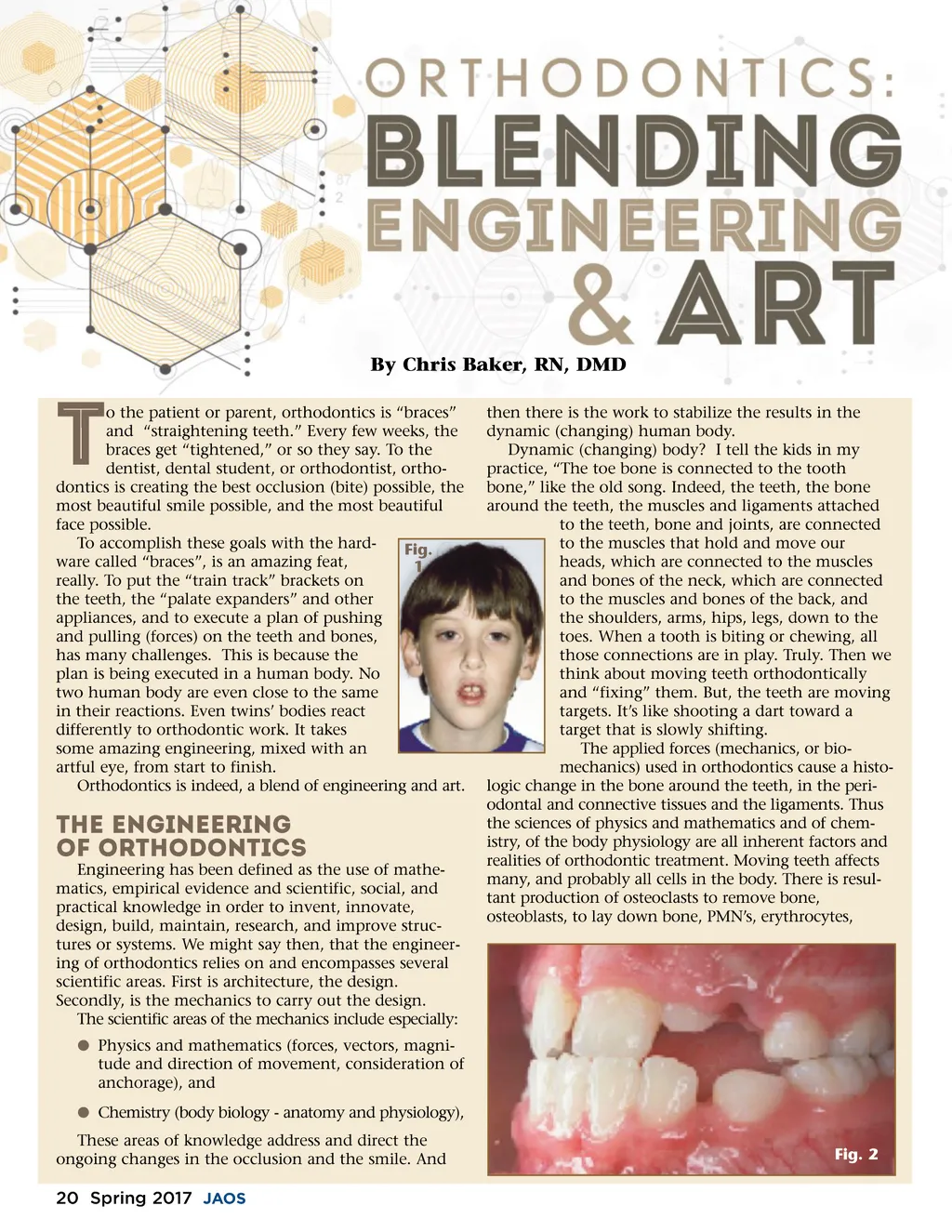
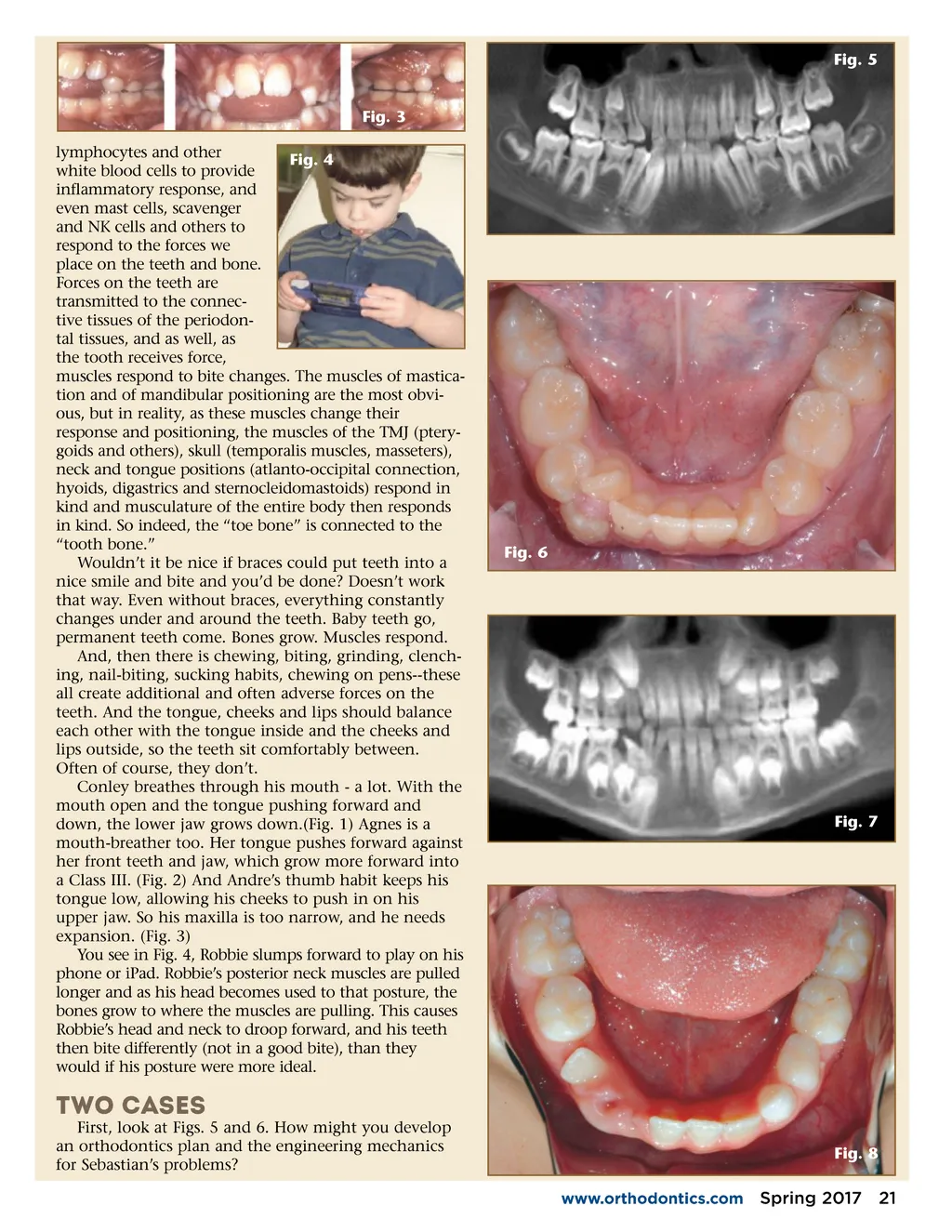
Fig. 5 Fig. 3 lymphocytes and other Fig. 4 white blood cells to provide inflammatory response, and even mast cells, scavenger and NK cells and others to respond to the forces we place on the teeth and bone. Forces on the teeth are transmitted to the connec-tive tissues of the periodon-tal tissues, and as well, as the tooth receives force, muscles respond to bite changes. The muscles of mastica-tion and of mandibular positioning are the most obvi-ous, but in reality, as these muscles change their response and positioning, the muscles of the TMJ (ptery-goids and others), skull (temporalis muscles, masseters), neck and tongue positions (atlanto-occipital connection, hyoids, digastrics and sternocleidomastoids) respond in kind and musculature of the entire body then responds in kind. So indeed, the “toe bone” is connected to the “tooth bone.” Wouldn’t it be nice if braces could put teeth into a nice smile and bite and you’d be done? Doesn’t work that way. Even without braces, everything constantly changes under and around the teeth. Baby teeth go, permanent teeth come. Bones grow. Muscles respond. And, then there is chewing, biting, grinding, clench-ing, nail-biting, sucking habits, chewing on pens--these all create additional and often adverse forces on the teeth. And the tongue, cheeks and lips should balance each other with the tongue inside and the cheeks and lips outside, so the teeth sit comfortably between. Often of course, they don’t. Conley breathes through his mouth -a lot. With the mouth open and the tongue pushing forward and down, the lower jaw grows down.(Fig. 1) Agnes is a mouth-breather too. Her tongue pushes forward against her front teeth and jaw, which grow more forward into a Class III. (Fig. 2) And Andre’s thumb habit keeps his tongue low, allowing his cheeks to push in on his upper jaw. So his maxilla is too narrow, and he needs expansion. (Fig. 3) You see in Fig. 4, Robbie slumps forward to play on his phone or iPad. Robbie’s posterior neck muscles are pulled longer and as his head becomes used to that posture, the bones grow to where the muscles are pulling. This causes Robbie’s head and neck to droop forward, and his teeth then bite differently (not in a good bite), than they would if his posture were more ideal. Fig. 6 Fig. 7 TWO CASES First, look at Figs. 5 and 6. How might you develop an orthodontics plan and the engineering mechanics for Sebastian’s problems? www.orthodontics.com Fig. 8 Spring 2017 21
Journal of the American Orthodontic Society Spring 2017: Page 21