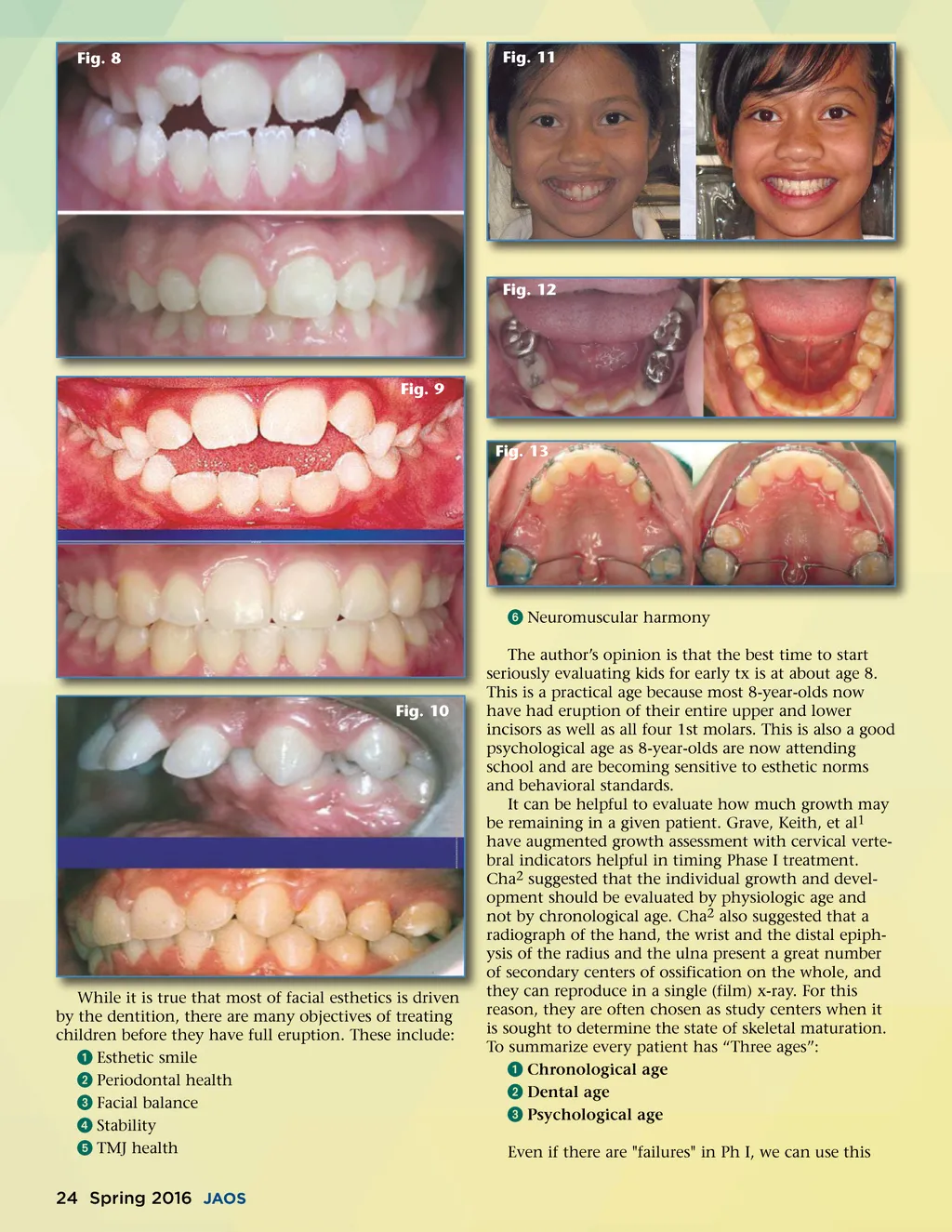
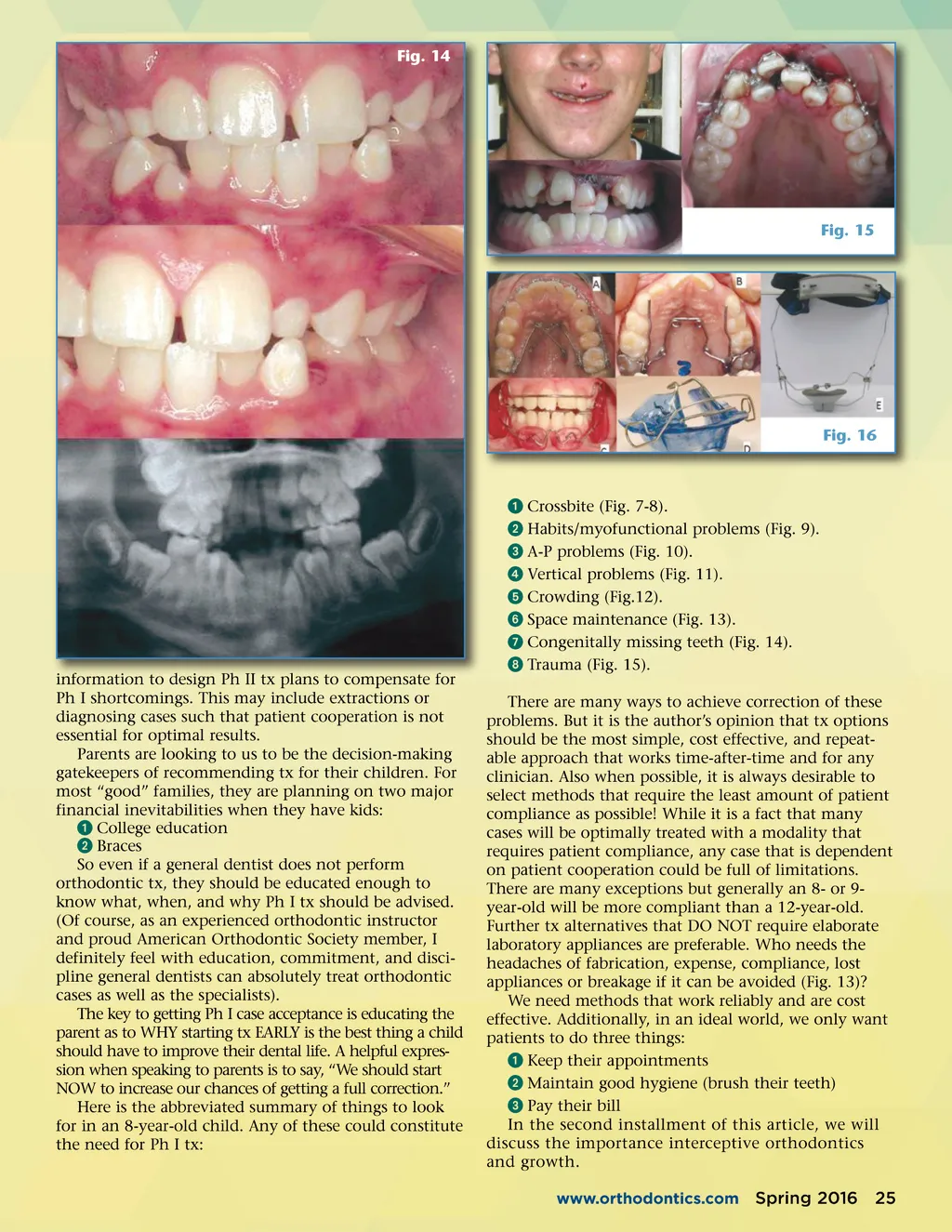
Fig. 8 Fig. 11 Fig. 12 Fig. 9 Fig. 13 ᕦ Neuromuscular harmony The author’s opinion is that the best time to start seriously evaluating kids for early tx is at about age 8. This is a practical age because most 8-year-olds now have had eruption of their entire upper and lower incisors as well as all four 1st molars. This is also a good psychological age as 8-year-olds are now attending school and are becoming sensitive to esthetic norms and behavioral standards. It can be helpful to evaluate how much growth may be remaining in a given patient. Grave, Keith, et al 1 have augmented growth assessment with cervical verte-bral indicators helpful in timing Phase I treatment. Cha 2 suggested that the individual growth and devel-opment should be evaluated by physiologic age and not by chronological age. Cha 2 also suggested that a radiograph of the hand, the wrist and the distal epiph-ysis of the radius and the ulna present a great number of secondary centers of ossification on the whole, and they can reproduce in a single (film) x-ray. For this reason, they are often chosen as study centers when it is sought to determine the state of skeletal maturation. To summarize every patient has “Three ages”: ᕡ Chronological age ᕢ Dental age ᕣ Psychological age Even if there are "failures" in Ph I, we can use this Fig. 10 While it is true that most of facial esthetics is driven by the dentition, there are many objectives of treating children before they have full eruption. These include: ᕡ Esthetic smile ᕢ Periodontal health ᕣ Facial balance ᕤ Stability ᕥ TMJ health 24 Spring 2016 JAOS
Journal of the American Orthodontic Society Spring 2016: Page 24