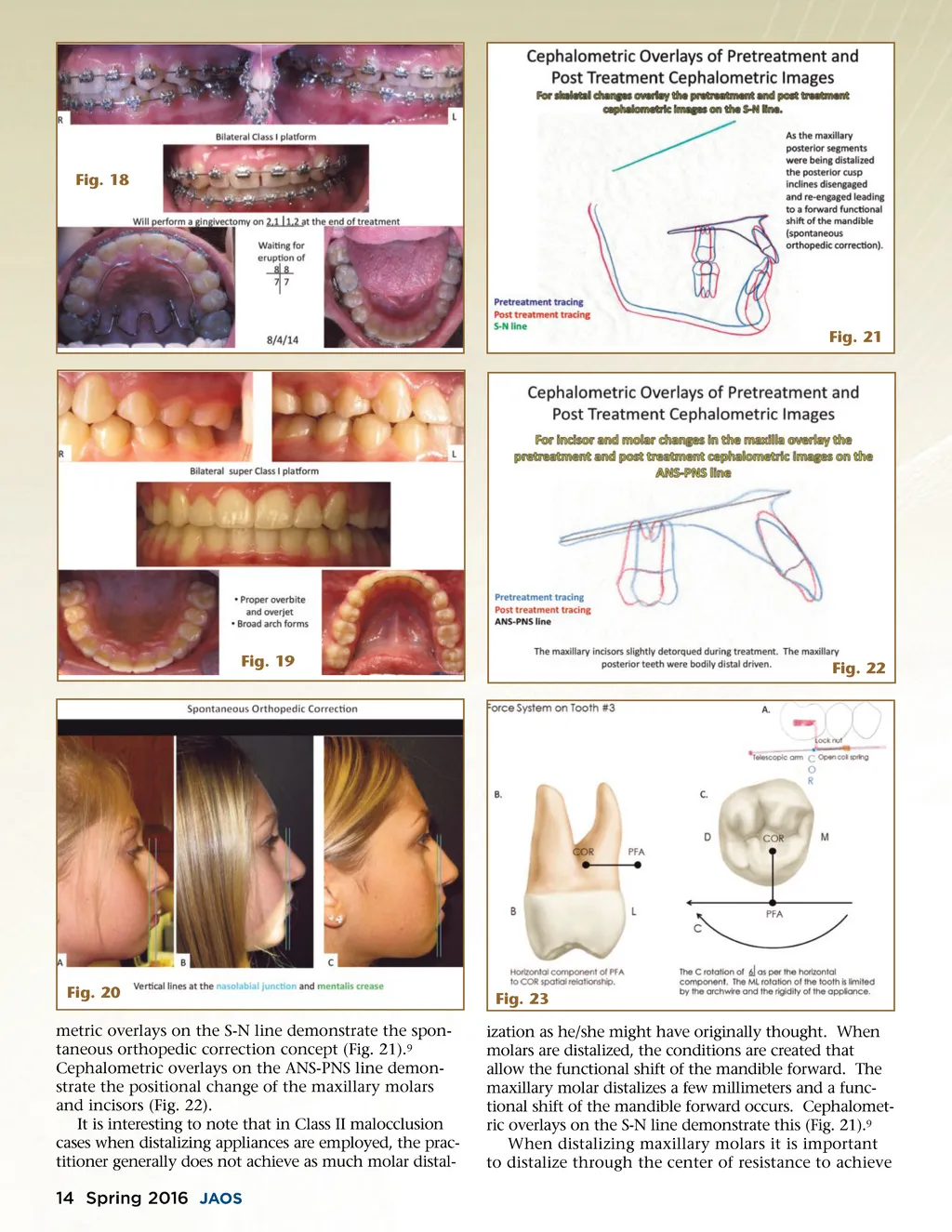
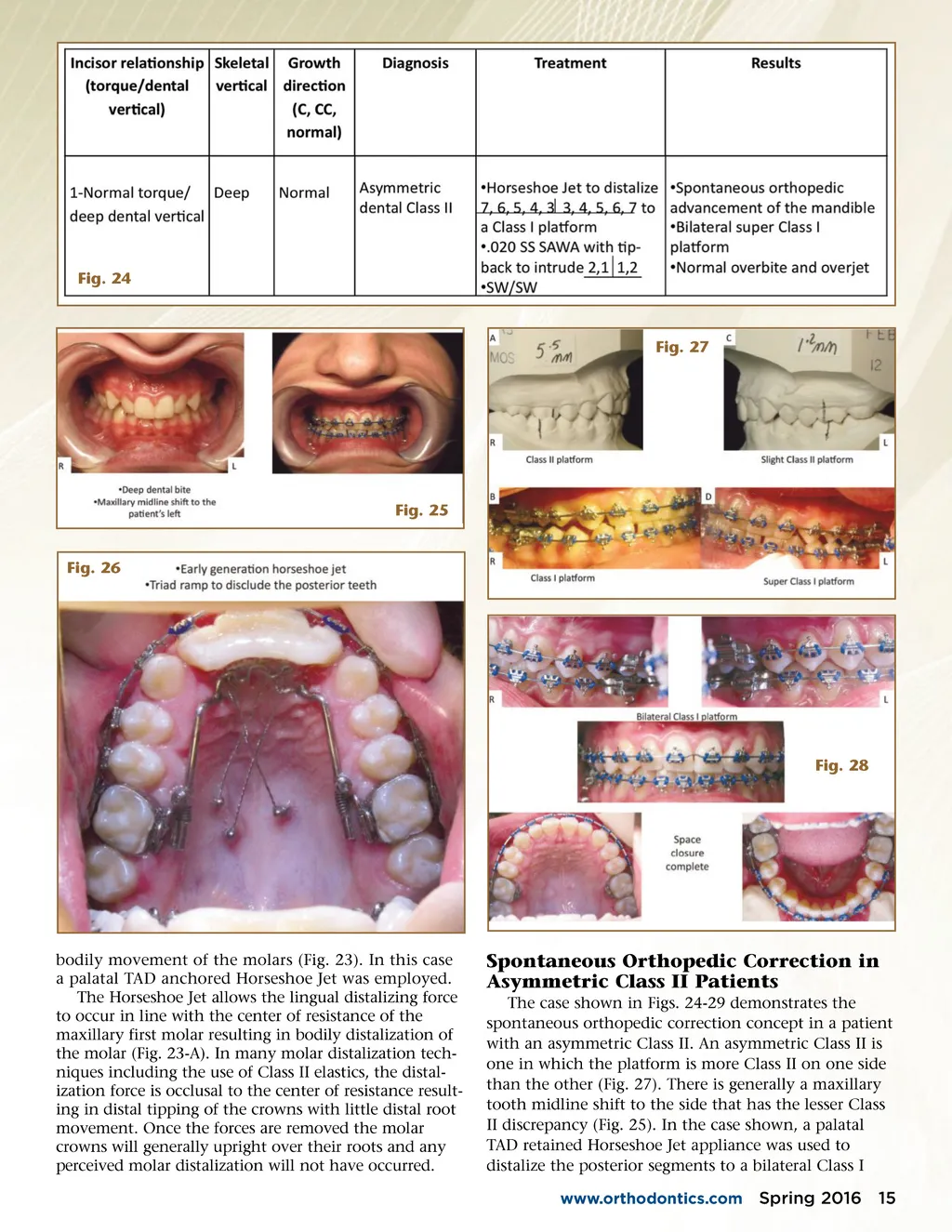
Fig. 24 Fig. 27 Fig. 25 Fig. 26 Fig. 28 bodily movement of the molars (Fig. 23). In this case a palatal TAD anchored Horseshoe Jet was employed. The Horseshoe Jet allows the lingual distalizing force to occur in line with the center of resistance of the maxillary first molar resulting in bodily distalization of the molar (Fig. 23-A). In many molar distalization tech-niques including the use of Class II elastics, the distal-ization force is occlusal to the center of resistance result-ing in distal tipping of the crowns with little distal root movement. Once the forces are removed the molar crowns will generally upright over their roots and any perceived molar distalization will not have occurred. Spontaneous Orthopedic Correction in Asymmetric Class II Patients The case shown in Figs. 24-29 demonstrates the spontaneous orthopedic correction concept in a patient with an asymmetric Class II. An asymmetric Class II is one in which the platform is more Class II on one side than the other (Fig. 27). There is generally a maxillary tooth midline shift to the side that has the lesser Class II discrepancy (Fig. 25). In the case shown, a palatal TAD retained Horseshoe Jet appliance was used to distalize the posterior segments to a bilateral Class I www.orthodontics.com Spring 2016 15
Journal of the American Orthodontic Society Spring 2016: Page 15