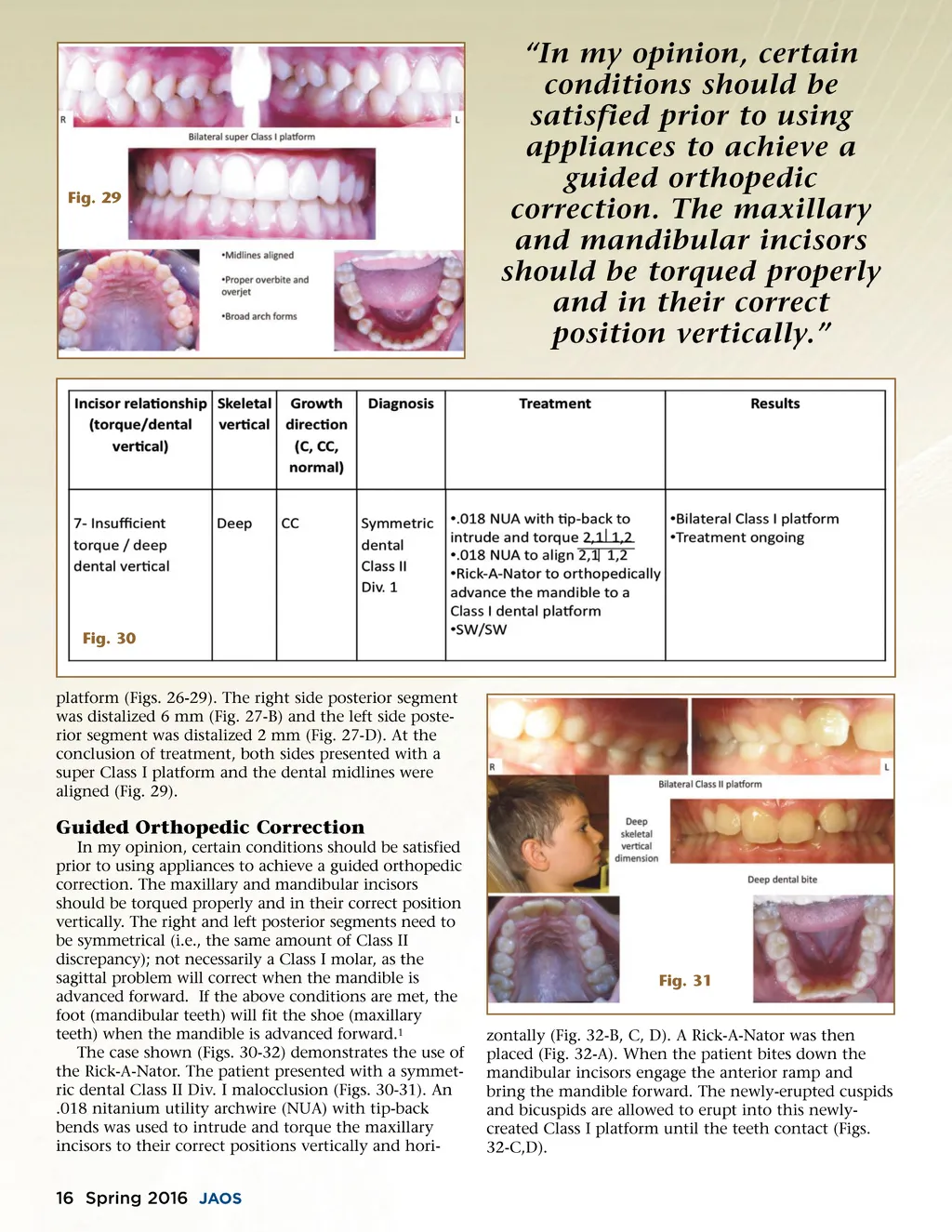
Fig. 29 “In my opinion, certain conditions should be satisfied prior to using appliances to achieve a guided orthopedic correction. The maxillary and mandibular incisors should be torqued properly and in their correct position vertically.” Fig. 30 platform (Figs. 26-29). The right side posterior segment was distalized 6 mm (Fig. 27-B) and the left side poste-rior segment was distalized 2 mm (Fig. 27-D). At the conclusion of treatment, both sides presented with a super Class I platform and the dental midlines were aligned (Fig. 29). Guided Orthopedic Correction In my opinion, certain conditions should be satisfied prior to using appliances to achieve a guided orthopedic correction. The maxillary and mandibular incisors should be torqued properly and in their correct position vertically. The right and left posterior segments need to be symmetrical (i.e., the same amount of Class II discrepancy); not necessarily a Class I molar, as the sagittal problem will correct when the mandible is advanced forward. If the above conditions are met, the foot (mandibular teeth) will fit the shoe (maxillary teeth) when the mandible is advanced forward. 1 The case shown (Figs. 30-32) demonstrates the use of the Rick-A-Nator. The patient presented with a symmet-ric dental Class II Div. I malocclusion (Figs. 30-31). An .018 nitanium utility archwire (NUA) with tip-back bends was used to intrude and torque the maxillary incisors to their correct positions vertically and hori-Fig. 31 zontally (Fig. 32-B, C, D). A Rick-A-Nator was then placed (Fig. 32-A). When the patient bites down the mandibular incisors engage the anterior ramp and bring the mandible forward. The newly-erupted cuspids and bicuspids are allowed to erupt into this newly-created Class I platform until the teeth contact (Figs. 32-C,D). 16 Spring 2016 JAOS
Journal of the American Orthodontic Society Spring 2016: Page 16