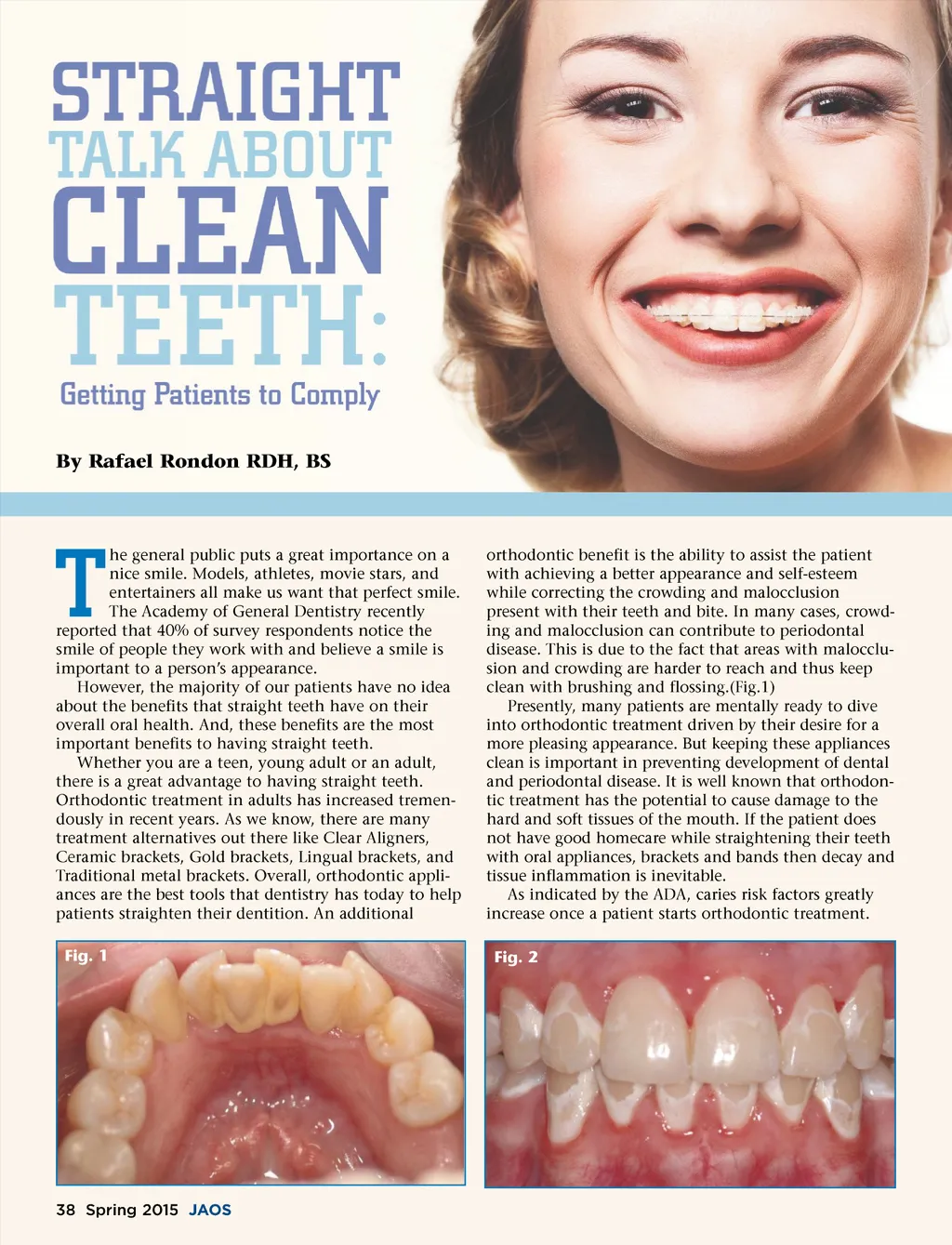
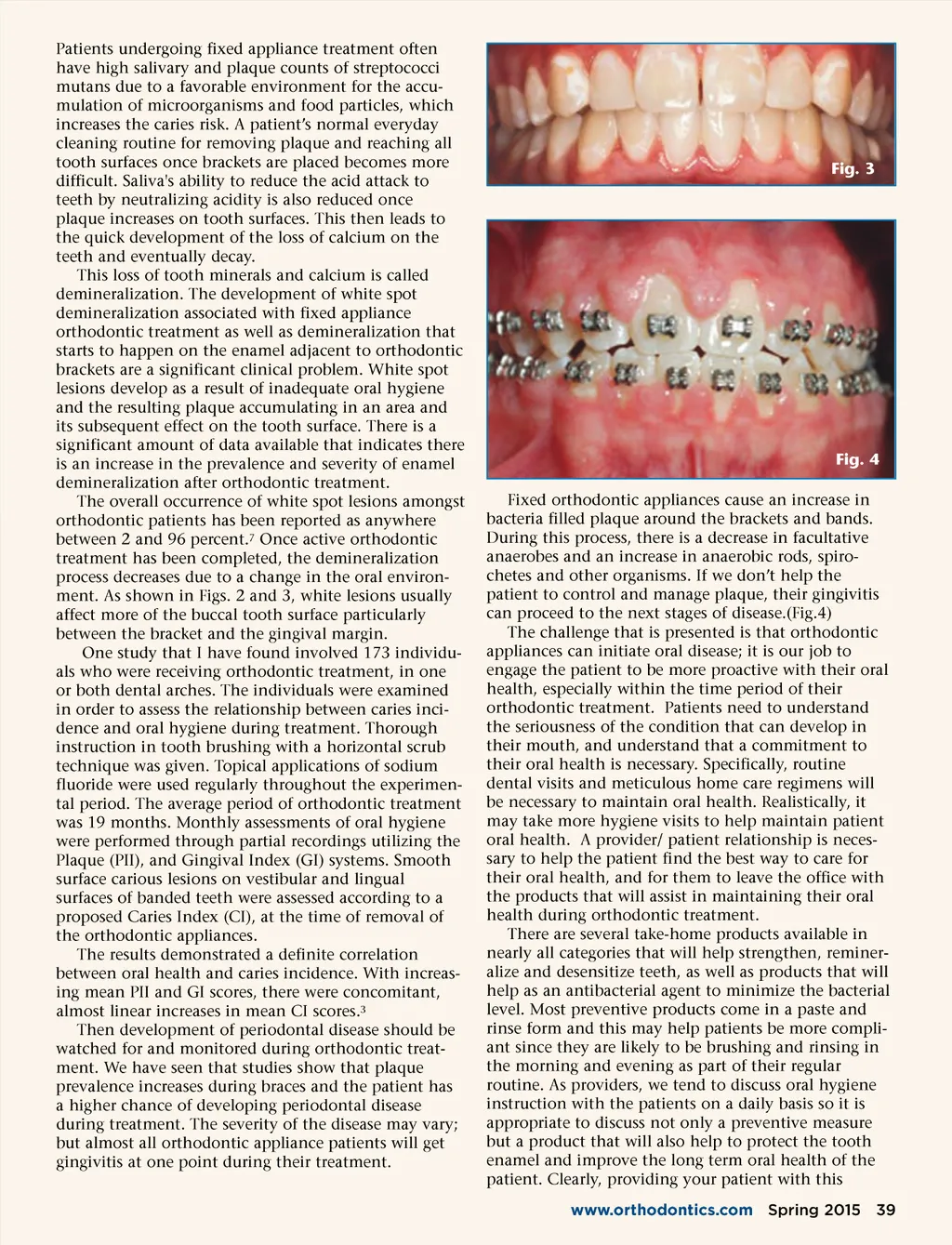
By Rafael Rondon RDH, BS he general public puts a great importance on a nice smile. Models, athletes, movie stars, and entertainers all make us want that perfect smile. The Academy of General Dentistry recently reported that 40% of survey respondents notice the smile of people they work with and believe a smile is important to a person’s appearance. However, the majority of our patients have no idea about the benefits that straight teeth have on their overall oral health. And, these benefits are the most important benefits to having straight teeth. Whether you are a teen, young adult or an adult, there is a great advantage to having straight teeth. Orthodontic treatment in adults has increased tremen-dously in recent years. As we know, there are many treatment alternatives out there like Clear Aligners, Ceramic brackets, Gold brackets, Lingual brackets, and Traditional metal brackets. Overall, orthodontic appli-ances are the best tools that dentistry has today to help patients straighten their dentition. An additional T orthodontic benefit is the ability to assist the patient with achieving a better appearance and self-esteem while correcting the crowding and malocclusion present with their teeth and bite. In many cases, crowd-ing and malocclusion can contribute to periodontal disease. This is due to the fact that areas with malocclu-sion and crowding are harder to reach and thus keep clean with brushing and flossing.(Fig.1) Presently, many patients are mentally ready to dive into orthodontic treatment driven by their desire for a more pleasing appearance. But keeping these appliances clean is important in preventing development of dental and periodontal disease. It is well known that orthodon-tic treatment has the potential to cause damage to the hard and soft tissues of the mouth. If the patient does not have good homecare while straightening their teeth with oral appliances, brackets and bands then decay and tissue inflammation is inevitable. As indicated by the ADA, caries risk factors greatly increase once a patient starts orthodontic treatment. Fig. 2 Fig. 1 38 Spring 2015 JAOS
Journal of the American Orthodontic Society Spring 2015: Page 38