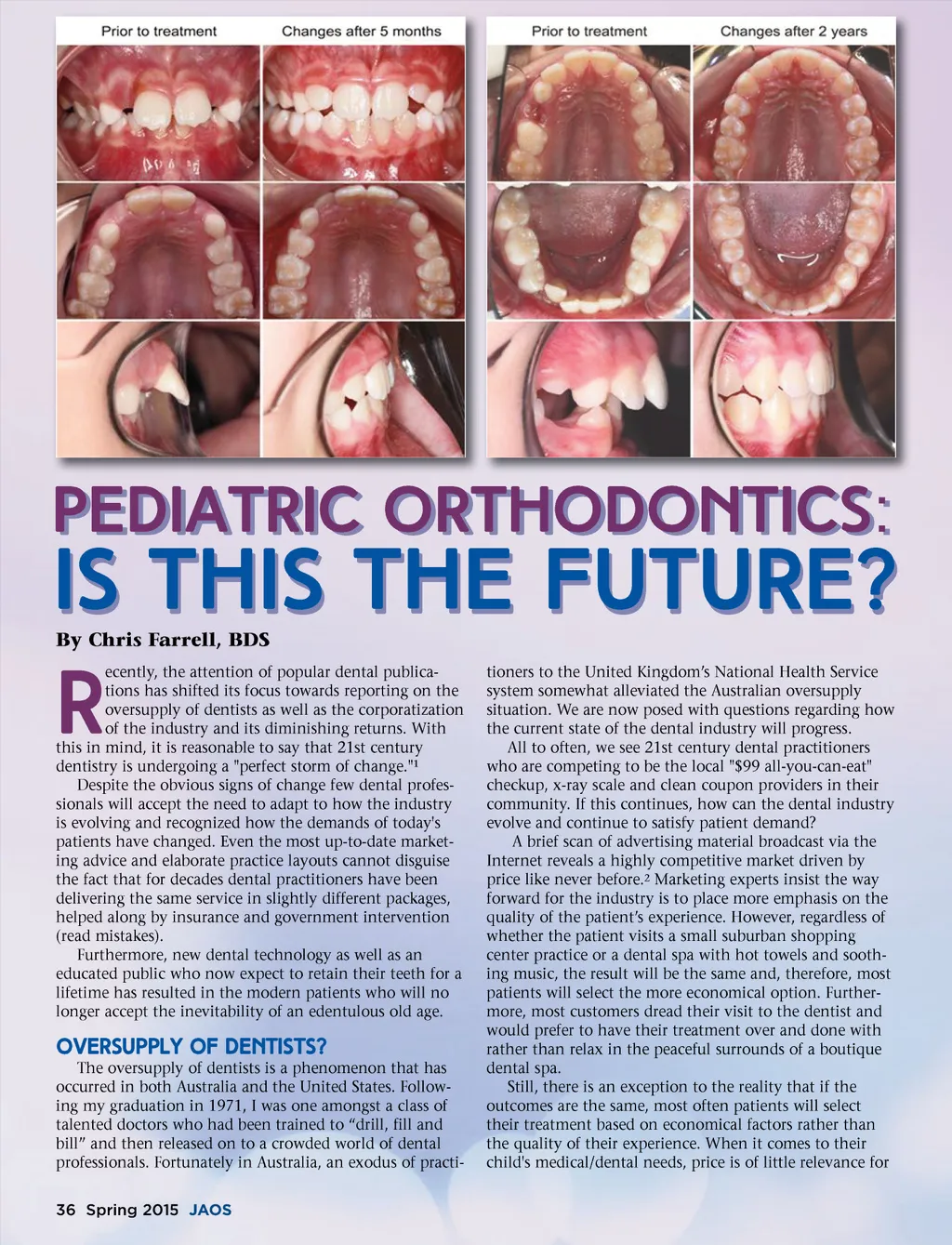
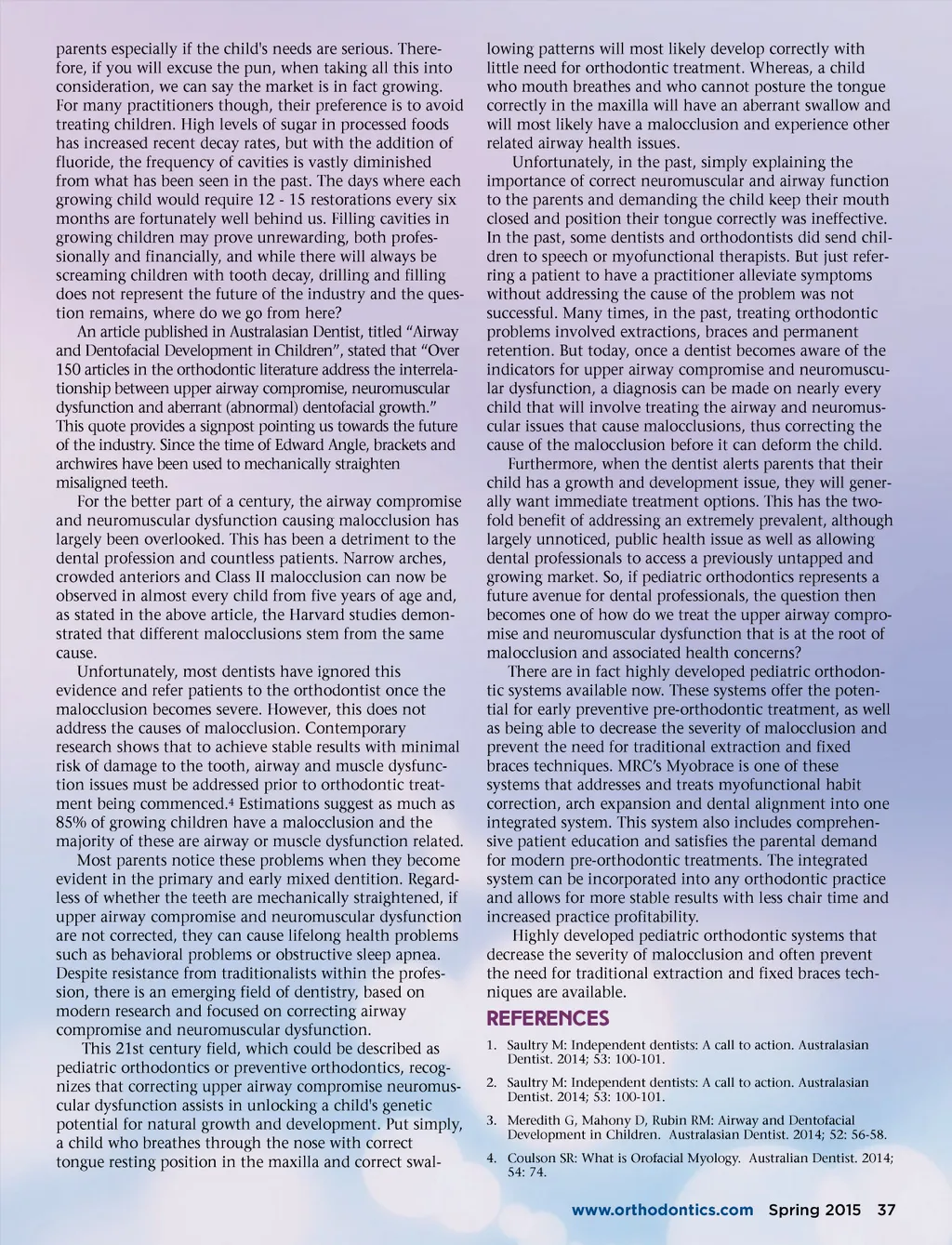
parents especially if the child's needs are serious. There-fore, if you will excuse the pun, when taking all this into consideration, we can say the market is in fact growing. For many practitioners though, their preference is to avoid treating children. High levels of sugar in processed foods has increased recent decay rates, but with the addition of fluoride, the frequency of cavities is vastly diminished from what has been seen in the past. The days where each growing child would require 12 -15 restorations every six months are fortunately well behind us. Filling cavities in growing children may prove unrewarding, both profes-sionally and financially, and while there will always be screaming children with tooth decay, drilling and filling does not represent the future of the industry and the ques-tion remains, where do we go from here? An article published in Australasian Dentist, titled “Airway and Dentofacial Development in Children”, stated that “Over 150 articles in the orthodontic literature address the interrela-tionship between upper airway compromise, neuromuscular dysfunction and aberrant (abnormal) dentofacial growth.” This quote provides a signpost pointing us towards the future of the industry. Since the time of Edward Angle, brackets and archwires have been used to mechanically straighten misaligned teeth. For the better part of a century, the airway compromise and neuromuscular dysfunction causing malocclusion has largely been overlooked. This has been a detriment to the dental profession and countless patients. Narrow arches, crowded anteriors and Class II malocclusion can now be observed in almost every child from five years of age and, as stated in the above article, the Harvard studies demon-strated that different malocclusions stem from the same cause. Unfortunately, most dentists have ignored this evidence and refer patients to the orthodontist once the malocclusion becomes severe. However, this does not address the causes of malocclusion. Contemporary research shows that to achieve stable results with minimal risk of damage to the tooth, airway and muscle dysfunc-tion issues must be addressed prior to orthodontic treat-ment being commenced. 4 Estimations suggest as much as 85% of growing children have a malocclusion and the majority of these are airway or muscle dysfunction related. Most parents notice these problems when they become evident in the primary and early mixed dentition. Regard-less of whether the teeth are mechanically straightened, if upper airway compromise and neuromuscular dysfunction are not corrected, they can cause lifelong health problems such as behavioral problems or obstructive sleep apnea. Despite resistance from traditionalists within the profes-sion, there is an emerging field of dentistry, based on modern research and focused on correcting airway compromise and neuromuscular dysfunction. This 21st century field, which could be described as pediatric orthodontics or preventive orthodontics, recog-nizes that correcting upper airway compromise neuromus-cular dysfunction assists in unlocking a child's genetic potential for natural growth and development. Put simply, a child who breathes through the nose with correct tongue resting position in the maxilla and correct swal-lowing patterns will most likely develop correctly with little need for orthodontic treatment. Whereas, a child who mouth breathes and who cannot posture the tongue correctly in the maxilla will have an aberrant swallow and will most likely have a malocclusion and experience other related airway health issues. Unfortunately, in the past, simply explaining the importance of correct neuromuscular and airway function to the parents and demanding the child keep their mouth closed and position their tongue correctly was ineffective. In the past, some dentists and orthodontists did send chil-dren to speech or myofunctional therapists. But just refer-ring a patient to have a practitioner alleviate symptoms without addressing the cause of the problem was not successful. Many times, in the past, treating orthodontic problems involved extractions, braces and permanent retention. But today, once a dentist becomes aware of the indicators for upper airway compromise and neuromuscu-lar dysfunction, a diagnosis can be made on nearly every child that will involve treating the airway and neuromus-cular issues that cause malocclusions, thus correcting the cause of the malocclusion before it can deform the child. Furthermore, when the dentist alerts parents that their child has a growth and development issue, they will gener-ally want immediate treatment options. This has the two-fold benefit of addressing an extremely prevalent, although largely unnoticed, public health issue as well as allowing dental professionals to access a previously untapped and growing market. So, if pediatric orthodontics represents a future avenue for dental professionals, the question then becomes one of how do we treat the upper airway compro-mise and neuromuscular dysfunction that is at the root of malocclusion and associated health concerns? There are in fact highly developed pediatric orthodon-tic systems available now. These systems offer the poten-tial for early preventive pre-orthodontic treatment, as well as being able to decrease the severity of malocclusion and prevent the need for traditional extraction and fixed braces techniques. MRC’s Myobrace is one of these systems that addresses and treats myofunctional habit correction, arch expansion and dental alignment into one integrated system. This system also includes comprehen-sive patient education and satisfies the parental demand for modern pre-orthodontic treatments. The integrated system can be incorporated into any orthodontic practice and allows for more stable results with less chair time and increased practice profitability. Highly developed pediatric orthodontic systems that decrease the severity of malocclusion and often prevent the need for traditional extraction and fixed braces tech-niques are available. R eferences 1. Saultry M: Independent dentists: A call to action. Australasian Dentist. 2014; 53: 100-101. 2. Saultry M: Independent dentists: A call to action. Australasian Dentist. 2014; 53: 100-101. 3. Meredith G, Mahony D, Rubin RM: Airway and Dentofacial Development in Children. Australasian Dentist. 2014; 52: 56-58. 4. Coulson SR: What is Orofacial Myology. Australian Dentist. 2014; 54: 74. www.orthodontics.com Spring 2015 37
Journal of the American Orthodontic Society Spring 2015: Page 37