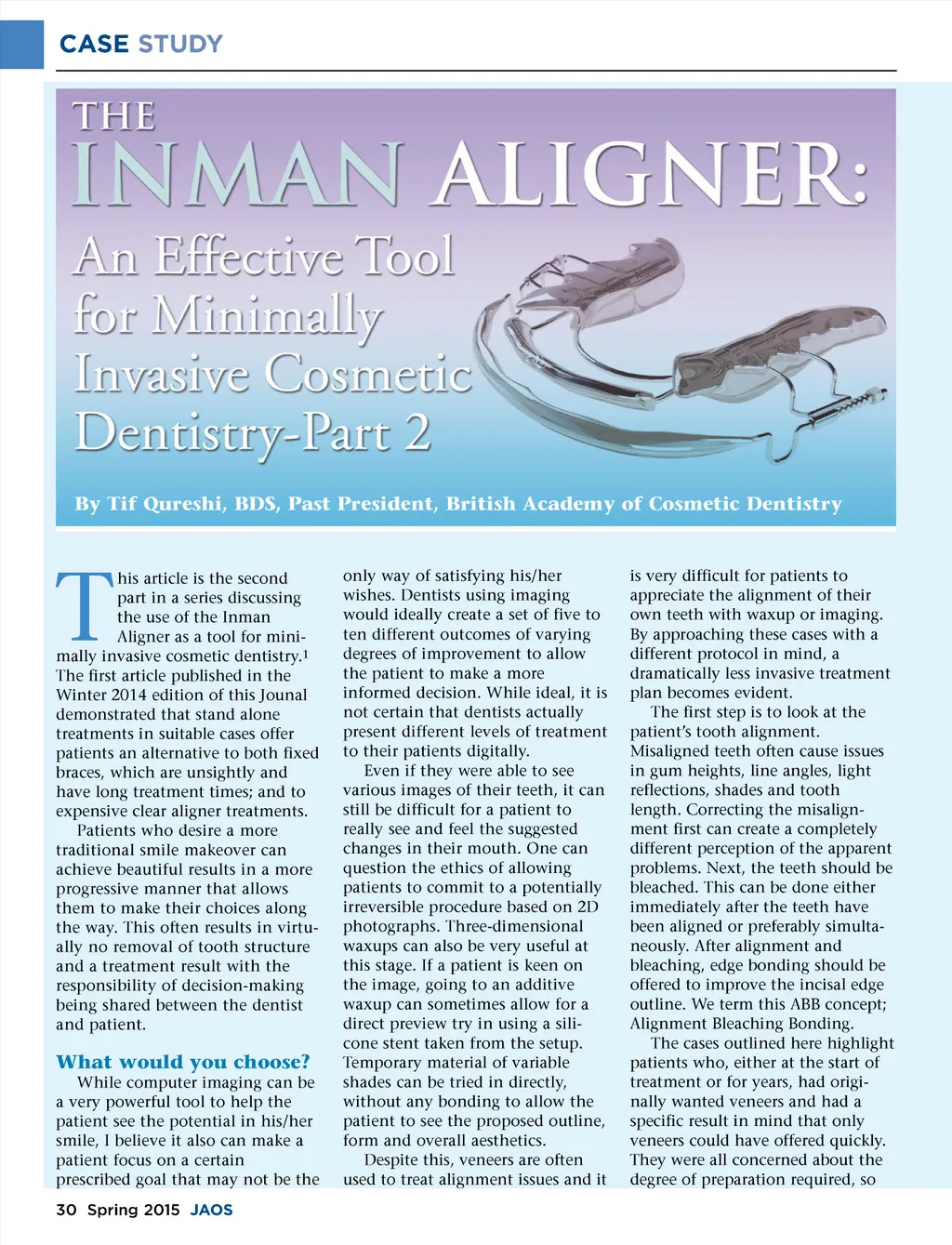
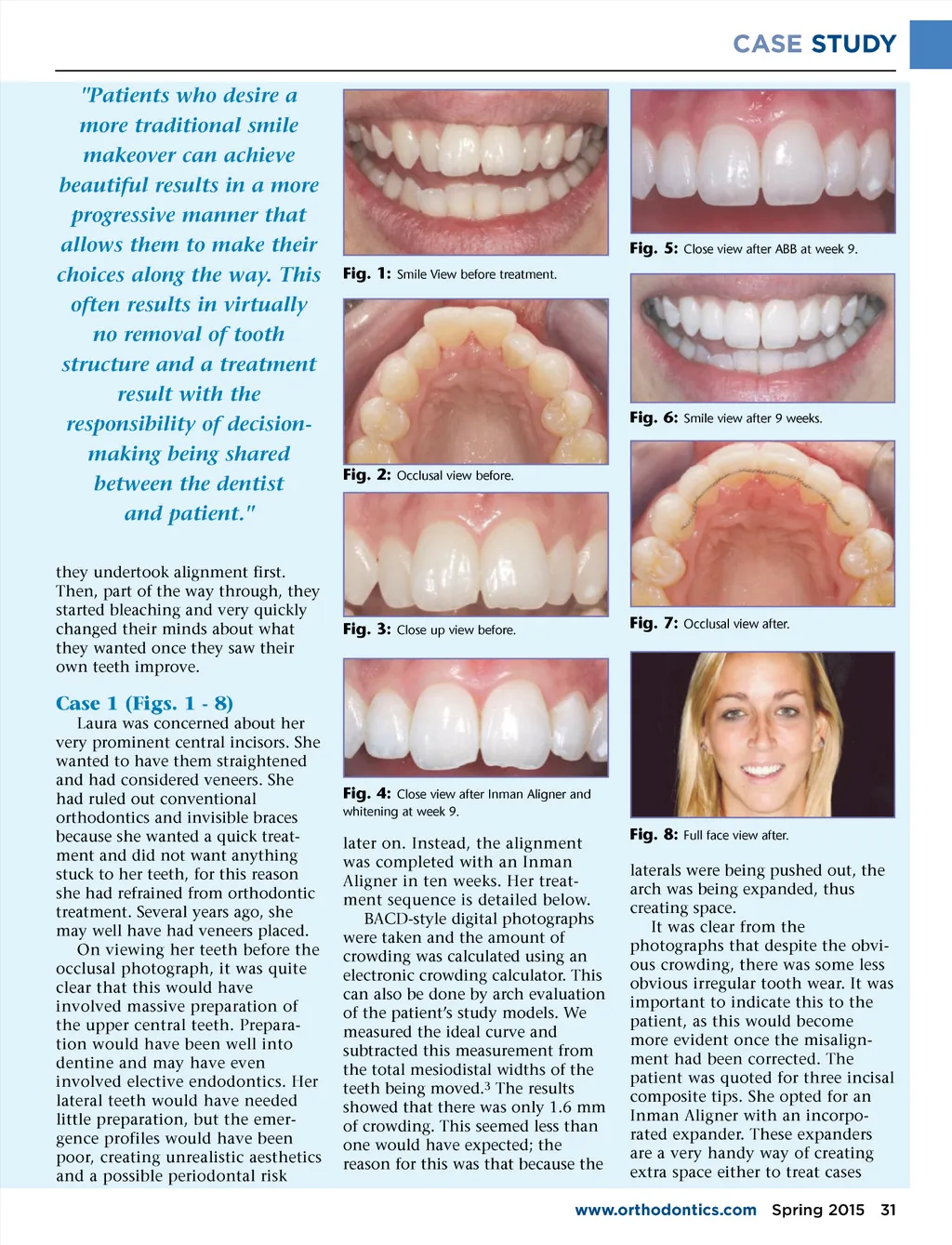
CASE STUDY By Tif Qureshi, BDS, Past President, British Academy of Cosmetic Dentistry T his article is the second part in a series discussing the use of the Inman Aligner as a tool for mini-mally invasive cosmetic dentistry. 1 The first article published in the Winter 2014 edition of this Jounal demonstrated that stand alone treatments in suitable cases offer patients an alternative to both fixed braces, which are unsightly and have long treatment times; and to expensive clear aligner treatments. Patients who desire a more traditional smile makeover can achieve beautiful results in a more progressive manner that allows them to make their choices along the way. This often results in virtu-ally no removal of tooth structure and a treatment result with the responsibility of decision-making being shared between the dentist and patient. What would you choose? While computer imaging can be a very powerful tool to help the patient see the potential in his/her smile, I believe it also can make a patient focus on a certain prescribed goal that may not be the 30 Spring 2015 JAOS only way of satisfying his/her wishes. Dentists using imaging would ideally create a set of five to ten different outcomes of varying degrees of improvement to allow the patient to make a more informed decision. While ideal, it is not certain that dentists actually present different levels of treatment to their patients digitally. Even if they were able to see various images of their teeth, it can still be difficult for a patient to really see and feel the suggested changes in their mouth. One can question the ethics of allowing patients to commit to a potentially irreversible procedure based on 2D photographs. Three-dimensional waxups can also be very useful at this stage. If a patient is keen on the image, going to an additive waxup can sometimes allow for a direct preview try in using a sili-cone stent taken from the setup. Temporary material of variable shades can be tried in directly, without any bonding to allow the patient to see the proposed outline, form and overall aesthetics. Despite this, veneers are often used to treat alignment issues and it is very difficult for patients to appreciate the alignment of their own teeth with waxup or imaging. By approaching these cases with a different protocol in mind, a dramatically less invasive treatment plan becomes evident. The first step is to look at the patient’s tooth alignment. Misaligned teeth often cause issues in gum heights, line angles, light reflections, shades and tooth length. Correcting the misalign-ment first can create a completely different perception of the apparent problems. Next, the teeth should be bleached. This can be done either immediately after the teeth have been aligned or preferably simulta-neously. After alignment and bleaching, edge bonding should be offered to improve the incisal edge outline. We term this ABB concept; Alignment Bleaching Bonding. The cases outlined here highlight patients who, either at the start of treatment or for years, had origi-nally wanted veneers and had a specific result in mind that only veneers could have offered quickly. They were all concerned about the degree of preparation required, so
Journal of the American Orthodontic Society Spring 2015: Page 30