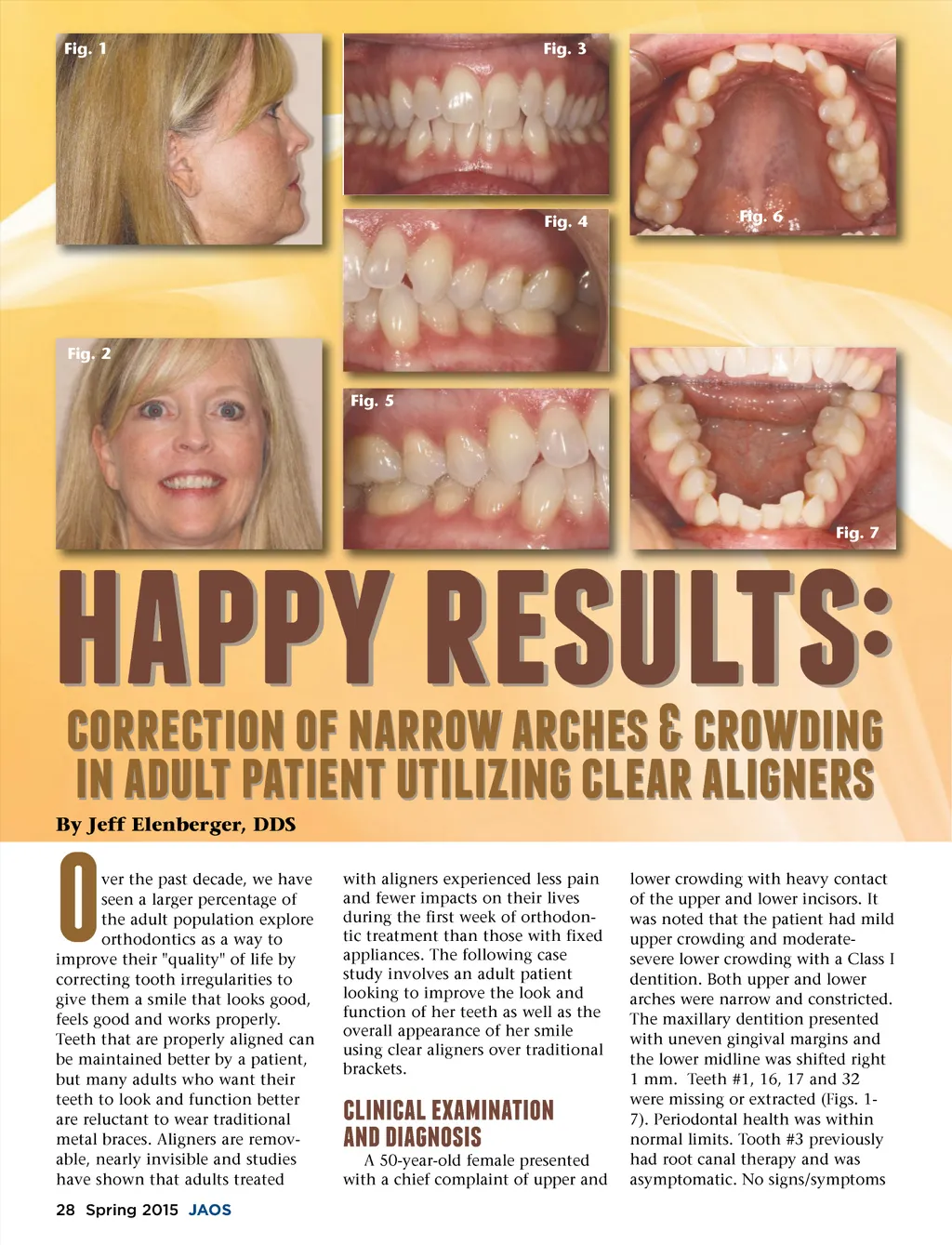
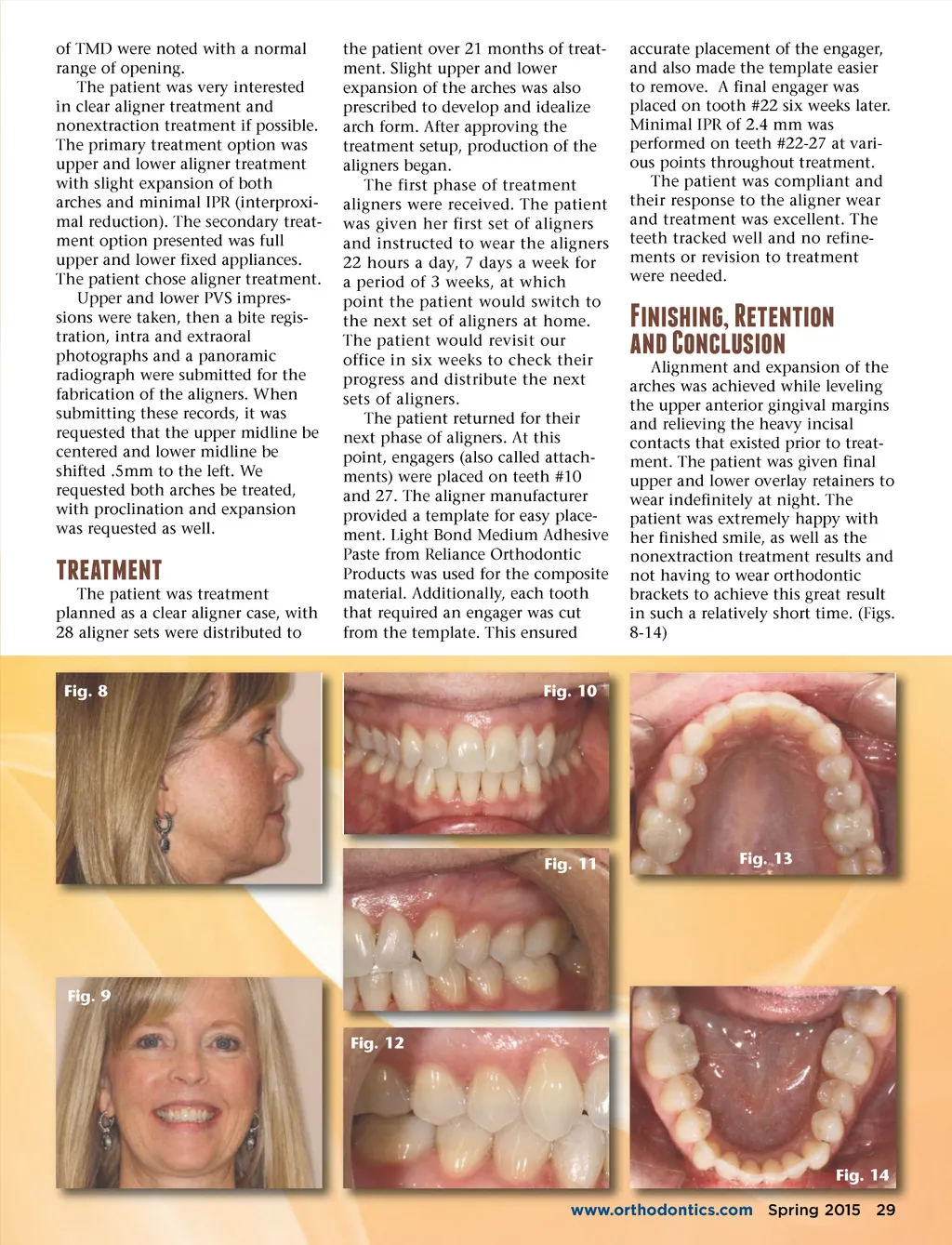
of TMD were noted with a normal range of opening. The patient was very interested in clear aligner treatment and nonextraction treatment if possible. The primary treatment option was upper and lower aligner treatment with slight expansion of both arches and minimal IPR (interproxi-mal reduction). The secondary treat-ment option presented was full upper and lower fixed appliances. The patient chose aligner treatment. Upper and lower PVS impres-sions were taken, then a bite regis-tration, intra and extraoral photographs and a panoramic radiograph were submitted for the fabrication of the aligners. When submitting these records, it was requested that the upper midline be centered and lower midline be shifted .5mm to the left. We requested both arches be treated, with proclination and expansion was requested as well. a; b;d; The patient was treatment planned as a clear aligner case, with 28 aligner sets were distributed to the patient over 21 months of treat-ment. Slight upper and lower expansion of the arches was also prescribed to develop and idealize arch form. After approving the treatment setup, production of the aligners began. The first phase of treatment aligners were received. The patient was given her first set of aligners and instructed to wear the aligners 22 hours a day, 7 days a week for a period of 3 weeks, at which point the patient would switch to the next set of aligners at home. The patient would revisit our office in six weeks to check their progress and distribute the next sets of aligners. The patient returned for their next phase of aligners. At this point, engagers (also called attach-ments) were placed on teeth #10 and 27. The aligner manufacturer provided a template for easy place-ment. Light Bond Medium Adhesive Paste from Reliance Orthodontic Products was used for the composite material. Additionally, each tooth that required an engager was cut from the template. This ensured accurate placement of the engager, and also made the template easier to remove. A final engager was placed on tooth #22 six weeks later. Minimal IPR of 2.4 mm was performed on teeth #22-27 at vari-ous points throughout treatment. The patient was compliant and their response to the aligner wear and treatment was excellent. The teeth tracked well and no refine-ments or revision to treatment were needed. Alignment and expansion of the arches was achieved while leveling the upper anterior gingival margins and relieving the heavy incisal contacts that existed prior to treat-ment. The patient was given final upper and lower overlay retainers to wear indefinitely at night. The patient was extremely happy with her finished smile, as well as the nonextraction treatment results and not having to wear orthodontic brackets to achieve this great result in such a relatively short time. (Figs. 8-14) c;b;c; �e;c;b;d;b;c;b; a;b; d;b; c;b; Fig. 8 Fig. 10 Fig. 11 Fig. 13 Fig. 9 Fig. 12 Fig. 14 www.orthodontics.com Spring 2015 29
Journal of the American Orthodontic Society Spring 2015: Page 29