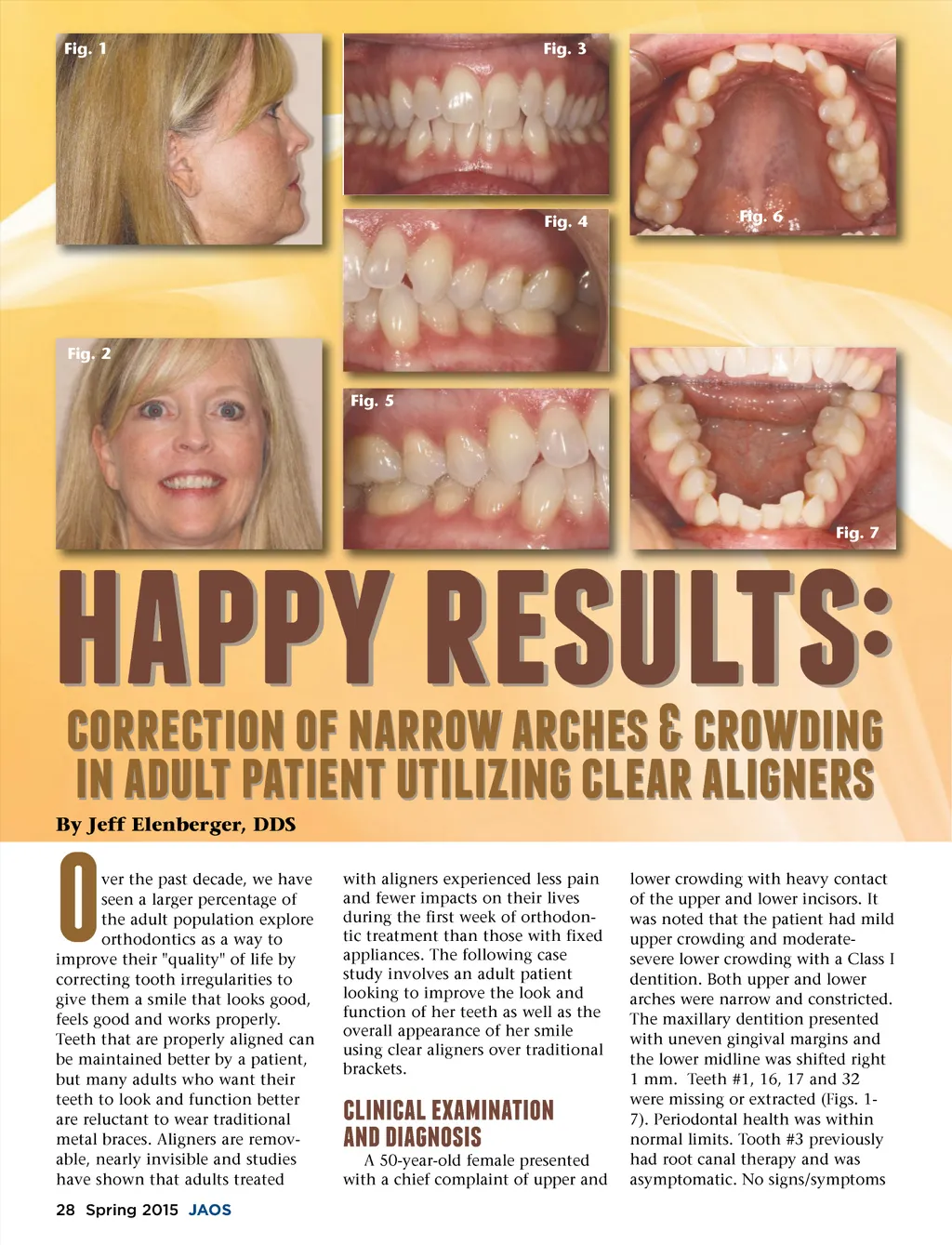
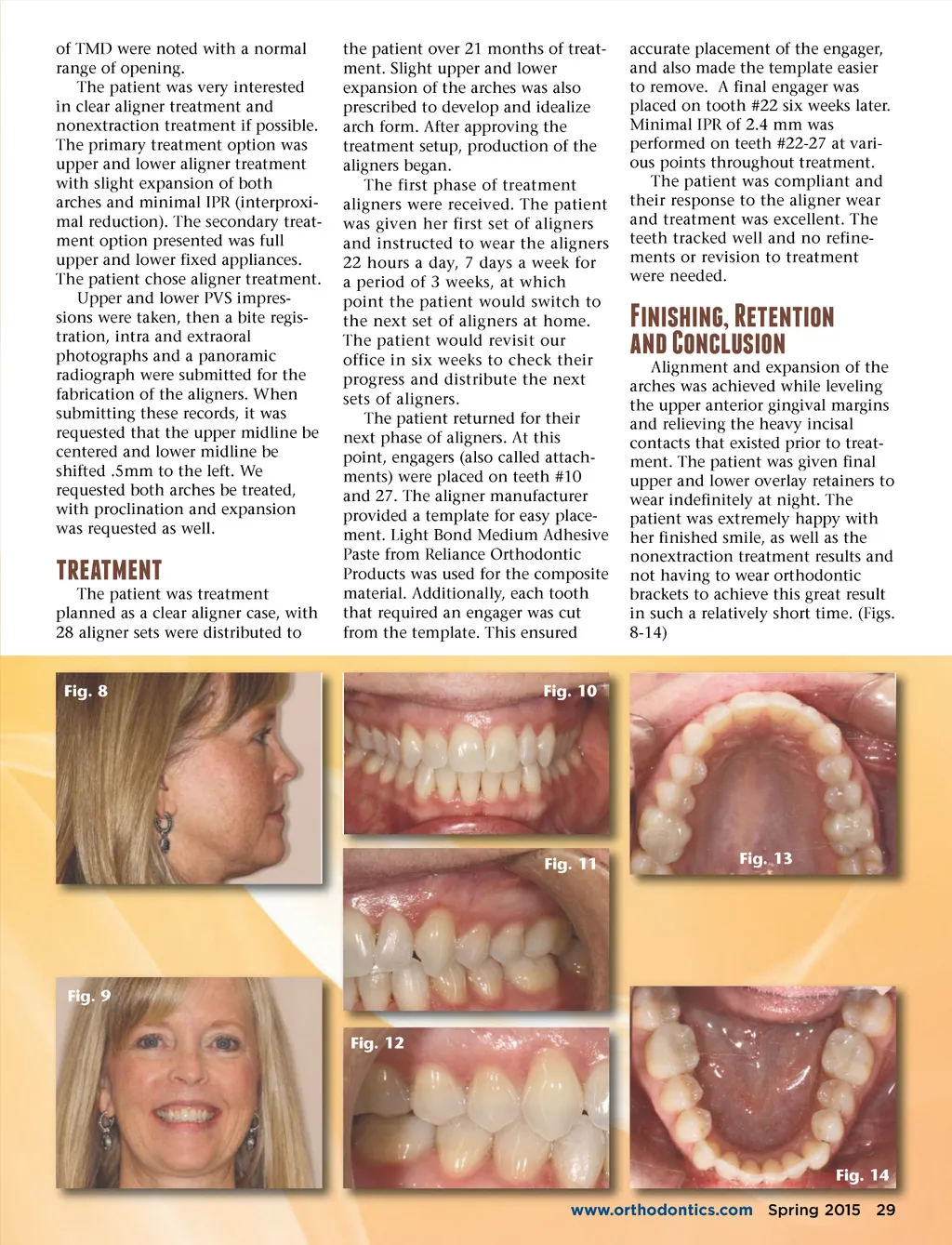
Fig. 1 Fig. 3 Fig. 4 Fig. 6 Fig. 2 Fig. 5 �e;a;�f;�f;d;  �c; c;b;d;�a;d;b;a;�d;d;a;�e; d;�b;d;�d; c;b; c;b;d;a; d;�f;a;c;b;d;c;c;c;b;d;a;d;a;c;b; with aligners experienced less pain and fewer impacts on their lives during the first week of orthodon-tic treatment than those with fixed appliances. The following case study involves an adult patient looking to improve the look and function of her teeth as well as the overall appearance of her smile using clear aligners over traditional brackets. Fig. 7 By Jeff Elenberger, DDS ver the past decade, we have seen a larger percentage of the adult population explore orthodontics as a way to improve their "quality" of life by correcting tooth irregularities to give them a smile that looks good, feels good and works properly. Teeth that are properly aligned can be maintained better by a patient, but many adults who want their teeth to look and function better are reluctant to wear traditional metal braces. Aligners are remov-able, nearly invisible and studies have shown that adults treated 28 Spring 2015 JAOS  A 50-year-old female presented with a chief complaint of upper and c;b;c;a;d;a; c;b;a;c;b; a;b; d; c;a;b; c; lower crowding with heavy contact of the upper and lower incisors. It was noted that the patient had mild upper crowding and moderate-severe lower crowding with a Class I dentition. Both upper and lower arches were narrow and constricted. The maxillary dentition presented with uneven gingival margins and the lower midline was shifted right 1 mm. Teeth #1, 16, 17 and 32 were missing or extracted (Figs. 1-7). Periodontal health was within normal limits. Tooth #3 previously had root canal therapy and was asymptomatic. No signs/symptoms
Journal of the American Orthodontic Society Spring 2015: Page 28