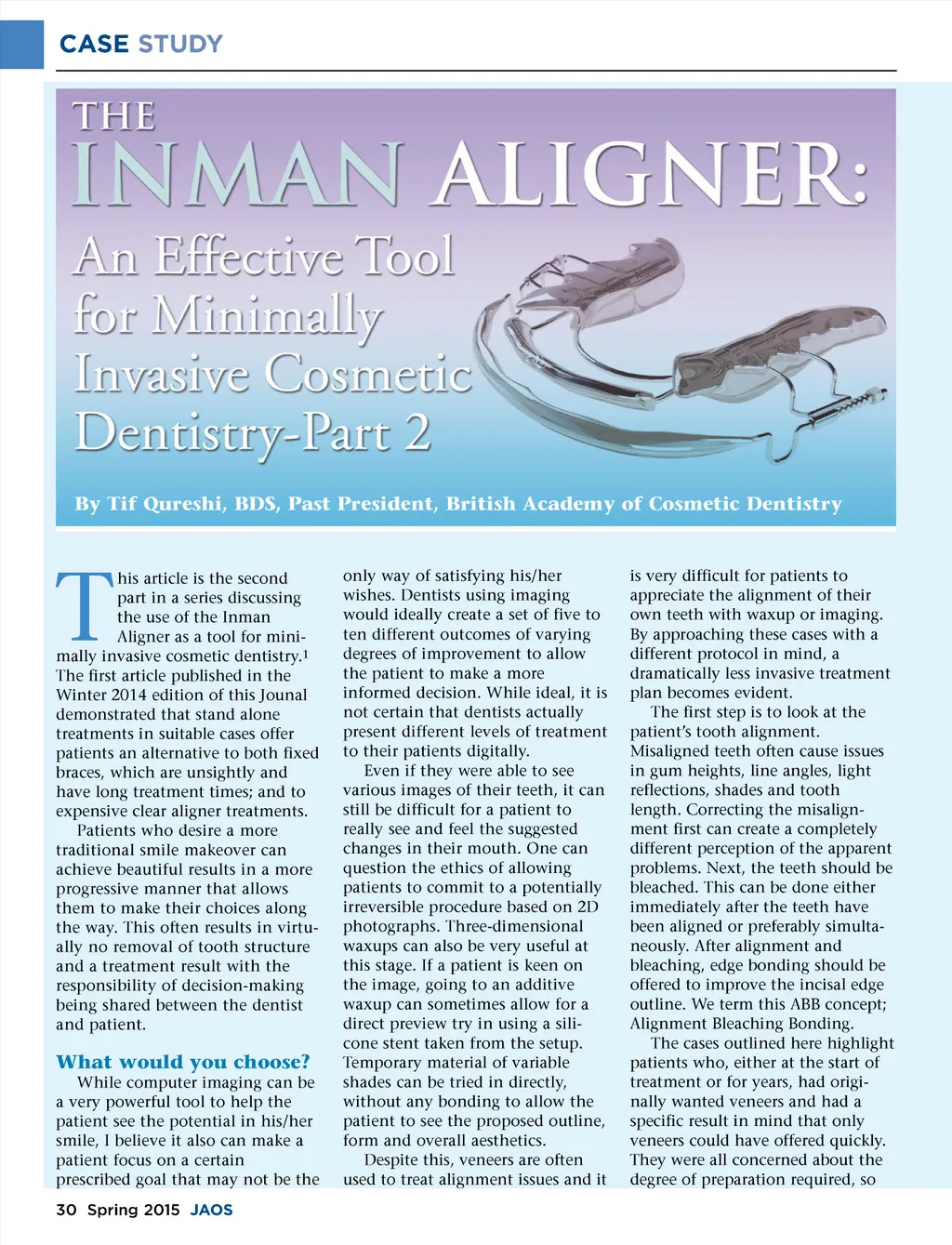
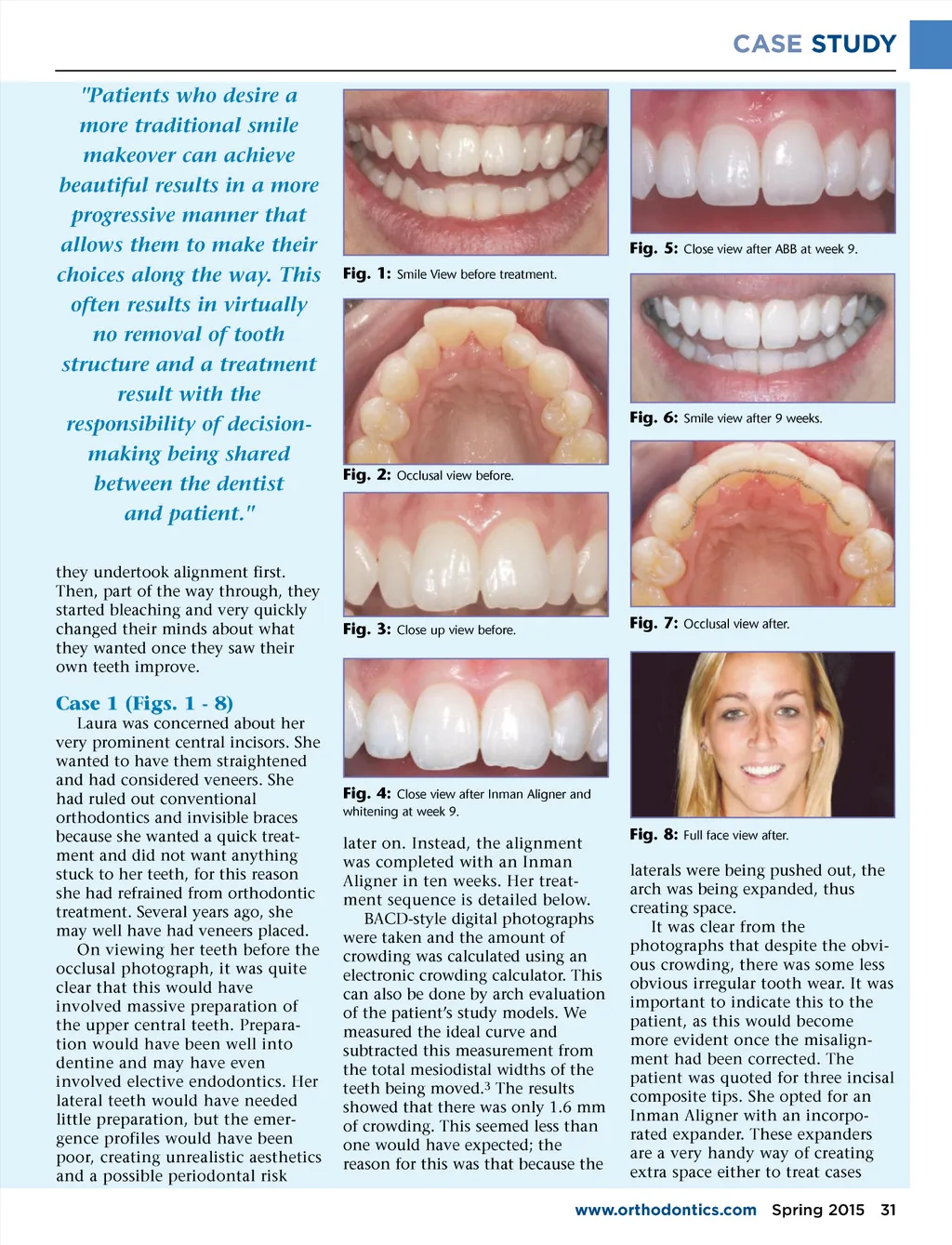
CASE STUDY "Patients who desire a more traditional smile makeover can achieve beautiful results in a more progressive manner that allows them to make their choices along the way. This often results in virtually no removal of tooth structure and a treatment result with the responsibility of decision-making being shared between the dentist and patient." they undertook alignment first. Then, part of the way through, they started bleaching and very quickly changed their minds about what they wanted once they saw their own teeth improve. Fig. 5: Close view after ABB at week 9. Fig. 1: Smile View before treatment. Fig. 6: Smile view after 9 weeks. Fig. 2: Occlusal view before. Fig. 3: Close up view before. Fig. 7: Occlusal view after. Case 1 (Figs. 1 -8) Laura was concerned about her very prominent central incisors. She wanted to have them straightened and had considered veneers. She had ruled out conventional orthodontics and invisible braces because she wanted a quick treat-ment and did not want anything stuck to her teeth, for this reason she had refrained from orthodontic treatment. Several years ago, she may well have had veneers placed. On viewing her teeth before the occlusal photograph, it was quite clear that this would have involved massive preparation of the upper central teeth. Prepara-tion would have been well into dentine and may have even involved elective endodontics. Her lateral teeth would have needed little preparation, but the emer-gence profiles would have been poor, creating unrealistic aesthetics and a possible periodontal risk Fig. 4: Close view after Inman Aligner and whitening at week 9. later on. Instead, the alignment was completed with an Inman Aligner in ten weeks. Her treat-ment sequence is detailed below. BACD-style digital photographs were taken and the amount of crowding was calculated using an electronic crowding calculator. This can also be done by arch evaluation of the patient’s study models. We measured the ideal curve and subtracted this measurement from the total mesiodistal widths of the teeth being moved. 3 The results showed that there was only 1.6 mm of crowding. This seemed less than one would have expected; the reason for this was that because the Fig. 8: Full face view after. laterals were being pushed out, the arch was being expanded, thus creating space. It was clear from the photographs that despite the obvi-ous crowding, there was some less obvious irregular tooth wear. It was important to indicate this to the patient, as this would become more evident once the misalign-ment had been corrected. The patient was quoted for three incisal composite tips. She opted for an Inman Aligner with an incorpo-rated expander. These expanders are a very handy way of creating extra space either to treat cases www.orthodontics.com Spring 2015 31
Journal of the American Orthodontic Society Spring 2015: Page 31