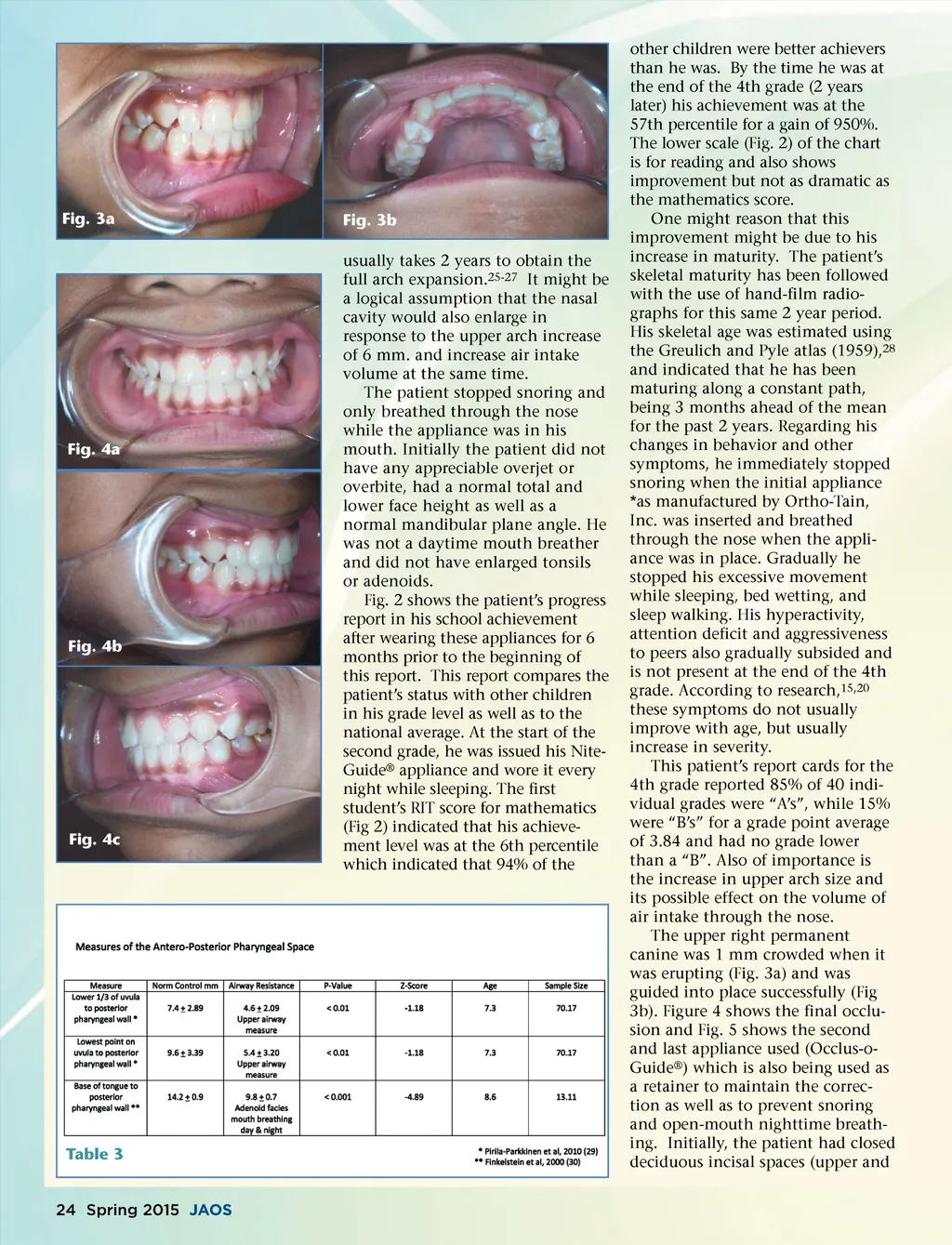
Fig. 7a Table 4 Fig. 5 Table 3. 29,30 Other meaningful cephalometric 31,32 and dental 32,33 measures are found in Table 4. A review of the cephalometric data between normal and those with breathing problems 9,30,34,35 is found in Table 5, while the dental measure of similar comparisons 36,11 are found in Table 6. The dental measures, however, have fairly low confidence levels with the excep-tion of Class II molars (P = < 0.004). 36 An example of a rather typical patient that is suspected of having a breathing problem (Fig. 7a) because of an excessive overjet and small mandible. The author (Miraglia) uses the lack of definition of the posterior portion of the mandibular plane, as a diagnostic symptom and can be seen in the initial profile. Fig. 6b Fig. 7b Fig. 8a lower) and now has an ideal occlu-sion with sufficient space for all of the teeth. Morphologic and Dental Symptoms in Analyzing for Sleep-Disordered Breathing Cephalometric measures of the pharyngeal spaces (Fig. 6) consist of 4 easily-traced dimensions 29 and their mean amounts are found in Fig. 6a Fig. 8b This patient is 10.7 years of age and is a habitual day and night mouth breather and snorer which may have contributed to the lack of forward growth of the mandible. An Occlus-o-Guide ® preformed appliance was issued to the patient and within a few months he converted to daytime and nighttime nose breathing. He wore the appli-ance for 1 to 3 hours daily for 20 months and then wore the same appliance as a retainer at night until he was 14.5 years of age. The final profile is seen in Fig. 7b. In a study by Keski-Nisula et al 37 www.orthodontics.com Spring 2015 25
Journal of the American Orthodontic Society Spring 2015: Page 25