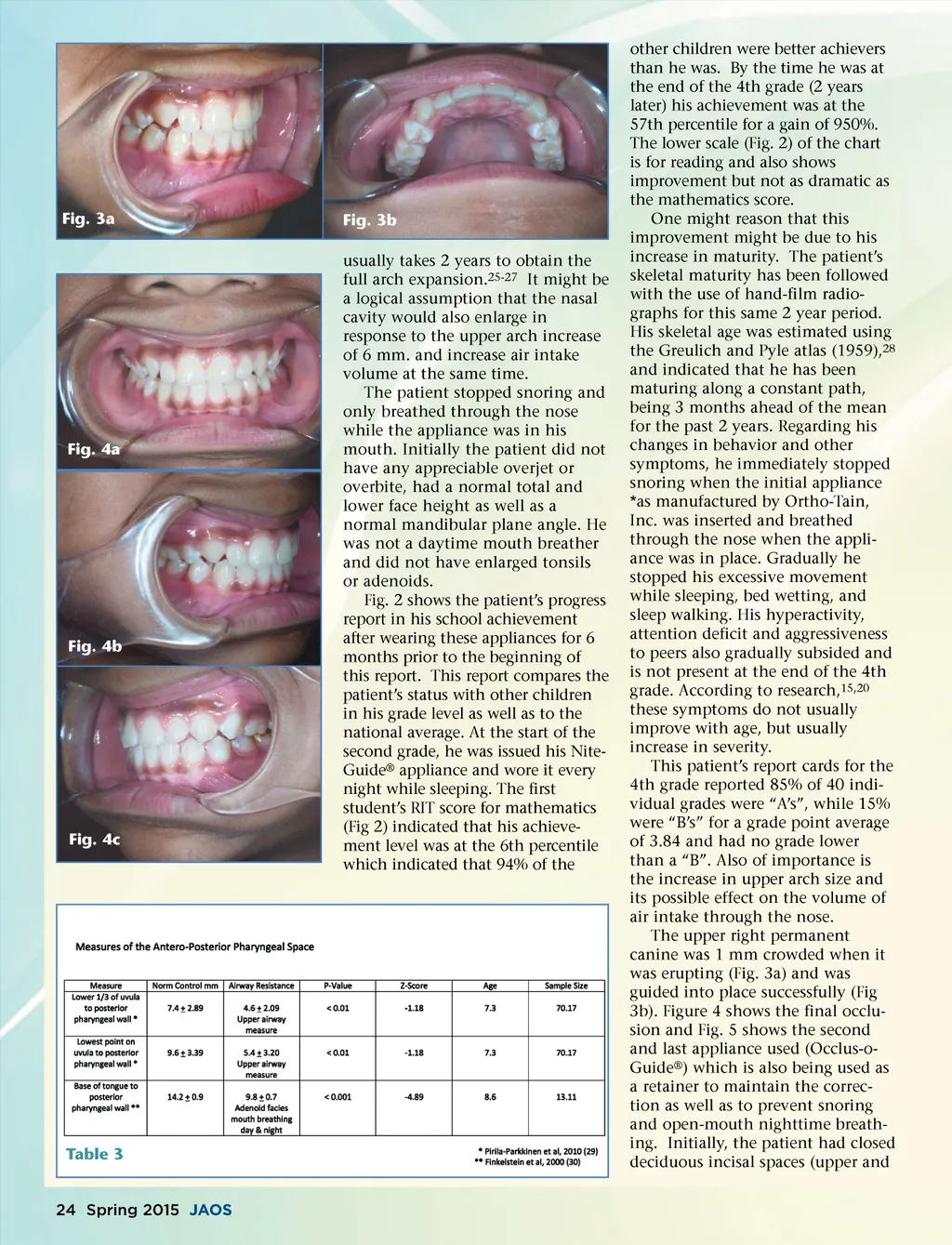
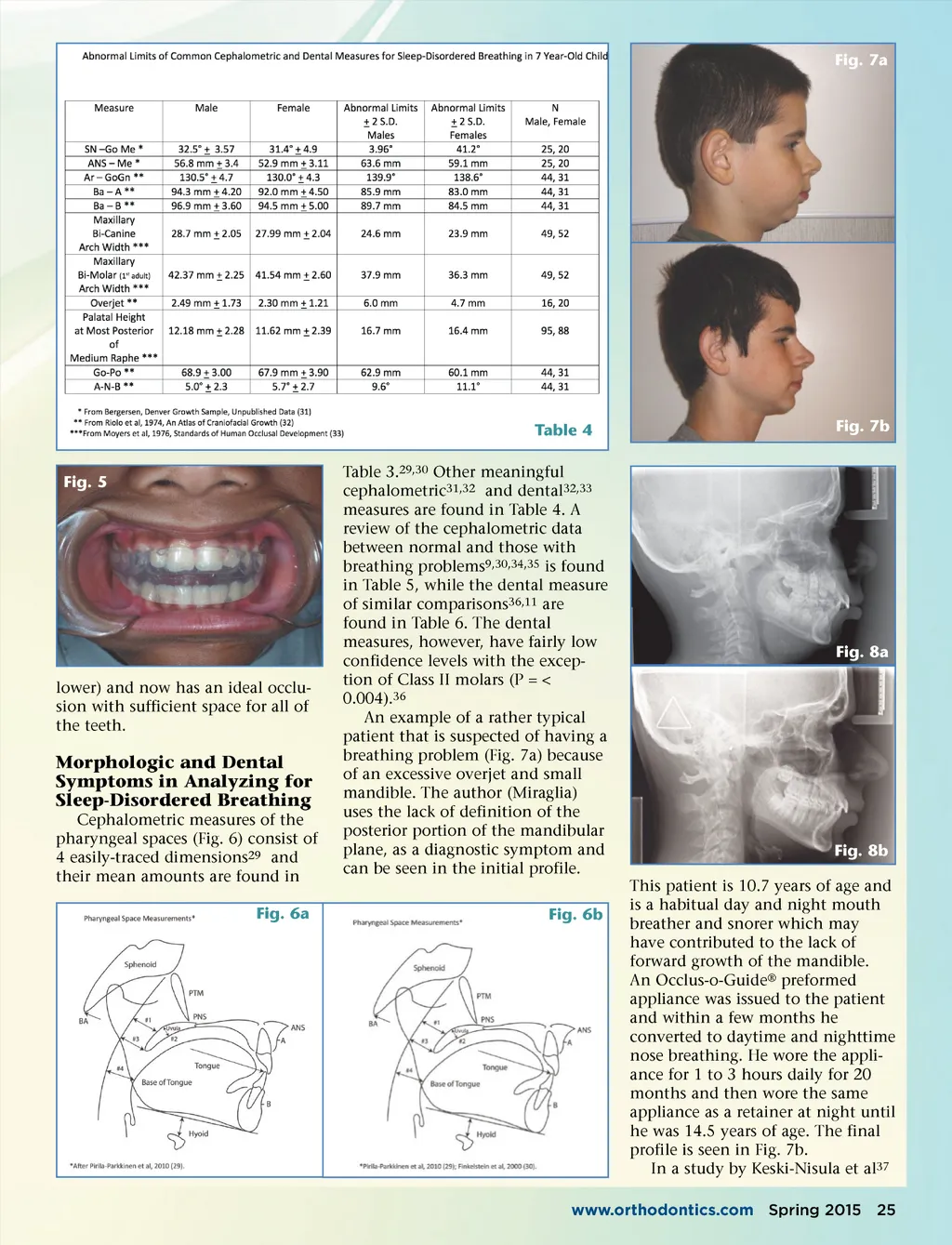
Fig. 3a Fig. 3b usually takes 2 years to obtain the full arch expansion. 25-27 It might be a logical assumption that the nasal cavity would also enlarge in response to the upper arch increase of 6 mm. and increase air intake volume at the same time. The patient stopped snoring and only breathed through the nose while the appliance was in his mouth. Initially the patient did not have any appreciable overjet or overbite, had a normal total and lower face height as well as a normal mandibular plane angle. He was not a daytime mouth breather and did not have enlarged tonsils or adenoids. Fig. 2 shows the patient’s progress report in his school achievement after wearing these appliances for 6 months prior to the beginning of this report. This report compares the patient’s status with other children in his grade level as well as to the national average. At the start of the second grade, he was issued his Nite-Guide ® appliance and wore it every night while sleeping. The first student’s RIT score for mathematics (Fig 2) indicated that his achieve-ment level was at the 6th percentile which indicated that 94% of the Fig. 4a Fig. 4b Fig. 4c Table 3 24 Spring 2015 JAOS other children were better achievers than he was. By the time he was at the end of the 4th grade (2 years later) his achievement was at the 57th percentile for a gain of 950%. The lower scale (Fig. 2) of the chart is for reading and also shows improvement but not as dramatic as the mathematics score. One might reason that this improvement might be due to his increase in maturity. The patient’s skeletal maturity has been followed with the use of hand-film radio-graphs for this same 2 year period. His skeletal age was estimated using the Greulich and Pyle atlas (1959), 28 and indicated that he has been maturing along a constant path, being 3 months ahead of the mean for the past 2 years. Regarding his changes in behavior and other symptoms, he immediately stopped snoring when the initial appliance *as manufactured by Ortho-Tain, Inc. was inserted and breathed through the nose when the appli-ance was in place. Gradually he stopped his excessive movement while sleeping, bed wetting, and sleep walking. His hyperactivity, attention deficit and aggressiveness to peers also gradually subsided and is not present at the end of the 4th grade. According to research, 15,20 these symptoms do not usually improve with age, but usually increase in severity. This patient’s report cards for the 4th grade reported 85% of 40 indi-vidual grades were “A’s”, while 15% were “B’s” for a grade point average of 3.84 and had no grade lower than a “B”. Also of importance is the increase in upper arch size and its possible effect on the volume of air intake through the nose. The upper right permanent canine was 1 mm crowded when it was erupting (Fig. 3a) and was guided into place successfully (Fig 3b). Figure 4 shows the final occlu-sion and Fig. 5 shows the second and last appliance used (Occlus-o-Guide ® ) which is also being used as a retainer to maintain the correc-tion as well as to prevent snoring and open-mouth nighttime breath-ing. Initially, the patient had closed deciduous incisal spaces (upper and
Journal of the American Orthodontic Society Spring 2015: Page 24