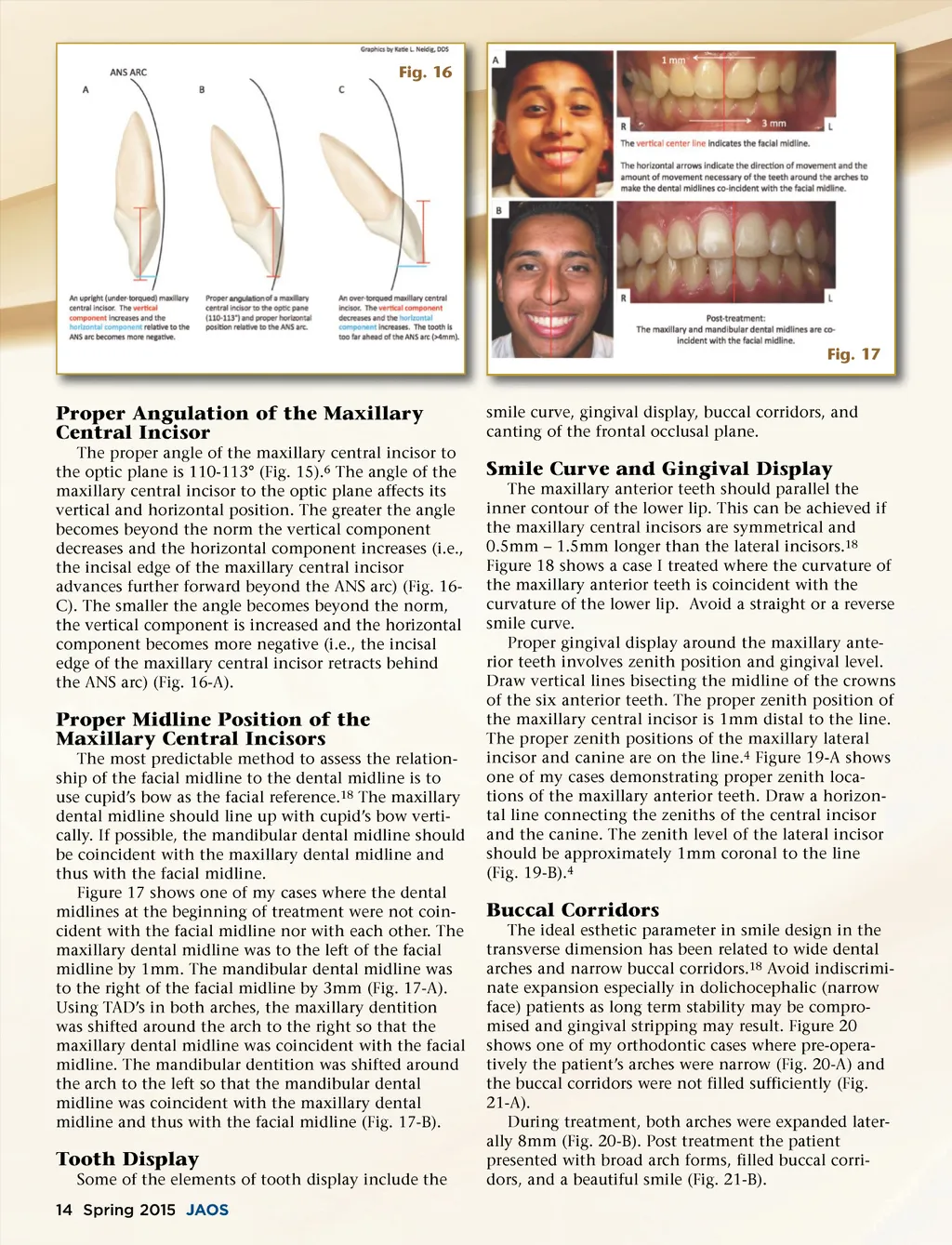
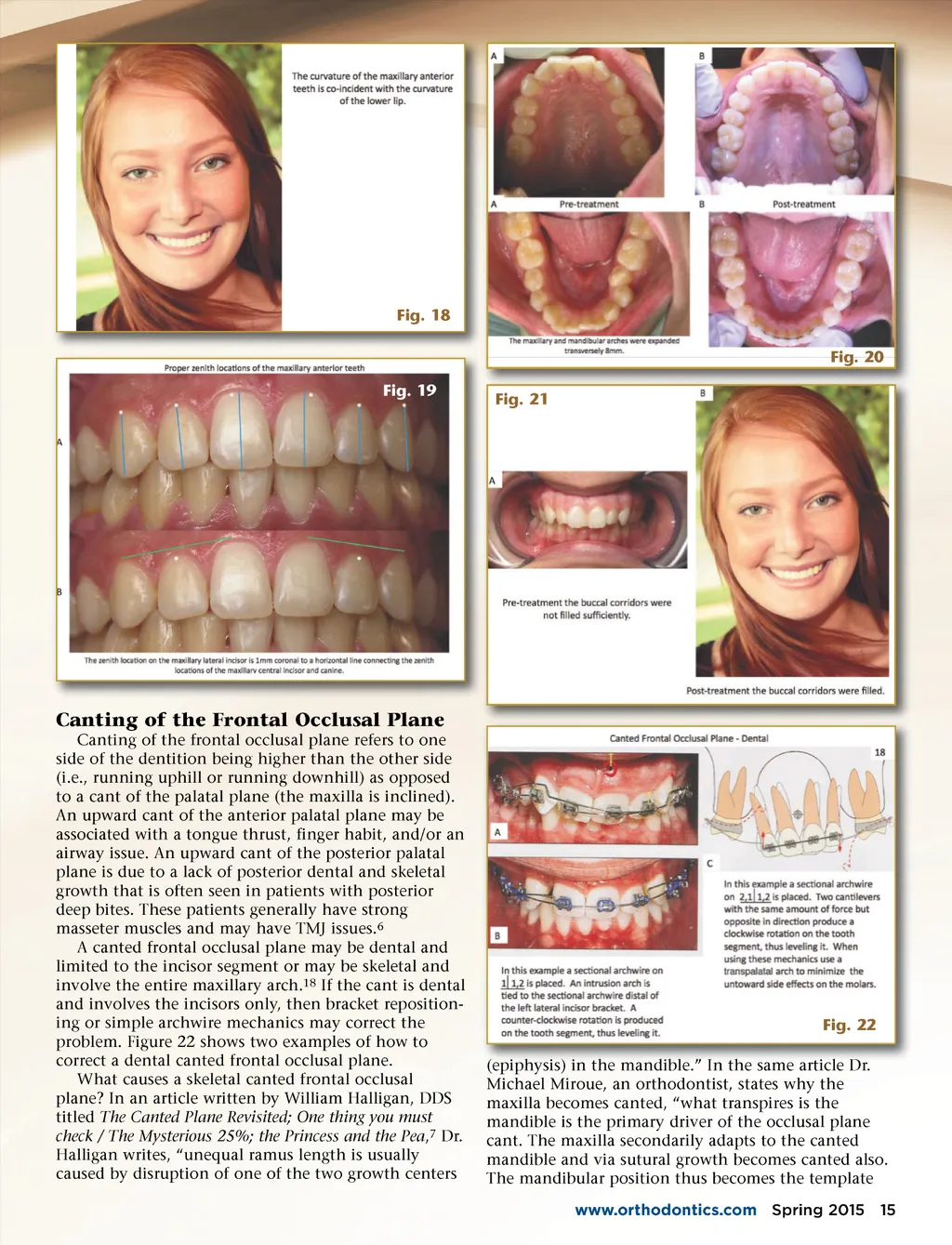
Fig. 16 Fig. 17 Proper Angulation of the Maxillary Central Incisor The proper angle of the maxillary central incisor to the optic plane is 110-113° (Fig. 15). 6 The angle of the maxillary central incisor to the optic plane affects its vertical and horizontal position. The greater the angle becomes beyond the norm the vertical component decreases and the horizontal component increases (i.e., the incisal edge of the maxillary central incisor advances further forward beyond the ANS arc) (Fig. 16-C). The smaller the angle becomes beyond the norm, the vertical component is increased and the horizontal component becomes more negative (i.e., the incisal edge of the maxillary central incisor retracts behind the ANS arc) (Fig. 16-A). smile curve, gingival display, buccal corridors, and canting of the frontal occlusal plane. Smile Curve and Gingival Display The maxillary anterior teeth should parallel the inner contour of the lower lip. This can be achieved if the maxillary central incisors are symmetrical and 0.5mm – 1.5mm longer than the lateral incisors. 18 Figure 18 shows a case I treated where the curvature of the maxillary anterior teeth is coincident with the curvature of the lower lip. Avoid a straight or a reverse smile curve. Proper gingival display around the maxillary ante-rior teeth involves zenith position and gingival level. Draw vertical lines bisecting the midline of the crowns of the six anterior teeth. The proper zenith position of the maxillary central incisor is 1mm distal to the line. The proper zenith positions of the maxillary lateral incisor and canine are on the line. 4 Figure 19-A shows one of my cases demonstrating proper zenith loca-tions of the maxillary anterior teeth. Draw a horizon-tal line connecting the zeniths of the central incisor and the canine. The zenith level of the lateral incisor should be approximately 1mm coronal to the line (Fig. 19-B). 4 Proper Midline Position of the Maxillary Central Incisors The most predictable method to assess the relation-ship of the facial midline to the dental midline is to use cupid’s bow as the facial reference. 18 The maxillary dental midline should line up with cupid’s bow verti-cally. If possible, the mandibular dental midline should be coincident with the maxillary dental midline and thus with the facial midline. Figure 17 shows one of my cases where the dental midlines at the beginning of treatment were not coin-cident with the facial midline nor with each other. The maxillary dental midline was to the left of the facial midline by 1mm. The mandibular dental midline was to the right of the facial midline by 3mm (Fig. 17-A). Using TAD’s in both arches, the maxillary dentition was shifted around the arch to the right so that the maxillary dental midline was coincident with the facial midline. The mandibular dentition was shifted around the arch to the left so that the mandibular dental midline was coincident with the maxillary dental midline and thus with the facial midline (Fig. 17-B). Buccal Corridors The ideal esthetic parameter in smile design in the transverse dimension has been related to wide dental arches and narrow buccal corridors. 18 Avoid indiscrimi-nate expansion especially in dolichocephalic (narrow face) patients as long term stability may be compro-mised and gingival stripping may result. Figure 20 shows one of my orthodontic cases where pre-opera-tively the patient’s arches were narrow (Fig. 20-A) and the buccal corridors were not filled sufficiently (Fig. 21-A). During treatment, both arches were expanded later-ally 8mm (Fig. 20-B). Post treatment the patient presented with broad arch forms, filled buccal corri-dors, and a beautiful smile (Fig. 21-B). Tooth Display Some of the elements of tooth display include the 14 Spring 2015 JAOS
Journal of the American Orthodontic Society Spring 2015: Page 14