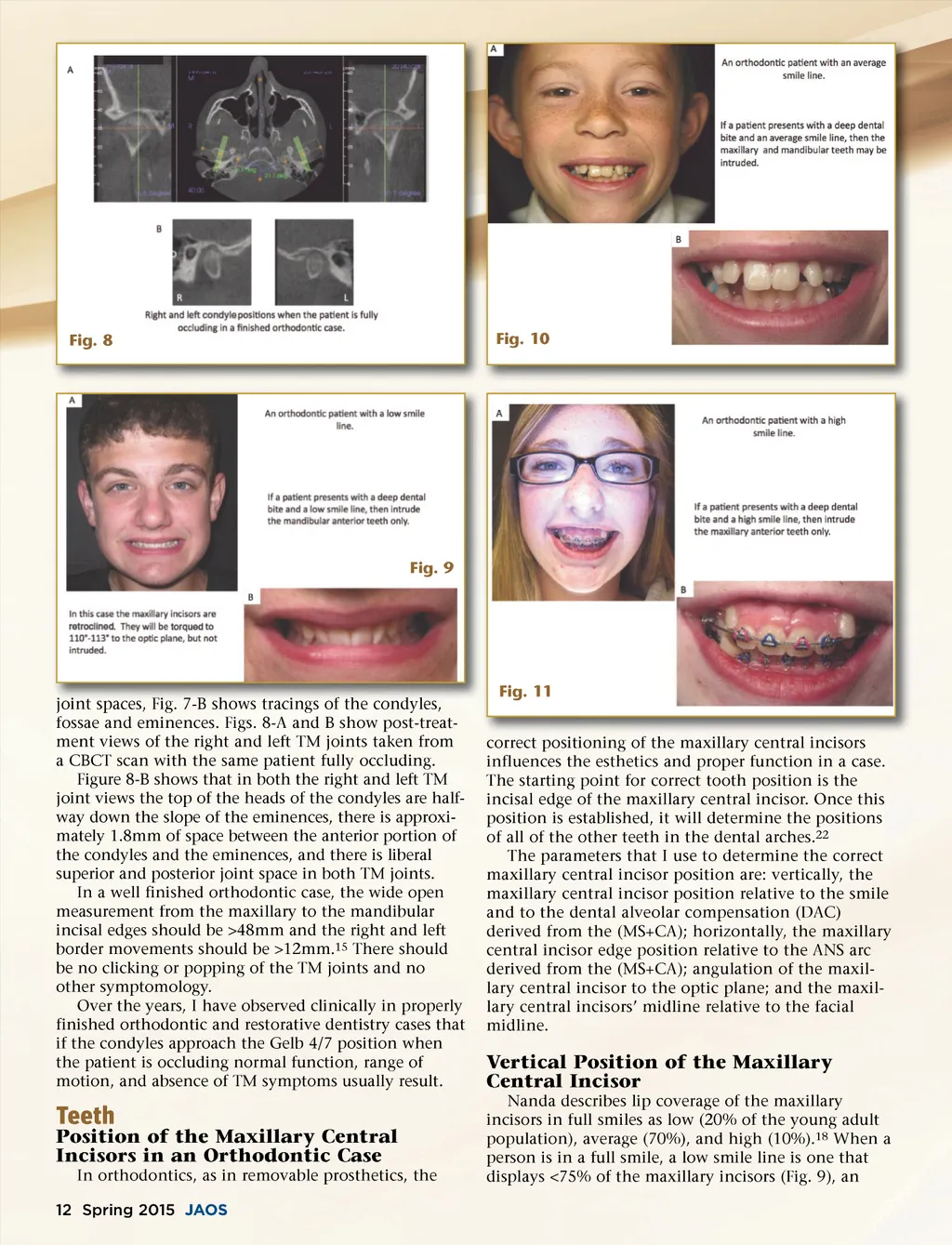
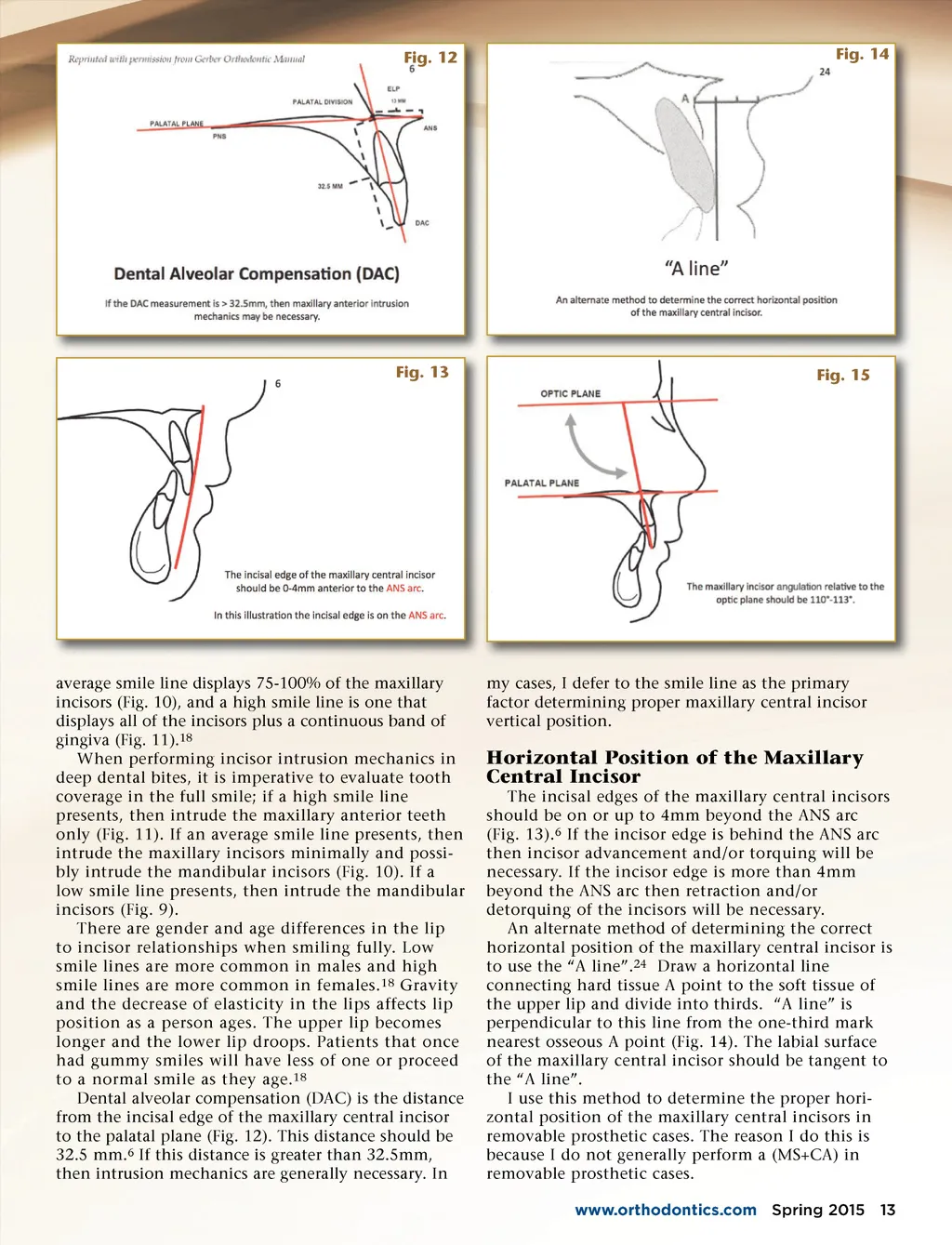
Fig. 12 Fig. 14 Fig. 13 Fig. 15 average smile line displays 75-100% of the maxillary incisors (Fig. 10), and a high smile line is one that displays all of the incisors plus a continuous band of gingiva (Fig. 11). 18 When performing incisor intrusion mechanics in deep dental bites, it is imperative to evaluate tooth coverage in the full smile; if a high smile line presents, then intrude the maxillary anterior teeth only (Fig. 11). If an average smile line presents, then intrude the maxillary incisors minimally and possi-bly intrude the mandibular incisors (Fig. 10). If a low smile line presents, then intrude the mandibular incisors (Fig. 9). There are gender and age differences in the lip to incisor relationships when smiling fully. Low smile lines are more common in males and high smile lines are more common in females. 18 Gravity and the decrease of elasticity in the lips affects lip position as a person ages. The upper lip becomes longer and the lower lip droops. Patients that once had gummy smiles will have less of one or proceed to a normal smile as they age. 18 Dental alveolar compensation (DAC) is the distance from the incisal edge of the maxillary central incisor to the palatal plane (Fig. 12). This distance should be 32.5 mm. 6 If this distance is greater than 32.5mm, then intrusion mechanics are generally necessary. In my cases, I defer to the smile line as the primary factor determining proper maxillary central incisor vertical position. Horizontal Position of the Maxillary Central Incisor The incisal edges of the maxillary central incisors should be on or up to 4mm beyond the ANS arc (Fig. 13). 6 If the incisor edge is behind the ANS arc then incisor advancement and/or torquing will be necessary. If the incisor edge is more than 4mm beyond the ANS arc then retraction and/or detorquing of the incisors will be necessary. An alternate method of determining the correct horizontal position of the maxillary central incisor is to use the “A line”. 24 Draw a horizontal line connecting hard tissue A point to the soft tissue of the upper lip and divide into thirds. “A line” is perpendicular to this line from the one-third mark nearest osseous A point (Fig. 14). The labial surface of the maxillary central incisor should be tangent to the “A line”. I use this method to determine the proper hori-zontal position of the maxillary central incisors in removable prosthetic cases. The reason I do this is because I do not generally perform a (MS+CA) in removable prosthetic cases. www.orthodontics.com Spring 2015 13
Journal of the American Orthodontic Society Spring 2015: Page 13