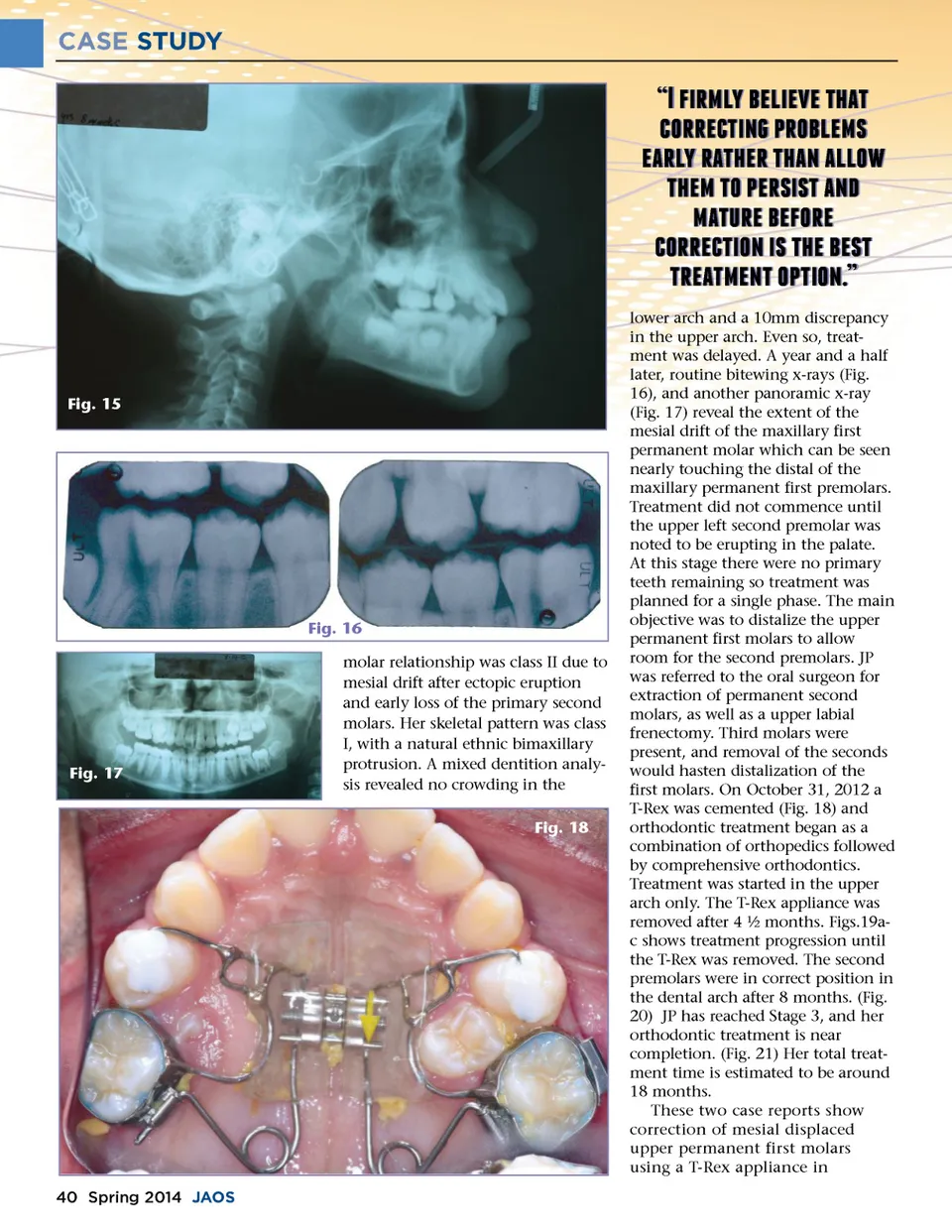
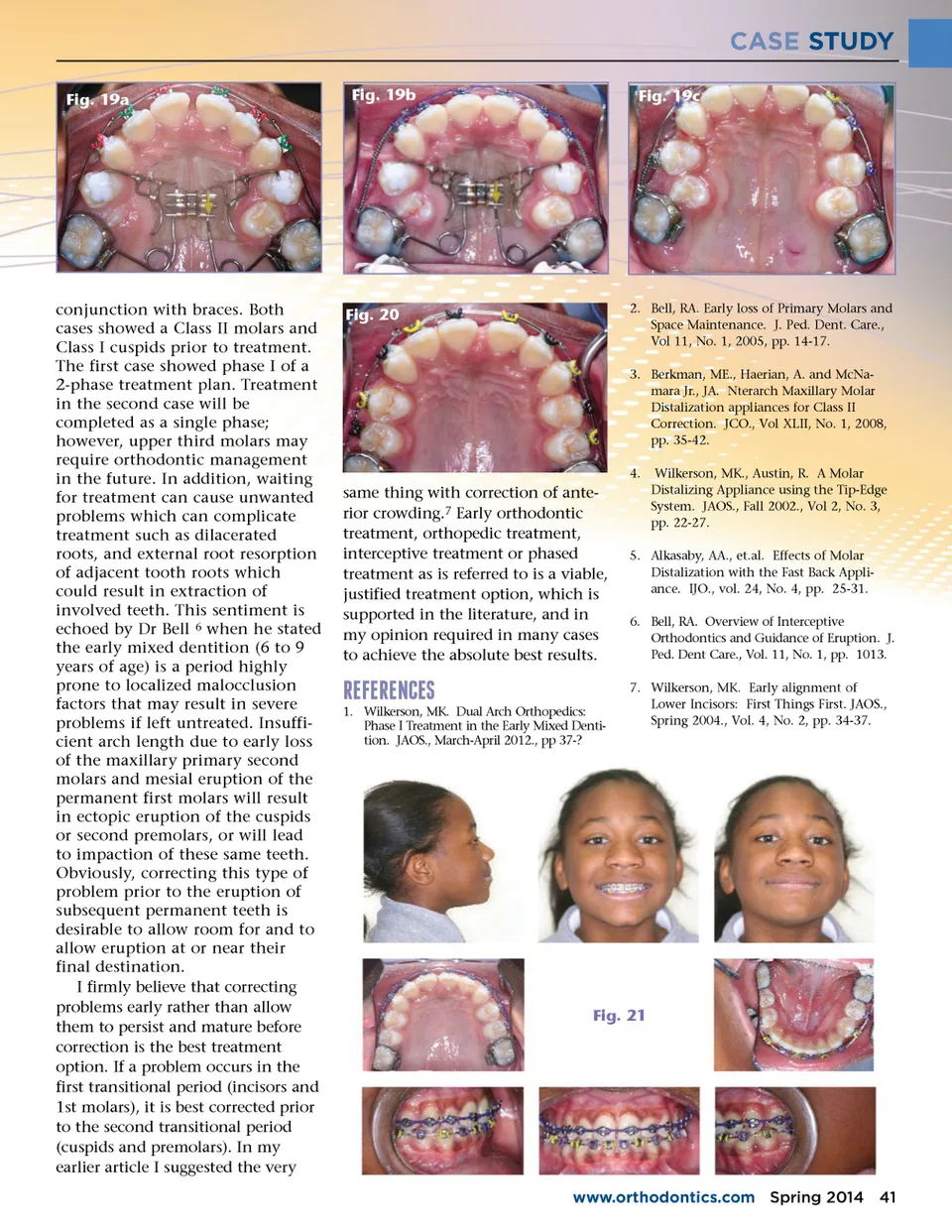
CASE STUDY Fig. 19a Fig. 19b Fig. 19c conjunction with braces. Both cases showed a Class II molars and Class I cuspids prior to treatment. The first case showed phase I of a 2-phase treatment plan. Treatment in the second case will be completed as a single phase; however, upper third molars may require orthodontic management in the future. In addition, waiting for treatment can cause unwanted problems which can complicate treatment such as dilacerated roots, and external root resorption of adjacent tooth roots which could result in extraction of involved teeth. This sentiment is echoed by Dr Bell 6 when he stated the early mixed dentition (6 to 9 years of age) is a period highly prone to localized malocclusion factors that may result in severe problems if left untreated. Insuffi-cient arch length due to early loss of the maxillary primary second molars and mesial eruption of the permanent first molars will result in ectopic eruption of the cuspids or second premolars, or will lead to impaction of these same teeth. Obviously, correcting this type of problem prior to the eruption of subsequent permanent teeth is desirable to allow room for and to allow eruption at or near their final destination. I firmly believe that correcting problems early rather than allow them to persist and mature before correction is the best treatment option. If a problem occurs in the first transitional period (incisors and 1st molars), it is best corrected prior to the second transitional period (cuspids and premolars). In my earlier article I suggested the very Fig. 20 2. Bell, RA. Early loss of Primary Molars and Space Maintenance. J. Ped. Dent. Care., Vol 11, No. 1, 2005, pp. 14-17. 3. Berkman, ME., Haerian, A. and McNa-mara Jr., JA. Nterarch Maxillary Molar Distalization appliances for Class II Correction. JCO., Vol XLII, No. 1, 2008, pp. 35-42. 4. Wilkerson, MK., Austin, R. A Molar Distalizing Appliance using the Tip-Edge System. JAOS., Fall 2002., Vol 2, No. 3, pp. 22-27. same thing with correction of ante-rior crowding. 7 Early orthodontic treatment, orthopedic treatment, interceptive treatment or phased treatment as is referred to is a viable, justified treatment option, which is supported in the literature, and in my opinion required in many cases to achieve the absolute best results. 5. Alkasaby, AA., et.al. Effects of Molar Distalization with the Fast Back Appli-ance. IJO., vol. 24, No. 4, pp. 25-31. 6. Bell, RA. Overview of Interceptive Orthodontics and Guidance of Eruption. J. Ped. Dent Care., Vol. 11, No. 1, pp. 1013. 7. Wilkerson, MK. Early alignment of Lower Incisors: First Things First. JAOS., Spring 2004., Vol. 4, No. 2, pp. 34-37. �a;�a;�d;�b; 1. Wilkerson, MK. Dual Arch Orthopedics: Phase I Treatment in the Early Mixed Denti-tion. JAOS., March-April 2012., pp 37-? Fig. 21 www.orthodontics.com Spring 2014 41
Journal of the American Orthodontic Society Spring 2014: Page 41