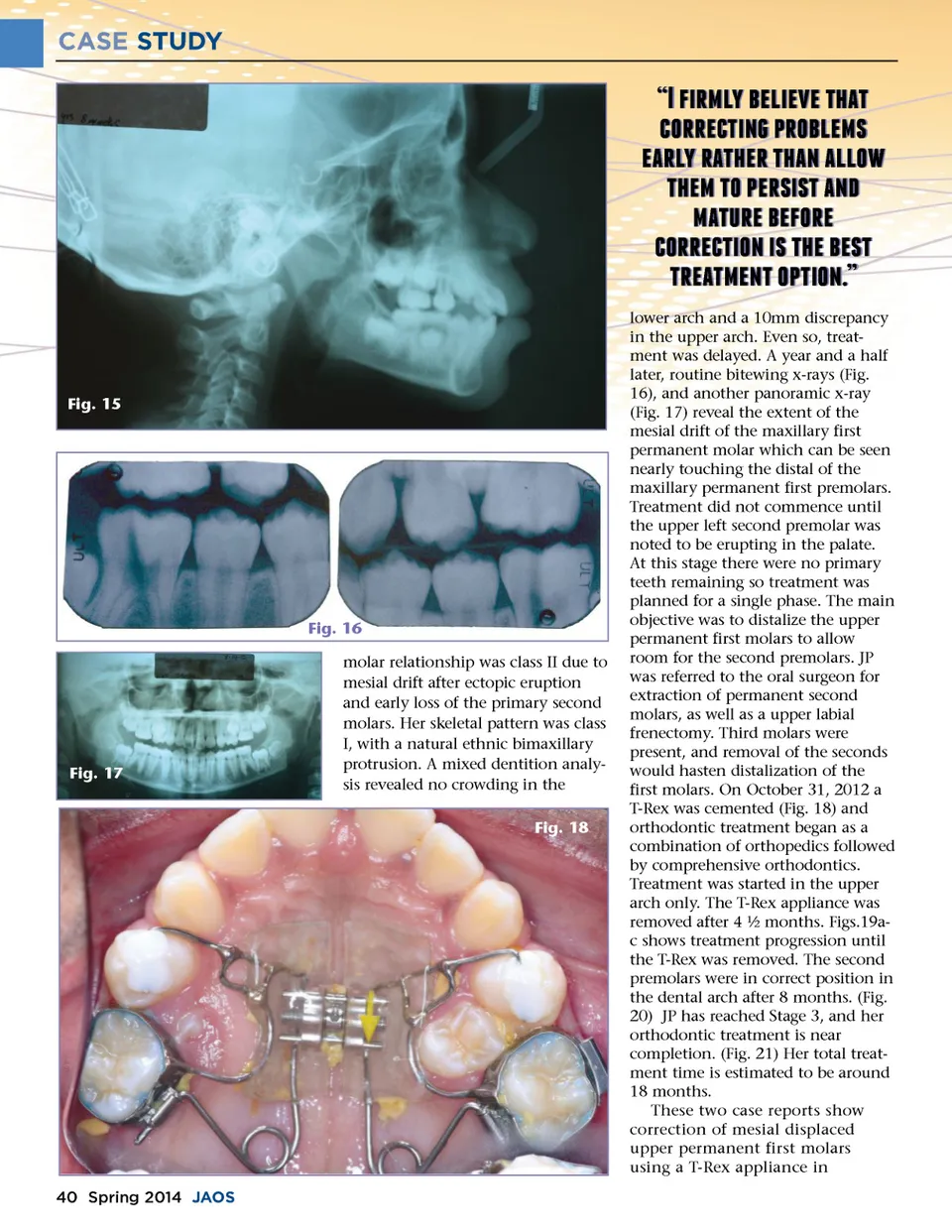
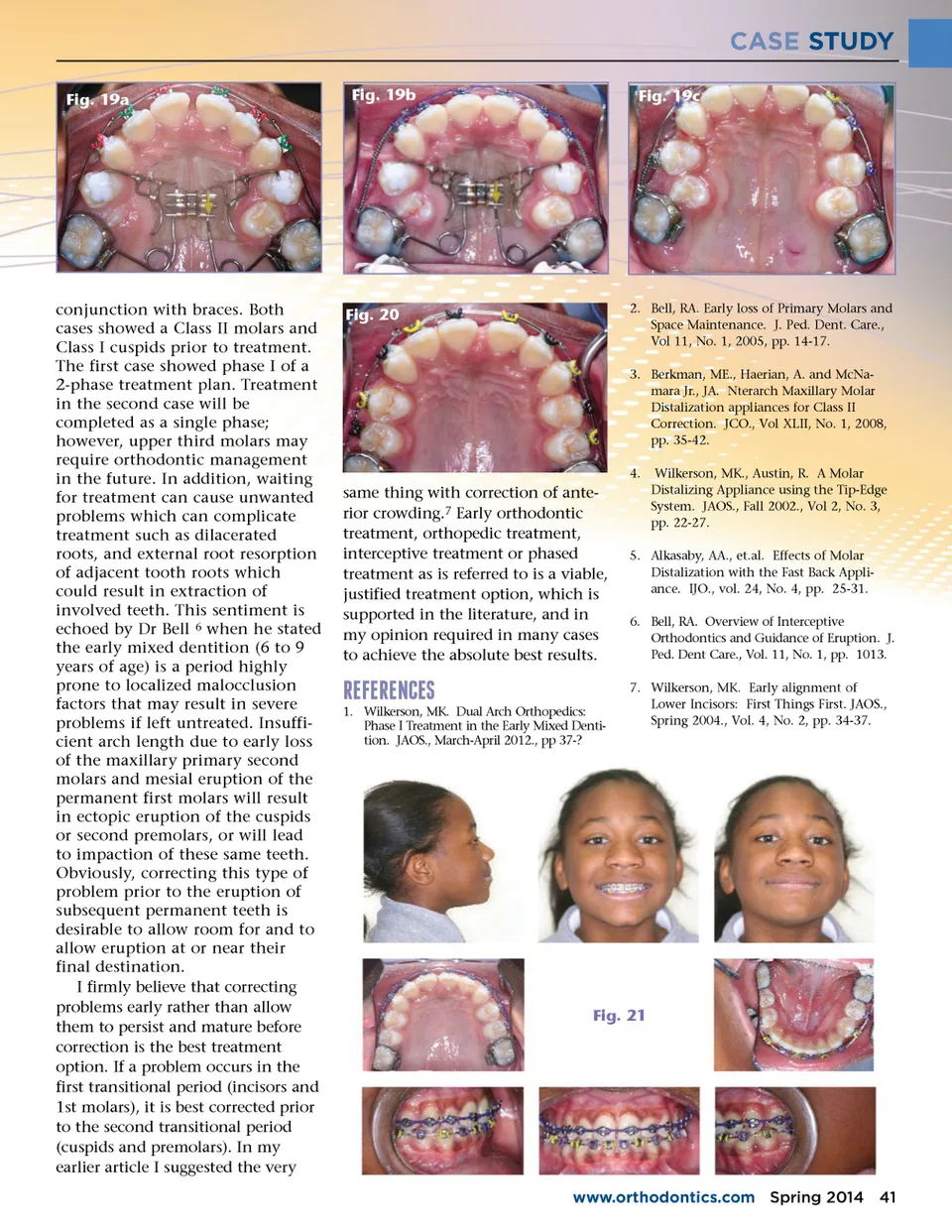
CASE STUDY �c;! b;e;! b;  !f;d;f; c;e;e; f;b;! e;c; a; d;e;!e;d;f; e;!f;d;!d;c; f; !f;c;! e;a;b;a;f;!d;�f; d;f;�e;e; ! c;e; c;e;e; f;b;c;!b;a;!f; ! a;f; f;e; d;f; f;!c; f;b;c;  lower arch and a 10mm discrepancy in the upper arch. Even so, treat-ment was delayed. A year and a half later, routine bitewing x-rays (Fig. 16), and another panoramic x-ray (Fig. 17) reveal the extent of the mesial drift of the maxillary first permanent molar which can be seen nearly touching the distal of the maxillary permanent first premolars. Treatment did not commence until the upper left second premolar was noted to be erupting in the palate. At this stage there were no primary teeth remaining so treatment was planned for a single phase. The main objective was to distalize the upper permanent first molars to allow room for the second premolars. JP was referred to the oral surgeon for extraction of permanent second molars, as well as a upper labial frenectomy. Third molars were present, and removal of the seconds would hasten distalization of the first molars. On October 31, 2012 a T-Rex was cemented (Fig. 18) and orthodontic treatment began as a combination of orthopedics followed by comprehensive orthodontics. Treatment was started in the upper arch only. The T-Rex appliance was removed after 4 ½ months. Figs.19a-c shows treatment progression until the T-Rex was removed. The second premolars were in correct position in the dental arch after 8 months. (Fig. 20) JP has reached Stage 3, and her orthodontic treatment is near completion. (Fig. 21) Her total treat-ment time is estimated to be around 18 months. These two case reports show correction of mesial displaced upper permanent first molars using a T-Rex appliance in Fig. 15 Fig. 16 molar relationship was class II due to mesial drift after ectopic eruption and early loss of the primary second molars. Her skeletal pattern was class I, with a natural ethnic bimaxillary protrusion. A mixed dentition analy-sis revealed no crowding in the Fig. 18 Fig. 17 40 Spring 2014 JAOS
Journal of the American Orthodontic Society Spring 2014: Page 40