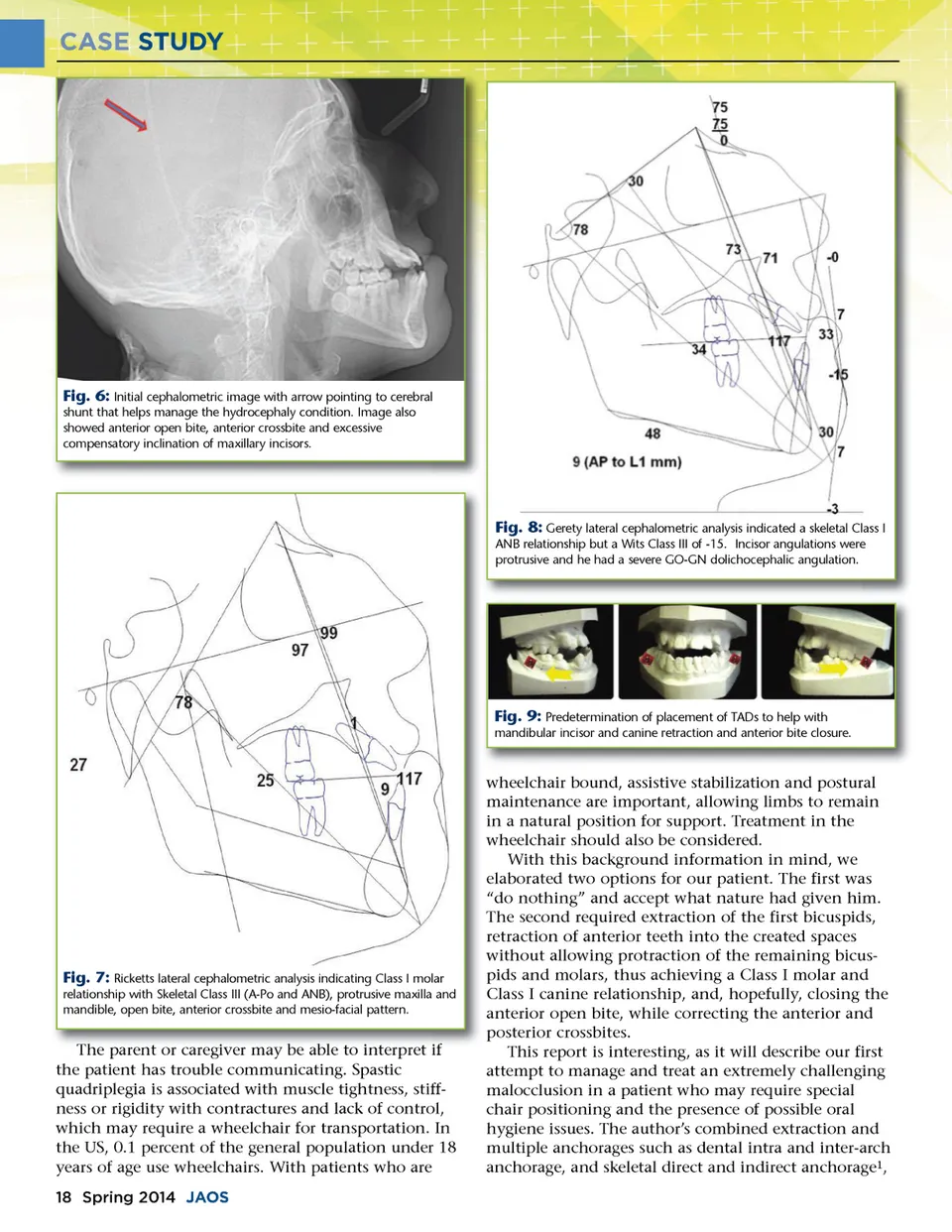
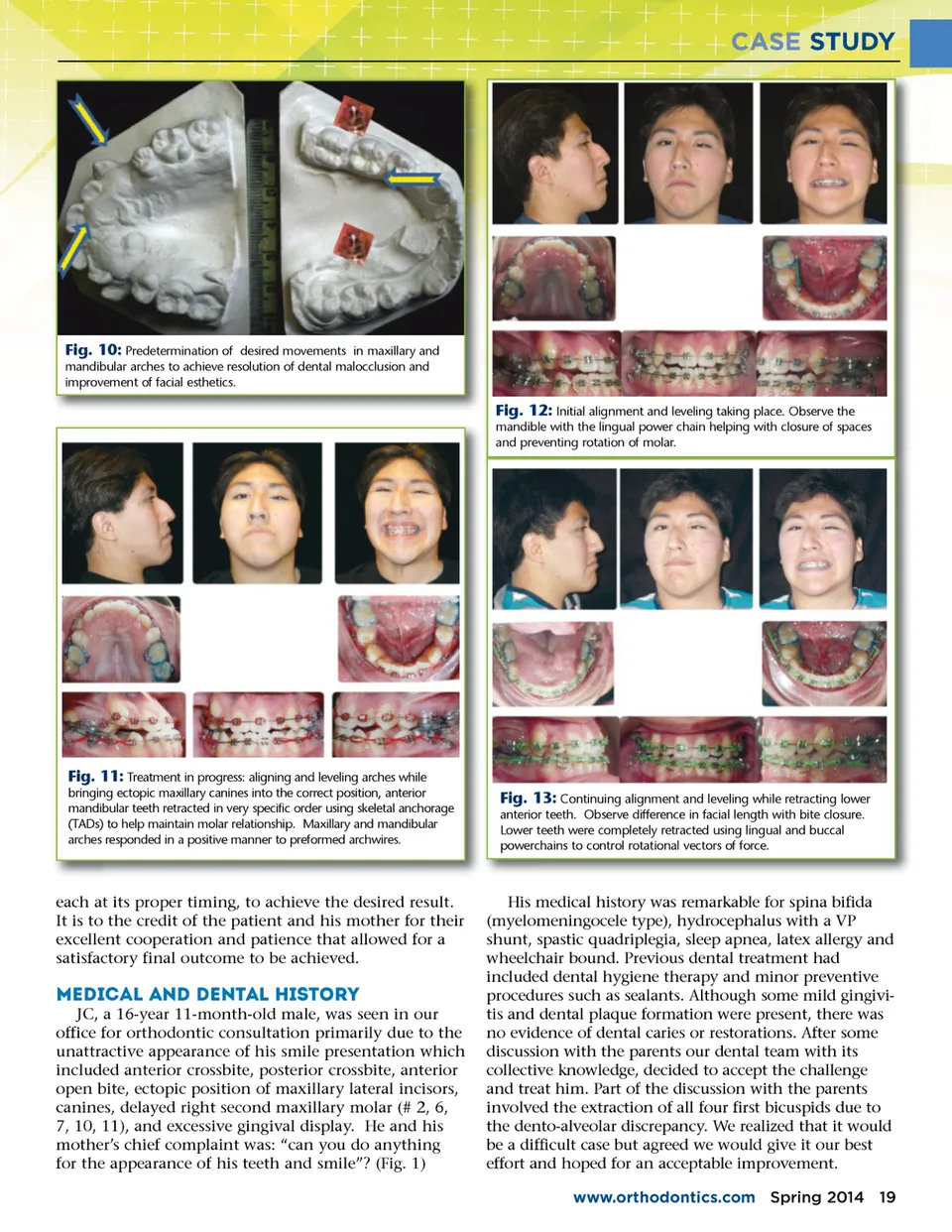
CASE STUDY Fig. 6: Initial cephalometric image with arrow pointing to cerebral shunt that helps manage the hydrocephaly condition. Image also showed anterior open bite, anterior crossbite and excessive compensatory inclination of maxillary incisors. Fig. 8: Gerety lateral cephalometric analysis indicated a skeletal Class I ANB relationship but a Wits Class III of -15. Incisor angulations were protrusive and he had a severe GO-GN dolichocephalic angulation. Fig. 9: Predetermination of placement of TADs to help with mandibular incisor and canine retraction and anterior bite closure. Fig. 7: Ricketts lateral cephalometric analysis indicating Class I molar relationship with Skeletal Class III (A-Po and ANB), protrusive maxilla and mandible, open bite, anterior crossbite and mesio-facial pattern. The parent or caregiver may be able to interpret if the patient has trouble communicating. Spastic quadriplegia is associated with muscle tightness, stiff-ness or rigidity with contractures and lack of control, which may require a wheelchair for transportation. In the US, 0.1 percent of the general population under 18 years of age use wheelchairs. With patients who are 18 Spring 2014 JAOS wheelchair bound, assistive stabilization and postural maintenance are important, allowing limbs to remain in a natural position for support. Treatment in the wheelchair should also be considered. With this background information in mind, we elaborated two options for our patient. The first was “do nothing” and accept what nature had given him. The second required extraction of the first bicuspids, retraction of anterior teeth into the created spaces without allowing protraction of the remaining bicus-pids and molars, thus achieving a Class I molar and Class I canine relationship, and, hopefully, closing the anterior open bite, while correcting the anterior and posterior crossbites. This report is interesting, as it will describe our first attempt to manage and treat an extremely challenging malocclusion in a patient who may require special chair positioning and the presence of possible oral hygiene issues. The author’s combined extraction and multiple anchorages such as dental intra and inter-arch anchorage, and skeletal direct and indirect anchorage 1 ,
Journal of the American Orthodontic Society Spring 2014: Page 18