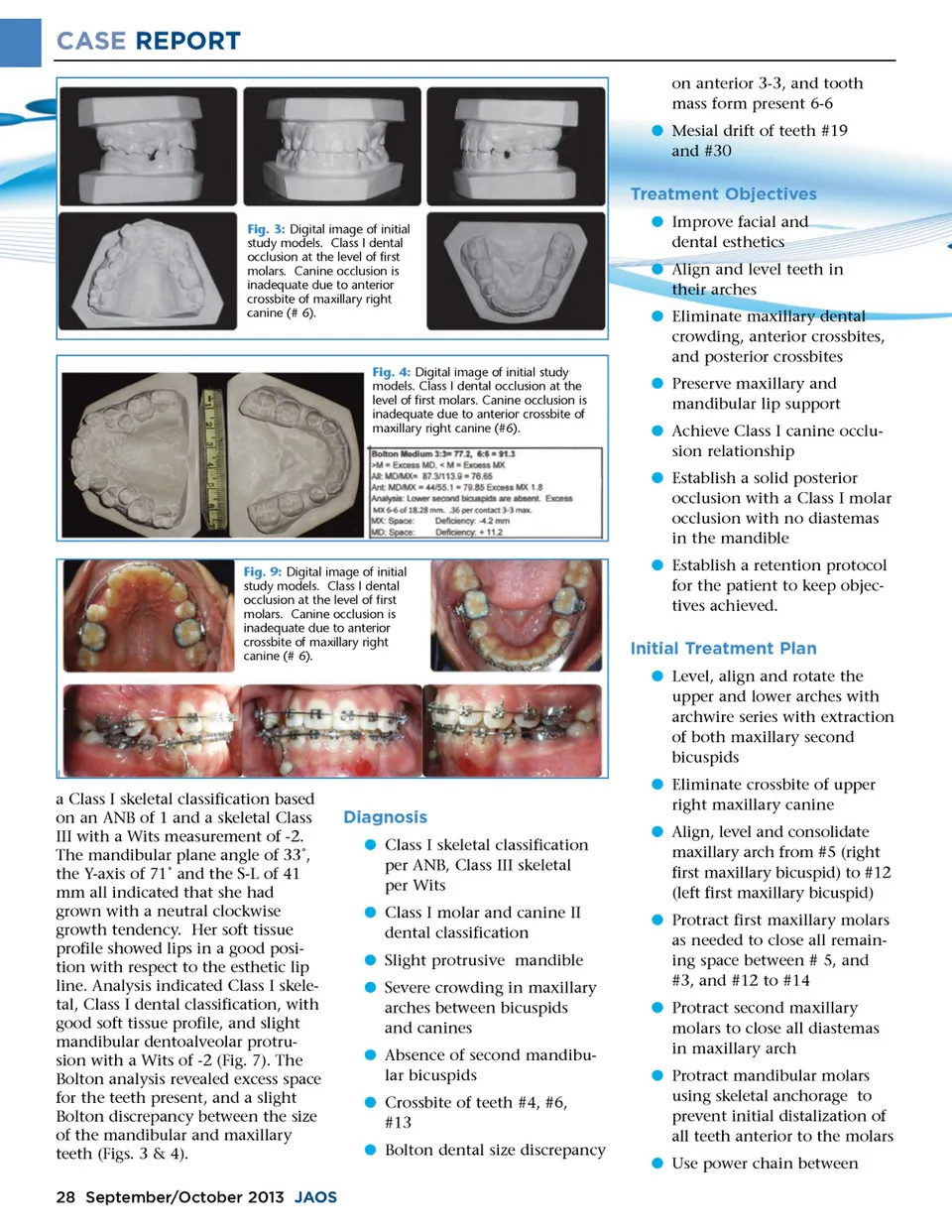
CASE REPORT on anterior 3-3, and tooth mass form present 6-6 b Mesial drift of teeth #19 and #30 Treatment Objectives Fig. 3: Digital image of initial study models. Class I dental occlusion at the level of first molars. Canine occlusion is inadequate due to anterior crossbite of maxillary right canine (# 6). b Improve facial and dental esthetics b Align and level teeth in their arches b Eliminate maxillary dental crowding, anterior crossbites, and posterior crossbites b Preserve maxillary and mandibular lip support b Achieve Class I canine occlu-sion relationship b Establish a solid posterior occlusion with a Class I molar occlusion with no diastemas in the mandible Fig. 4: Digital image of initial study models. Class I dental occlusion at the level of first molars. Canine occlusion is inadequate due to anterior crossbite of maxillary right canine (#6). Fig. 9: Digital image of initial study models. Class I dental occlusion at the level of first molars. Canine occlusion is inadequate due to anterior crossbite of maxillary right canine (# 6). b Establish a retention protocol for the patient to keep objec-tives achieved. Initial Treatment Plan b Level, align and rotate the upper and lower arches with archwire series with extraction of both maxillary second bicuspids a Class I skeletal classification based on an ANB of 1 and a skeletal Class III with a Wits measurement of -2. The mandibular plane angle of 33˚, the Y-axis of 71˚ and the S-L of 41 mm all indicated that she had grown with a neutral clockwise growth tendency. Her soft tissue profile showed lips in a good posi-tion with respect to the esthetic lip line. Analysis indicated Class I skele-tal, Class I dental classification, with good soft tissue profile, and slight mandibular dentoalveolar protru-sion with a Wits of -2 (Fig. 7). The Bolton analysis revealed excess space for the teeth present, and a slight Bolton discrepancy between the size of the mandibular and maxillary teeth (Figs. 3 & 4). 28 September/October 2013 JAOS Diagnosis b Class I skeletal classification per ANB, Class III skeletal per Wits b Class I molar and canine II dental classification b Slight protrusive mandible b Severe crowding in maxillary arches between bicuspids and canines b Absence of second mandibu-lar bicuspids b Crossbite of teeth #4, #6, #13 b Bolton dental size discrepancy b Eliminate crossbite of upper right maxillary canine b Align, level and consolidate maxillary arch from #5 (right first maxillary bicuspid) to #12 (left first maxillary bicuspid) b Protract first maxillary molars as needed to close all remain-ing space between # 5, and #3, and #12 to #14 b Protract second maxillary molars to close all diastemas in maxillary arch b Protract mandibular molars using skeletal anchorage to prevent initial distalization of all teeth anterior to the molars b Use power chain between
Journal of the American Orthodontic Society September-October 2013: Page 28