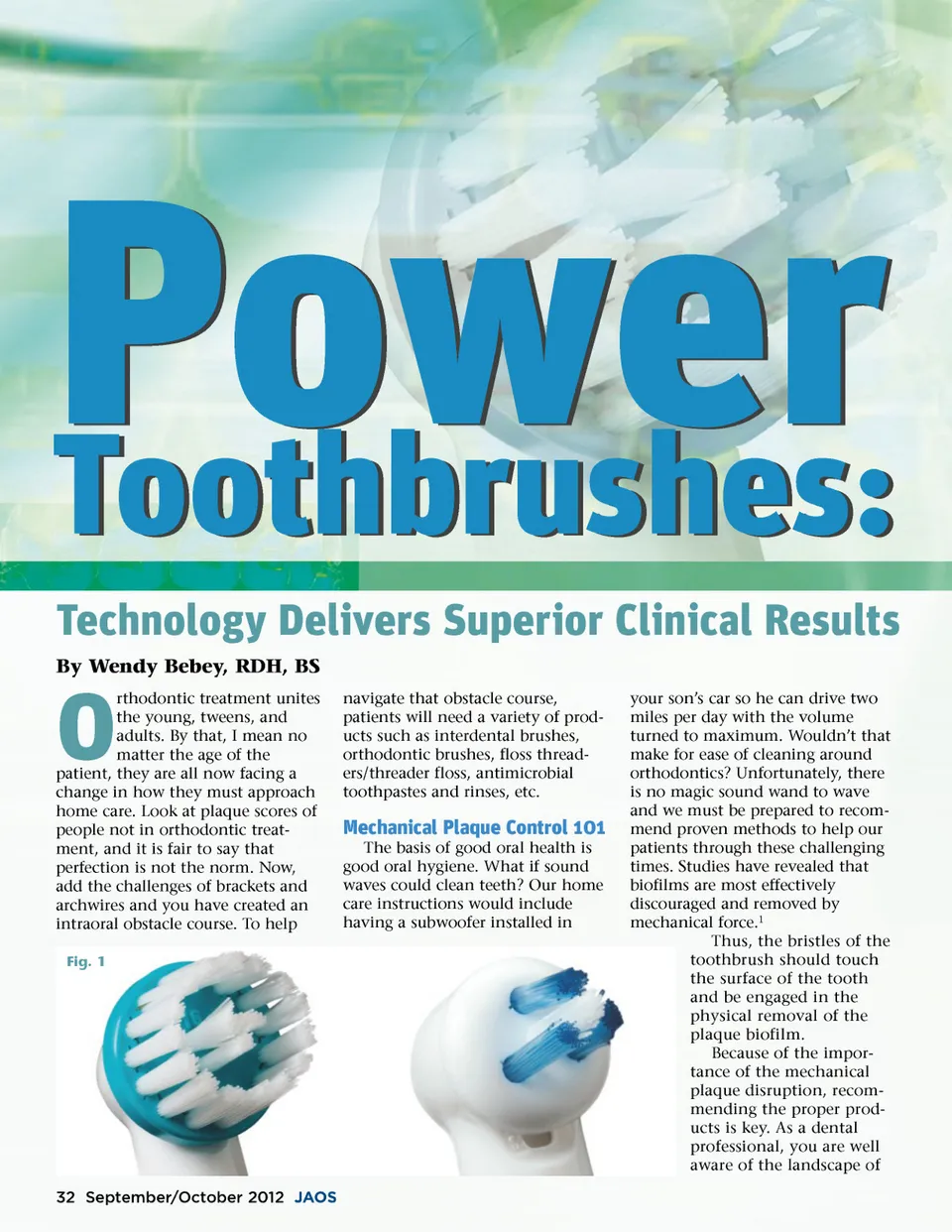
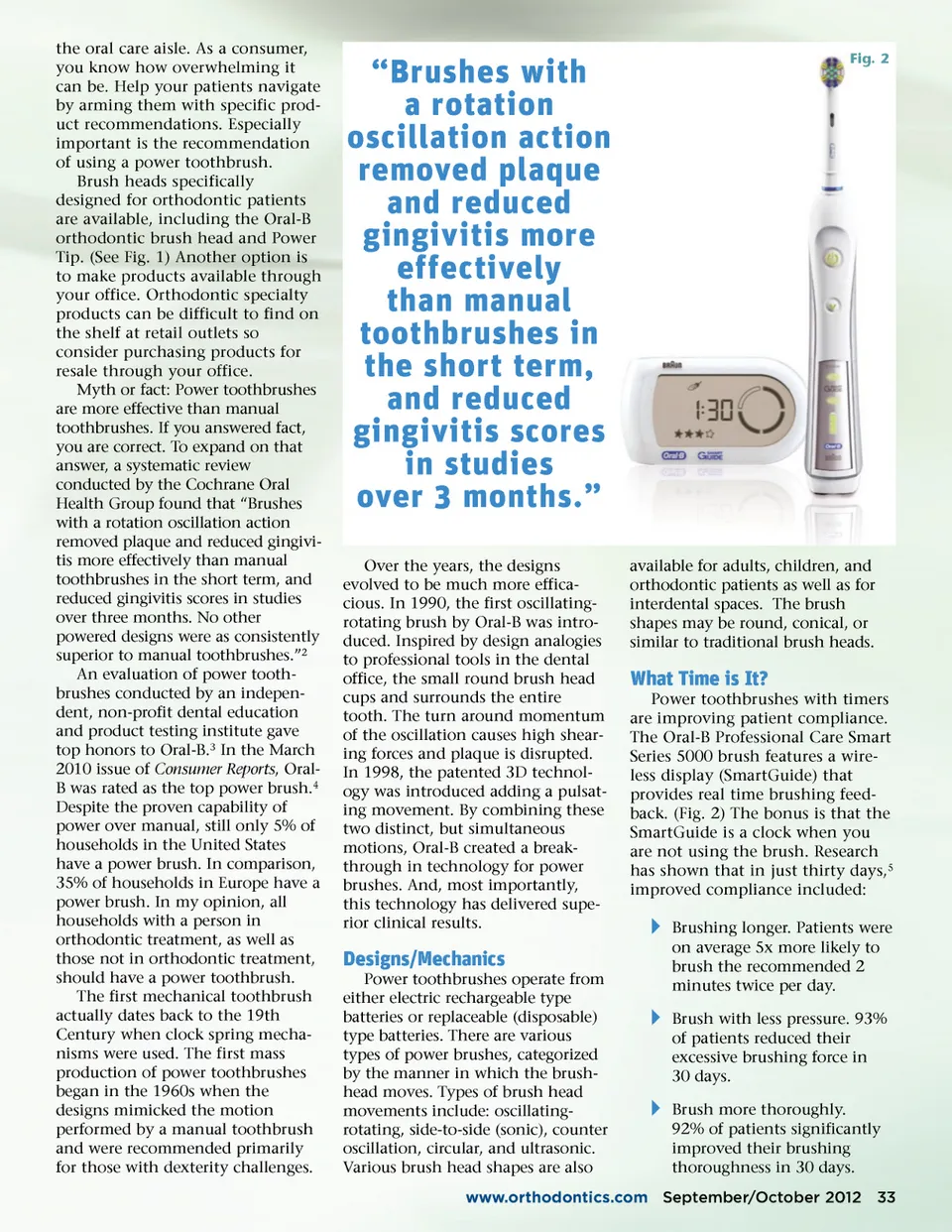
the oral care aisle. As a consumer, you know how overwhelming it can be. Help your patients navigate by arming them with specific prod-uct recommendations. Especially important is the recommendation of using a power toothbrush. Brush heads specifically designed for orthodontic patients are available, including the Oral-B orthodontic brush head and Power Tip. (See Fig. 1) Another option is to make products available through your office. Orthodontic specialty products can be difficult to find on the shelf at retail outlets so consider purchasing products for resale through your office. Myth or fact: Power toothbrushes are more effective than manual toothbrushes. If you answered fact, you are correct. To expand on that answer, a systematic review conducted by the Cochrane Oral Health Group found that “Brushes with a rotation oscillation action removed plaque and reduced gingivi-tis more effectively than manual toothbrushes in the short term, and reduced gingivitis scores in studies over three months. No other powered designs were as consistently superior to manual toothbrushes.” 2 An evaluation of power tooth-brushes conducted by an indepen-dent, non-profit dental education and product testing institute gave top honors to Oral-B. 3 In the March 2010 issue of Consumer Reports , Oral-B was rated as the top power brush. 4 Despite the proven capability of power over manual, still only 5% of households in the United States have a power brush. In comparison, 35% of households in Europe have a power brush. In my opinion, all households with a person in orthodontic treatment, as well as those not in orthodontic treatment, should have a power toothbrush. The first mechanical toothbrush actually dates back to the 19th Century when clock spring mecha-nisms were used. The first mass production of power toothbrushes began in the 1960s when the designs mimicked the motion performed by a manual toothbrush and were recommended primarily for those with dexterity challenges. “Brushes with a rotation oscillation action removed plaque and reduced gingivitis more effectively than manual toothbrushes in the short term, and reduced gingivitis scores in studies over 3 months.” Over the years, the designs evolved to be much more effica-cious. In 1990, the first oscillating-rotating brush by Oral-B was intro-duced. Inspired by design analogies to professional tools in the dental office, the small round brush head cups and surrounds the entire tooth. The turn around momentum of the oscillation causes high shear-ing forces and plaque is disrupted. In 1998, the patented 3D technol-ogy was introduced adding a pulsat-ing movement. By combining these two distinct, but simultaneous motions, Oral-B created a break-through in technology for power brushes. And, most importantly, this technology has delivered supe-rior clinical results. Fig. 2 available for adults, children, and orthodontic patients as well as for interdental spaces. The brush shapes may be round, conical, or similar to traditional brush heads. What Time is It? Power toothbrushes with timers are improving patient compliance. The Oral-B Professional Care Smart Series 5000 brush features a wire-less display (SmartGuide) that provides real time brushing feed-back. (Fig. 2) The bonus is that the SmartGuide is a clock when you are not using the brush. Research has shown that in just thirty days, 5 improved compliance included: Ī Brushing longer. Patients were on average 5x more likely to brush the recommended 2 minutes twice per day. Designs/Mechanics Power toothbrushes operate from either electric rechargeable type batteries or replaceable (disposable) type batteries. There are various types of power brushes, categorized by the manner in which the brush-head moves. Types of brush head movements include: oscillating-rotating, side-to-side (sonic), counter oscillation, circular, and ultrasonic. Various brush head shapes are also Ī Brush with less pressure. 93% of patients reduced their excessive brushing force in 30 days. Ī Brush more thoroughly. 92% of patients significantly improved their brushing thoroughness in 30 days. www.orthodontics.com September/October 2012 33
Journal of the American Orthodontic Society September-October 2012: Page 33