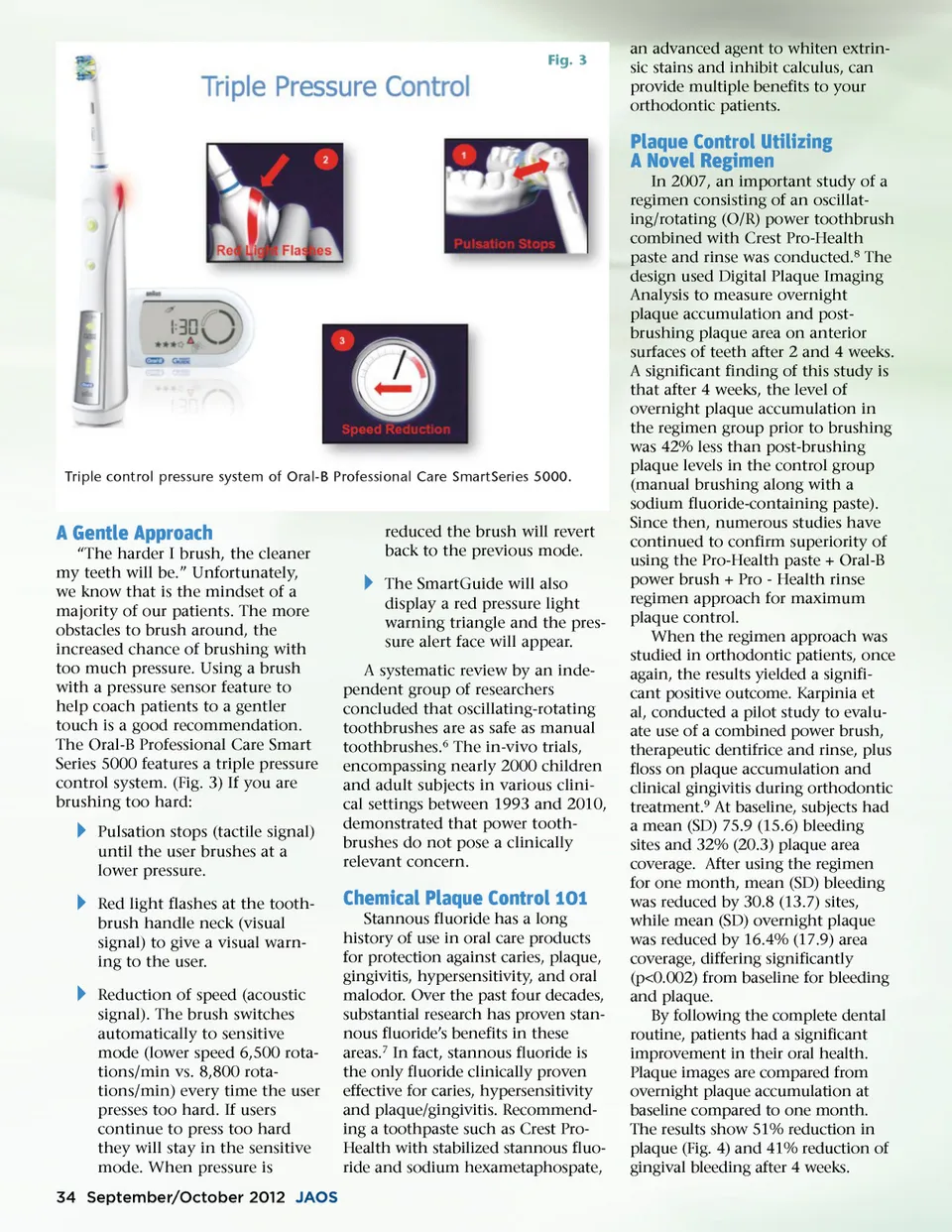
Fig. 3 an advanced agent to whiten extrin-sic stains and inhibit calculus, can provide multiple benefits to your orthodontic patients. Plaque Control Utilizing A Novel Regimen In 2007, an important study of a regimen consisting of an oscillat-ing/rotating (O/R) power toothbrush combined with Crest Pro-Health paste and rinse was conducted. 8 The design used Digital Plaque Imaging Analysis to measure overnight plaque accumulation and post-brushing plaque area on anterior surfaces of teeth after 2 and 4 weeks. A significant finding of this study is that after 4 weeks, the level of overnight plaque accumulation in the regimen group prior to brushing was 42% less than post-brushing plaque levels in the control group (manual brushing along with a sodium fluoride-containing paste). Since then, numerous studies have continued to confirm superiority of using the Pro-Health paste + Oral-B power brush + Pro -Health rinse regimen approach for maximum plaque control. When the regimen approach was studied in orthodontic patients, once again, the results yielded a signifi-cant positive outcome. Karpinia et al, conducted a pilot study to evalu-ate use of a combined power brush, therapeutic dentifrice and rinse, plus floss on plaque accumulation and clinical gingivitis during orthodontic treatment. 9 At baseline, subjects had a mean (SD) 75.9 (15.6) bleeding sites and 32% (20.3) plaque area coverage. After using the regimen for one month, mean (SD) bleeding was reduced by 30.8 (13.7) sites, while mean (SD) overnight plaque was reduced by 16.4% (17.9) area coverage, differing significantly (p<0.002) from baseline for bleeding and plaque. By following the complete dental routine, patients had a significant improvement in their oral health. Plaque images are compared from overnight plaque accumulation at baseline compared to one month. The results show 51% reduction in plaque (Fig. 4) and 41% reduction of gingival bleeding after 4 weeks. Triple control pressure system of Oral-B Professional Care SmartSeries 5000. A Gentle Approach “The harder I brush, the cleaner my teeth will be.” Unfortunately, we know that is the mindset of a majority of our patients. The more obstacles to brush around, the increased chance of brushing with too much pressure. Using a brush with a pressure sensor feature to help coach patients to a gentler touch is a good recommendation. The Oral-B Professional Care Smart Series 5000 features a triple pressure control system. (Fig. 3) If you are brushing too hard: reduced the brush will revert back to the previous mode. Ī The SmartGuide will also display a red pressure light warning triangle and the pres-sure alert face will appear. A systematic review by an inde-pendent group of researchers concluded that oscillating-rotating toothbrushes are as safe as manual toothbrushes. 6 The in-vivo trials, encompassing nearly 2000 children and adult subjects in various clini-cal settings between 1993 and 2010, demonstrated that power tooth-brushes do not pose a clinically relevant concern. Ī Pulsation stops (tactile signal) until the user brushes at a lower pressure. Ī Red light flashes at the tooth-brush handle neck (visual signal) to give a visual warn-ing to the user. Chemical Plaque Control 101 Stannous fluoride has a long history of use in oral care products for protection against caries, plaque, gingivitis, hypersensitivity, and oral malodor. Over the past four decades, substantial research has proven stan-nous fluoride’s benefits in these areas. 7 In fact, stannous fluoride is the only fluoride clinically proven effective for caries, hypersensitivity and plaque/gingivitis. Recommend-ing a toothpaste such as Crest Pro-Health with stabilized stannous fluo-ride and sodium hexametaphospate, Ī Reduction of speed (acoustic signal). The brush switches automatically to sensitive mode (lower speed 6,500 rota-tions/min vs. 8,800 rota-tions/min) every time the user presses too hard. If users continue to press too hard they will stay in the sensitive mode. When pressure is 34 September/October 2012 JAOS
Journal of the American Orthodontic Society September-October 2012: Page 34