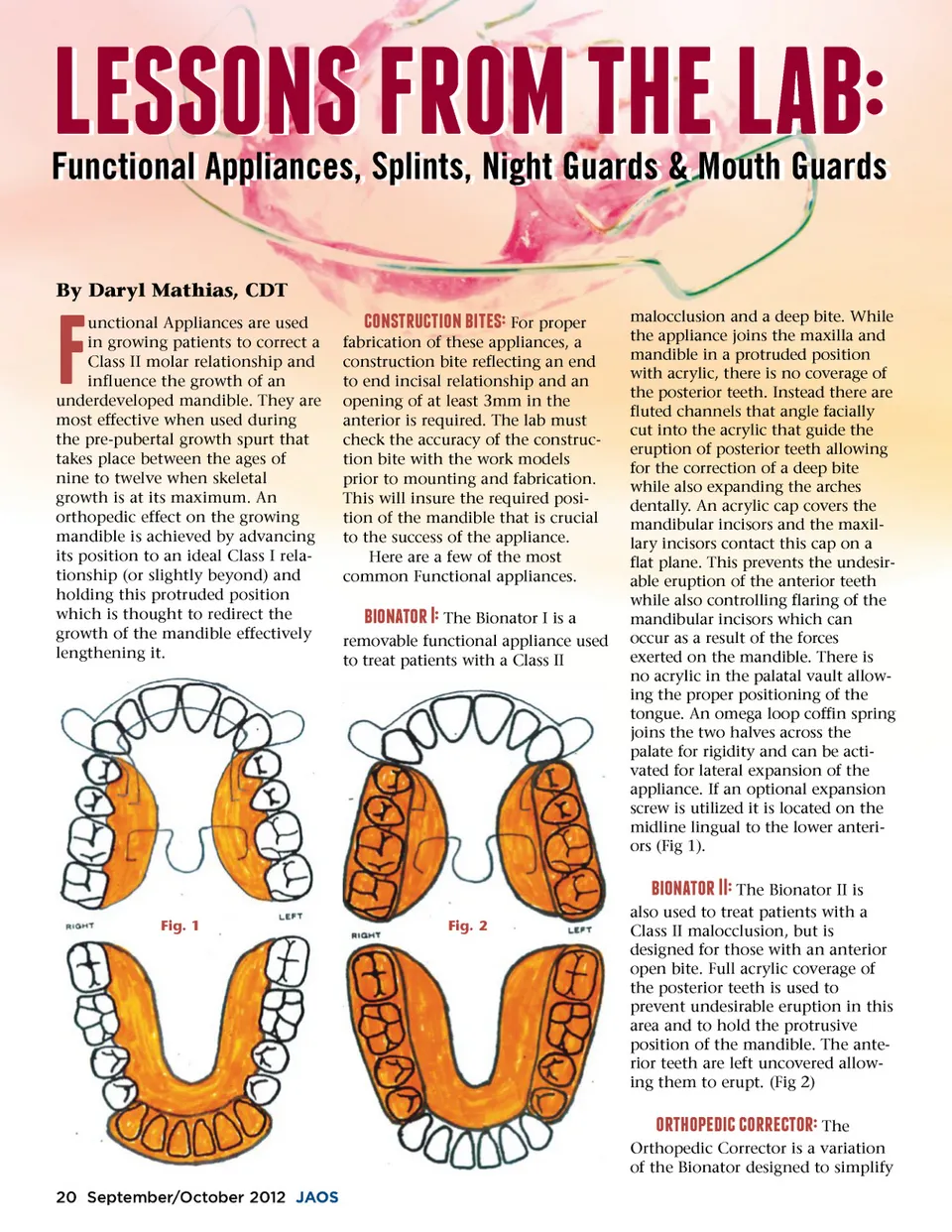
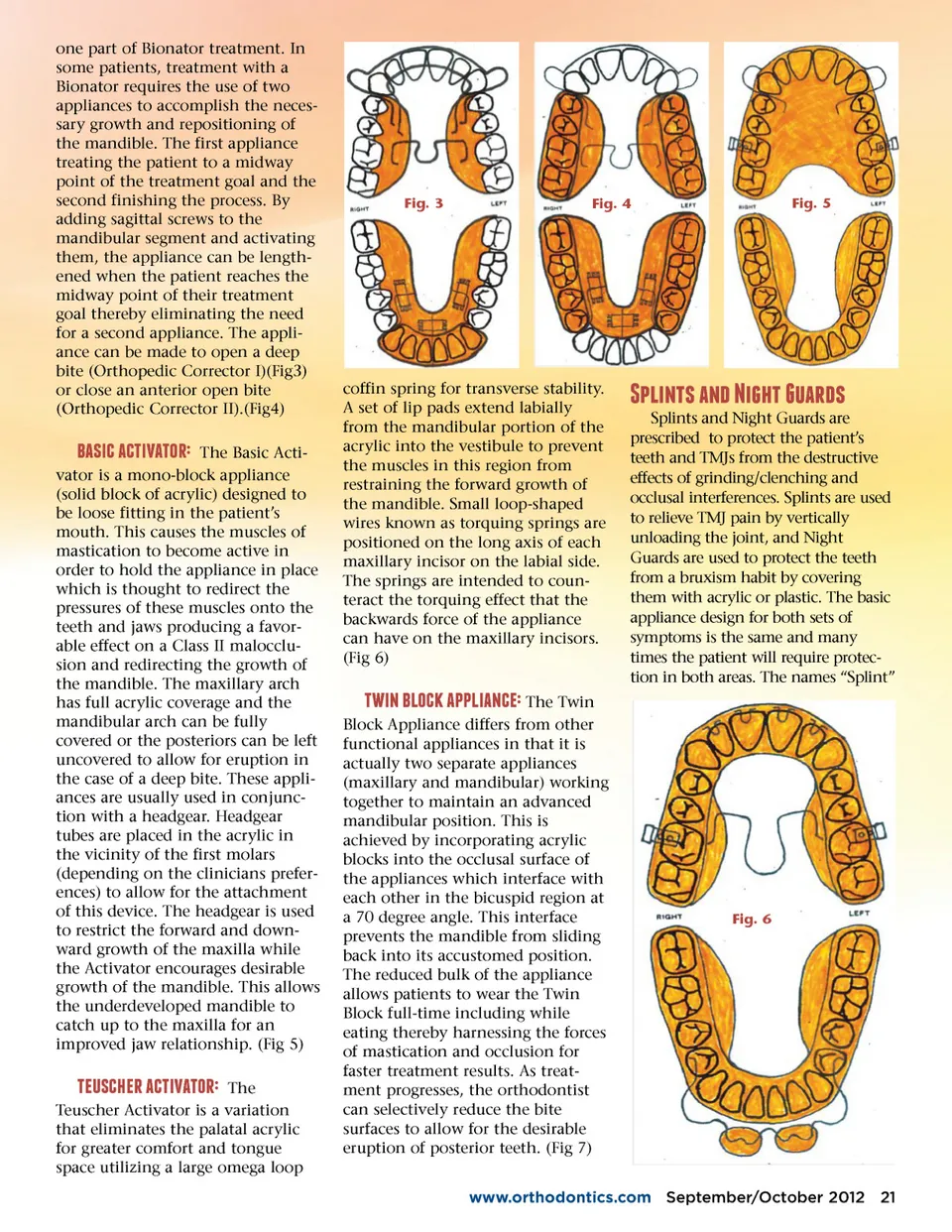
one part of Bionator treatment. In some patients, treatment with a Bionator requires the use of two appliances to accomplish the neces-sary growth and repositioning of the mandible. The first appliance treating the patient to a midway point of the treatment goal and the second finishing the process. By adding sagittal screws to the mandibular segment and activating them, the appliance can be length-ened when the patient reaches the midway point of their treatment goal thereby eliminating the need for a second appliance. The appli-ance can be made to open a deep bite (Orthopedic Corrector I)(Fig3) or close an anterior open bite (Orthopedic Corrector II).(Fig4) The Basic Acti-vator is a mono-block appliance (solid block of acrylic) designed to be loose fitting in the patient’s mouth. This causes the muscles of mastication to become active in order to hold the appliance in place which is thought to redirect the pressures of these muscles onto the teeth and jaws producing a favor-able effect on a Class II malocclu-sion and redirecting the growth of the mandible. The maxillary arch has full acrylic coverage and the mandibular arch can be fully covered or the posteriors can be left uncovered to allow for eruption in the case of a deep bite. These appli-ances are usually used in conjunc-tion with a headgear. Headgear tubes are placed in the acrylic in the vicinity of the first molars (depending on the clinicians prefer-ences) to allow for the attachment of this device. The headgear is used to restrict the forward and down-ward growth of the maxilla while the Activator encourages desirable growth of the mandible. This allows the underdeveloped mandible to catch up to the maxilla for an improved jaw relationship. (Fig 5) The Teuscher Activator is a variation that eliminates the palatal acrylic for greater comfort and tongue space utilizing a large omega loop Fig. 3 Fig. 4 Fig. 5 basic activator: coffin spring for transverse stability. A set of lip pads extend labially from the mandibular portion of the acrylic into the vestibule to prevent the muscles in this region from restraining the forward growth of the mandible. Small loop-shaped wires known as torquing springs are positioned on the long axis of each maxillary incisor on the labial side. The springs are intended to coun-teract the torquing effect that the backwards force of the appliance can have on the maxillary incisors. (Fig 6) splints and night Guards Splints and Night Guards are prescribed to protect the patient’s teeth and TMJs from the destructive effects of grinding/clenching and occlusal interferences. Splints are used to relieve TMJ pain by vertically unloading the joint, and Night Guards are used to protect the teeth from a bruxism habit by covering them with acrylic or plastic. The basic appliance design for both sets of symptoms is the same and many times the patient will require protec-tion in both areas. The names “Splint” twin block appliance: The Twin Block Appliance differs from other functional appliances in that it is actually two separate appliances (maxillary and mandibular) working together to maintain an advanced mandibular position. This is achieved by incorporating acrylic blocks into the occlusal surface of the appliances which interface with each other in the bicuspid region at a 70 degree angle. This interface prevents the mandible from sliding back into its accustomed position. The reduced bulk of the appliance allows patients to wear the Twin Block full-time including while eating thereby harnessing the forces of mastication and occlusion for faster treatment results. As treat-ment progresses, the orthodontist can selectively reduce the bite surfaces to allow for the desirable eruption of posterior teeth. (Fig 7) Fig. 6 teuscher activator: www.orthodontics.com September/October 2012 21
Journal of the American Orthodontic Society September-October 2012: Page 21