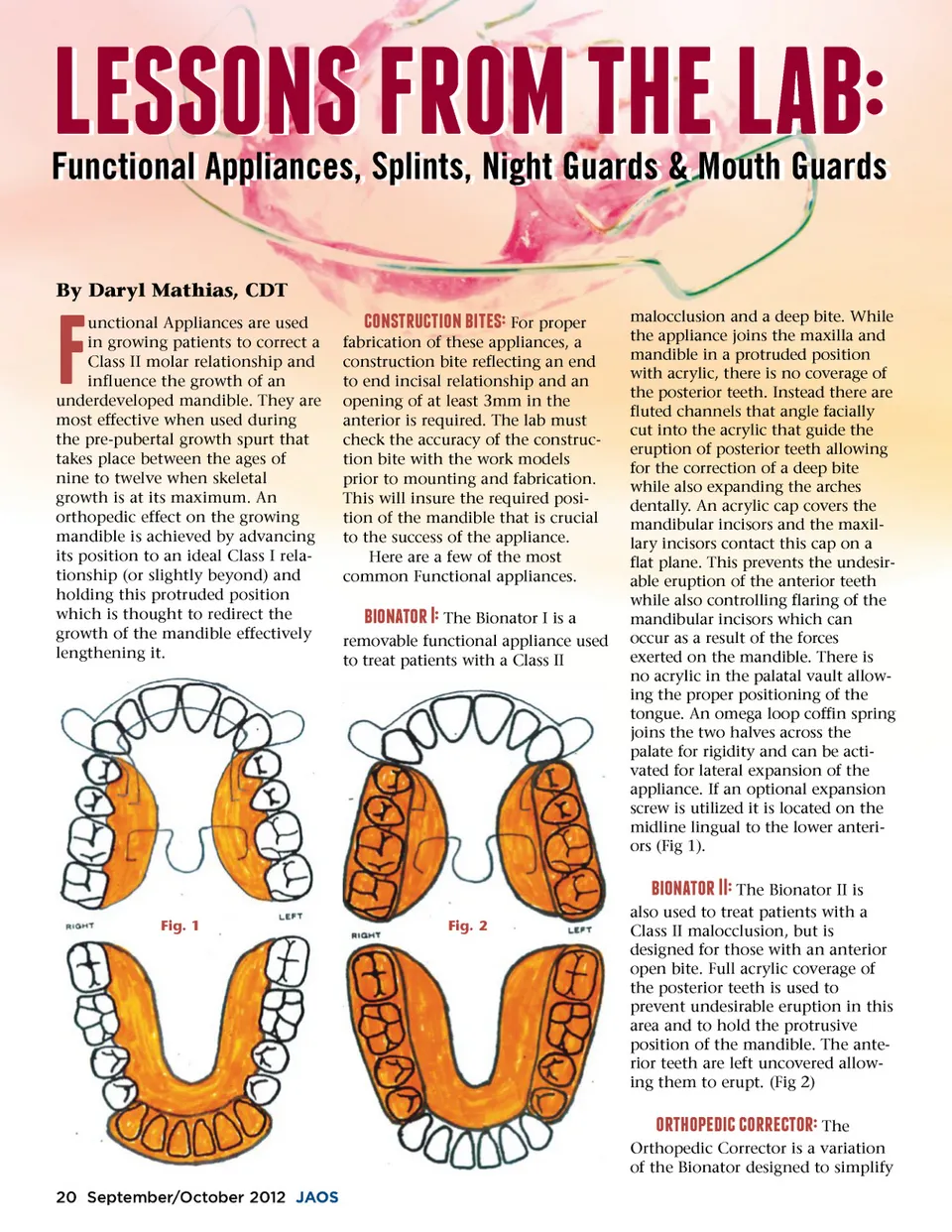
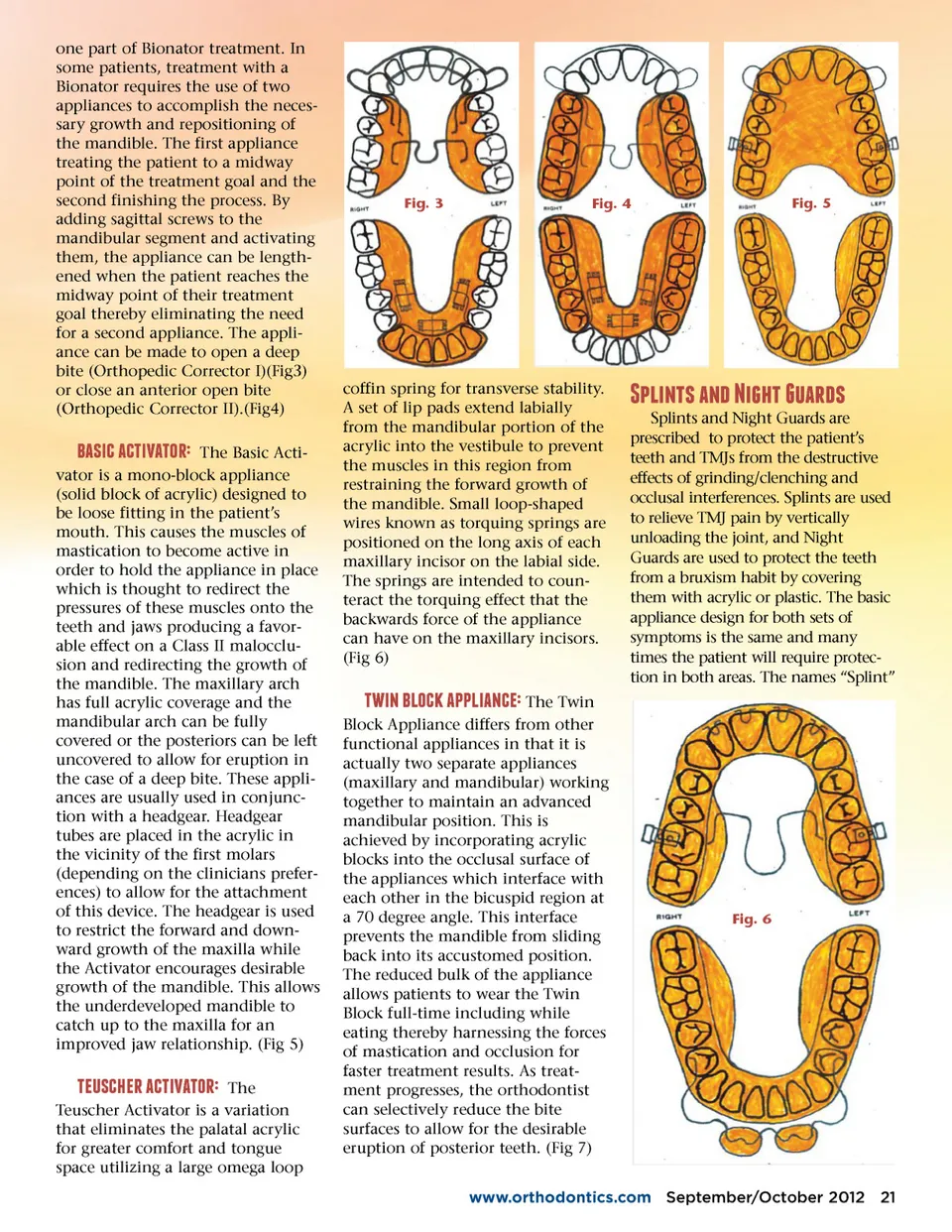
Lessons From the Lab: By Daryl Mathias, CDT unctional Appliances are used in growing patients to correct a Class II molar relationship and influence the growth of an underdeveloped mandible. They are most effective when used during the pre-pubertal growth spurt that takes place between the ages of nine to twelve when skeletal growth is at its maximum. An orthopedic effect on the growing mandible is achieved by advancing its position to an ideal Class I rela-tionship (or slightly beyond) and holding this protruded position which is thought to redirect the growth of the mandible effectively lengthening it. Functional Functional Appliances, Appliances, Splints, Splints, Night Night Guards Guards & & Mouth Mouth Guards Guards F construction bites: For proper fabrication of these appliances, a construction bite reflecting an end to end incisal relationship and an opening of at least 3mm in the anterior is required. The lab must check the accuracy of the construc-tion bite with the work models prior to mounting and fabrication. This will insure the required posi-tion of the mandible that is crucial to the success of the appliance. Here are a few of the most common Functional appliances. bionator I: The Bionator I is a removable functional appliance used to treat patients with a Class II malocclusion and a deep bite. While the appliance joins the maxilla and mandible in a protruded position with acrylic, there is no coverage of the posterior teeth. Instead there are fluted channels that angle facially cut into the acrylic that guide the eruption of posterior teeth allowing for the correction of a deep bite while also expanding the arches dentally. An acrylic cap covers the mandibular incisors and the maxil-lary incisors contact this cap on a flat plane. This prevents the undesir-able eruption of the anterior teeth while also controlling flaring of the mandibular incisors which can occur as a result of the forces exerted on the mandible. There is no acrylic in the palatal vault allow-ing the proper positioning of the tongue. An omega loop coffin spring joins the two halves across the palate for rigidity and can be acti-vated for lateral expansion of the appliance. If an optional expansion screw is utilized it is located on the midline lingual to the lower anteri-ors (Fig 1). bionator II: The Bionator II is Fig. 1 Fig. 2 also used to treat patients with a Class II malocclusion, but is designed for those with an anterior open bite. Full acrylic coverage of the posterior teeth is used to prevent undesirable eruption in this area and to hold the protrusive position of the mandible. The ante-rior teeth are left uncovered allow-ing them to erupt. (Fig 2) orthopedic corrector: The Orthopedic Corrector is a variation of the Bionator designed to simplify 20 September/October 2012 JAOS
Journal of the American Orthodontic Society September-October 2012: Page 20