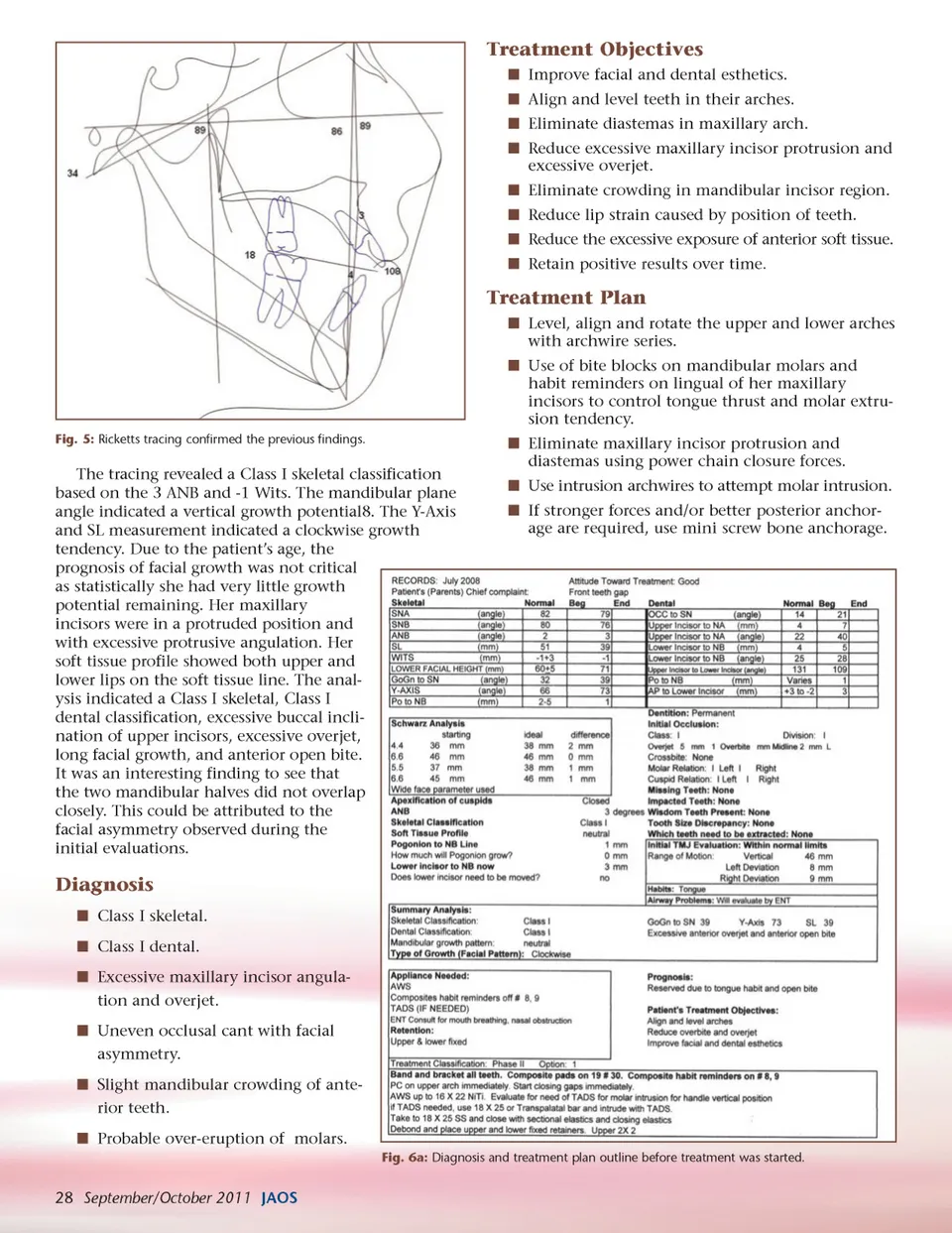
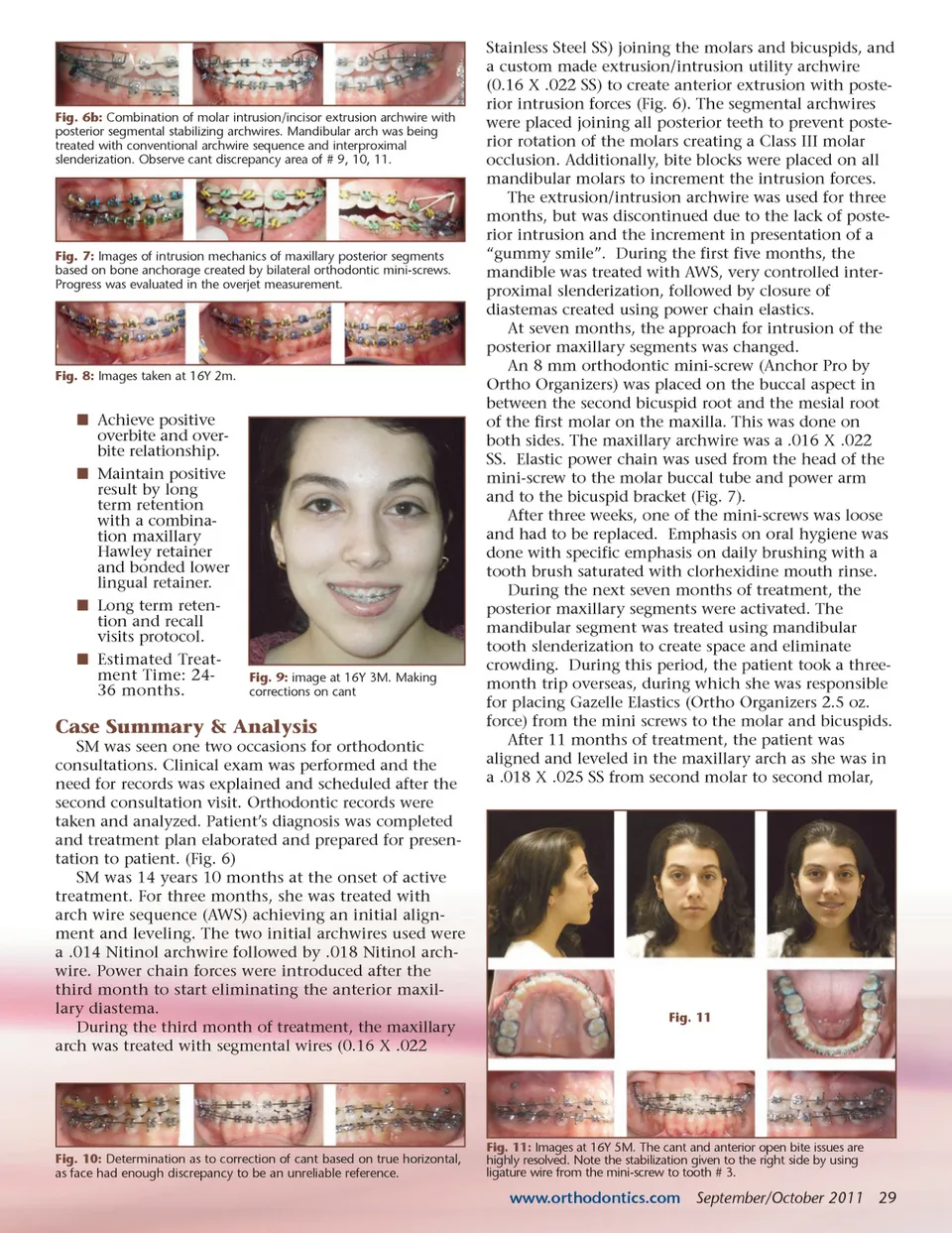
Fig. 6b: Combination of molar intrusion/incisor extrusion archwire with posterior segmental stabilizing archwires. Mandibular arch was being treated with conventional archwire sequence and interproximal slenderization. Observe cant discrepancy area of # 9, 10, 11. Fig. 7: Images of intrusion mechanics of maxillary posterior segments based on bone anchorage created by bilateral orthodontic mini-screws. Progress was evaluated in the overjet measurement. Fig. 8: Images taken at 16Y 2m. í Achieve positive overbite and over-bite relationship. í Maintain positive result by long term retention with a combina-tion maxillary Hawley retainer and bonded lower lingual retainer. í Long term reten-tion and recall visits protocol. í Estimated Treat-ment Time: 24-36 months. Fig. 9: image at 16Y 3M. Making corrections on cant Case Summary & Analysis SM was seen one two occasions for orthodontic consultations. Clinical exam was performed and the need for records was explained and scheduled after the second consultation visit. Orthodontic records were taken and analyzed. Patient’s diagnosis was completed and treatment plan elaborated and prepared for presen-tation to patient. (Fig. 6) SM was 14 years 10 months at the onset of active treatment. For three months, she was treated with arch wire sequence (AWS) achieving an initial align-ment and leveling. The two initial archwires used were a .014 Nitinol archwire followed by .018 Nitinol arch-wire. Power chain forces were introduced after the third month to start eliminating the anterior maxil-lary diastema. During the third month of treatment, the maxillary arch was treated with segmental wires (0.16 X .022 Stainless Steel SS) joining the molars and bicuspids, and a custom made extrusion/intrusion utility archwire (0.16 X .022 SS) to create anterior extrusion with poste-rior intrusion forces (Fig. 6). The segmental archwires were placed joining all posterior teeth to prevent poste-rior rotation of the molars creating a Class III molar occlusion. Additionally, bite blocks were placed on all mandibular molars to increment the intrusion forces. The extrusion/intrusion archwire was used for three months, but was discontinued due to the lack of poste-rior intrusion and the increment in presentation of a “gummy smile”. During the first five months, the mandible was treated with AWS, very controlled inter-proximal slenderization, followed by closure of diastemas created using power chain elastics. At seven months, the approach for intrusion of the posterior maxillary segments was changed. An 8 mm orthodontic mini-screw (Anchor Pro by Ortho Organizers) was placed on the buccal aspect in between the second bicuspid root and the mesial root of the first molar on the maxilla. This was done on both sides. The maxillary archwire was a .016 X .022 SS. Elastic power chain was used from the head of the mini-screw to the molar buccal tube and power arm and to the bicuspid bracket (Fig. 7). After three weeks, one of the mini-screws was loose and had to be replaced. Emphasis on oral hygiene was done with specific emphasis on daily brushing with a tooth brush saturated with clorhexidine mouth rinse. During the next seven months of treatment, the posterior maxillary segments were activated. The mandibular segment was treated using mandibular tooth slenderization to create space and eliminate crowding. During this period, the patient took a three-month trip overseas, during which she was responsible for placing Gazelle Elastics (Ortho Organizers 2.5 oz. force) from the mini screws to the molar and bicuspids. After 11 months of treatment, the patient was aligned and leveled in the maxillary arch as she was in a .018 X .025 SS from second molar to second molar, Fig. 11 Fig. 10: Determination as to correction of cant based on true horizontal, as face had enough discrepancy to be an unreliable reference. Fig. 11: Images at 16Y 5M. The cant and anterior open bite issues are highly resolved. Note the stabilization given to the right side by using ligature wire from the mini-screw to tooth # 3. www.orthodontics.com September/October 2011 29
Journal of the American Orthodontic Society September-October 2011: Page 29