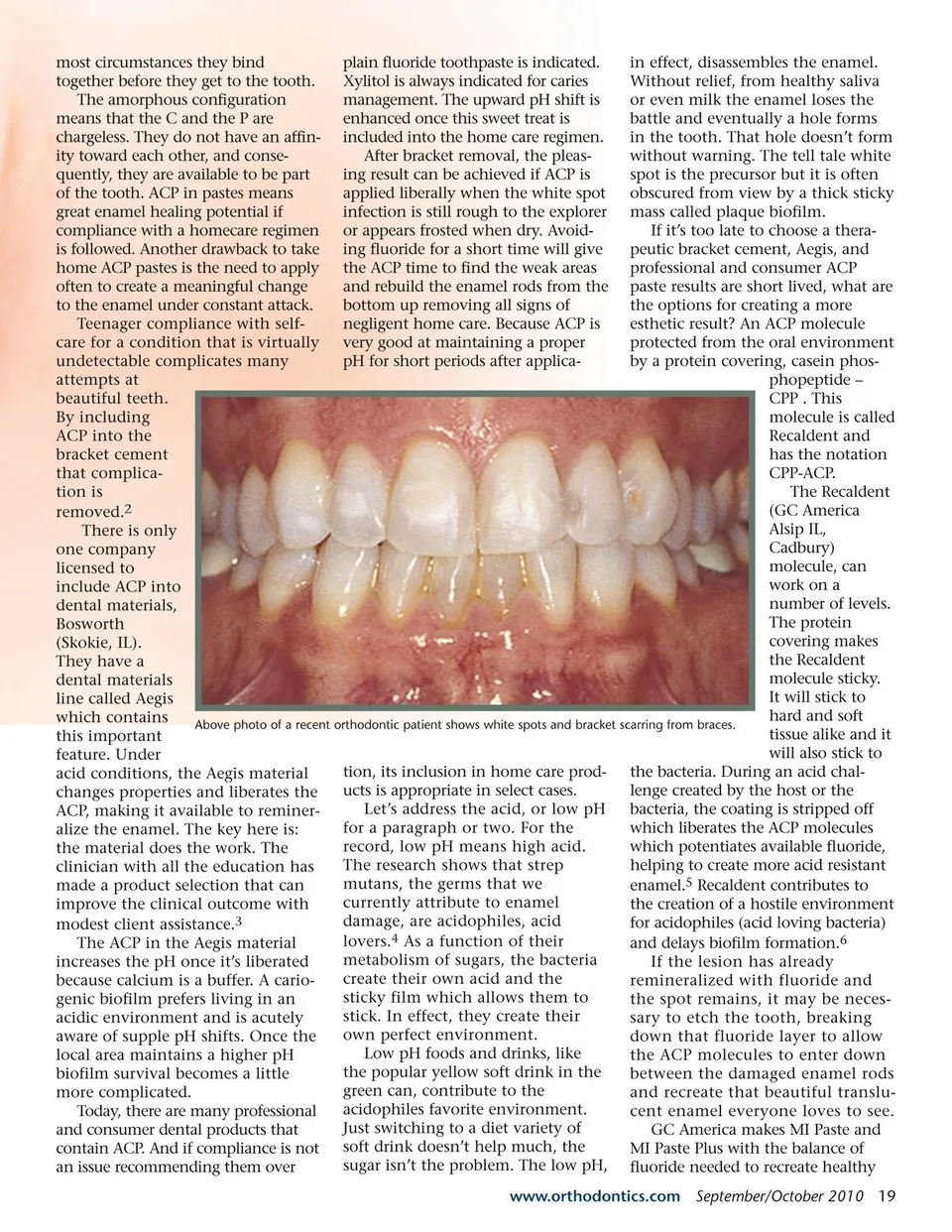
most circumstances they bind together before they get to the tooth. The amorphous configuration means that the C and the P are chargeless. They do not have an affin-ity toward each other, and conse-quently, they are available to be part of the tooth. ACP in pastes means great enamel healing potential if compliance with a homecare regimen is followed. Another drawback to take home ACP pastes is the need to apply often to create a meaningful change to the enamel under constant attack. Teenager compliance with self-care for a condition that is virtually undetectable complicates many attempts at beautiful teeth. By including ACP into the bracket cement that complica-tion is removed.2 There is only one company licensed to include ACP into dental materials, Bosworth (Skokie, IL). They have a dental materials line called Aegis which contains this important feature. Under plain fluoride toothpaste is indicated. Xylitol is always indicated for caries management. The upward pH shift is enhanced once this sweet treat is included into the home care regimen. After bracket removal, the pleas-ing result can be achieved if ACP is applied liberally when the white spot infection is still rough to the explorer or appears frosted when dry. Avoid-ing fluoride for a short time will give the ACP time to find the weak areas and rebuild the enamel rods from the bottom up removing all signs of negligent home care. Because ACP is very good at maintaining a proper pH for short periods after applica-in effect, disassembles the enamel. Without relief, from healthy saliva or even milk the enamel loses the battle and eventually a hole forms in the tooth. That hole doesn’t form without warning. The tell tale white spot is the precursor but it is often obscured from view by a thick sticky mass called plaque biofilm. If it’s too late to choose a thera-peutic bracket cement, Aegis, and professional and consumer ACP paste results are short lived, what are the options for creating a more esthetic result? An ACP molecule protected from the oral environment by a protein covering, casein phos-phopeptide – CPP . This molecule is called Recaldent and has the notation CPP-ACP. The Recaldent (GC America Alsip IL, Cadbury) molecule, can work on a Above photo of a recent orthodontic patient shows white spots and bracket scarring from braces. acid conditions, the Aegis material changes properties and liberates the ACP, making it available to reminer-alize the enamel. The key here is: the material does the work. The clinician with all the education has made a product selection that can improve the clinical outcome with modest client assistance.3 The ACP in the Aegis material increases the pH once it’s liberated because calcium is a buffer. A cario-genic biofilm prefers living in an acidic environment and is acutely aware of supple pH shifts. Once the local area maintains a higher pH biofilm survival becomes a little more complicated. Today, there are many professional and consumer dental products that contain ACP. And if compliance is not an issue recommending them over tion, its inclusion in home care prod-ucts is appropriate in select cases. Let’s address the acid, or low pH for a paragraph or two. For the record, low pH means high acid. The research shows that strep mutans, the germs that we currently attribute to enamel damage, are acidophiles, acid lovers.4 As a function of their metabolism of sugars, the bacteria create their own acid and the sticky film which allows them to stick. In effect, they create their own perfect environment. Low pH foods and drinks, like the popular yellow soft drink in the green can, contribute to the acidophiles favorite environment. Just switching to a diet variety of soft drink doesn’t help much, the sugar isn’t the problem. The low pH, number of levels. The protein covering makes the Recaldent molecule sticky. It will stick to hard and soft tissue alike and it will also stick to the bacteria. During an acid chal-lenge created by the host or the bacteria, the coating is stripped off which liberates the ACP molecules which potentiates available fluoride, helping to create more acid resistant enamel.5 Recaldent contributes to the creation of a hostile environment for acidophiles (acid loving bacteria) and delays biofilm formation.6 If the lesion has already remineralized with fluoride and the spot remains, it may be neces-sary to etch the tooth, breaking down that fluoride layer to allow the ACP molecules to enter down between the damaged enamel rods and recreate that beautiful translu-cent enamel everyone loves to see. GC America makes MI Paste and MI Paste Plus with the balance of fluoride needed to recreate healthy www.orthodontics.com September/October 2010 19
Journal of the American Orthodontic Society September-October 2010: Page 19