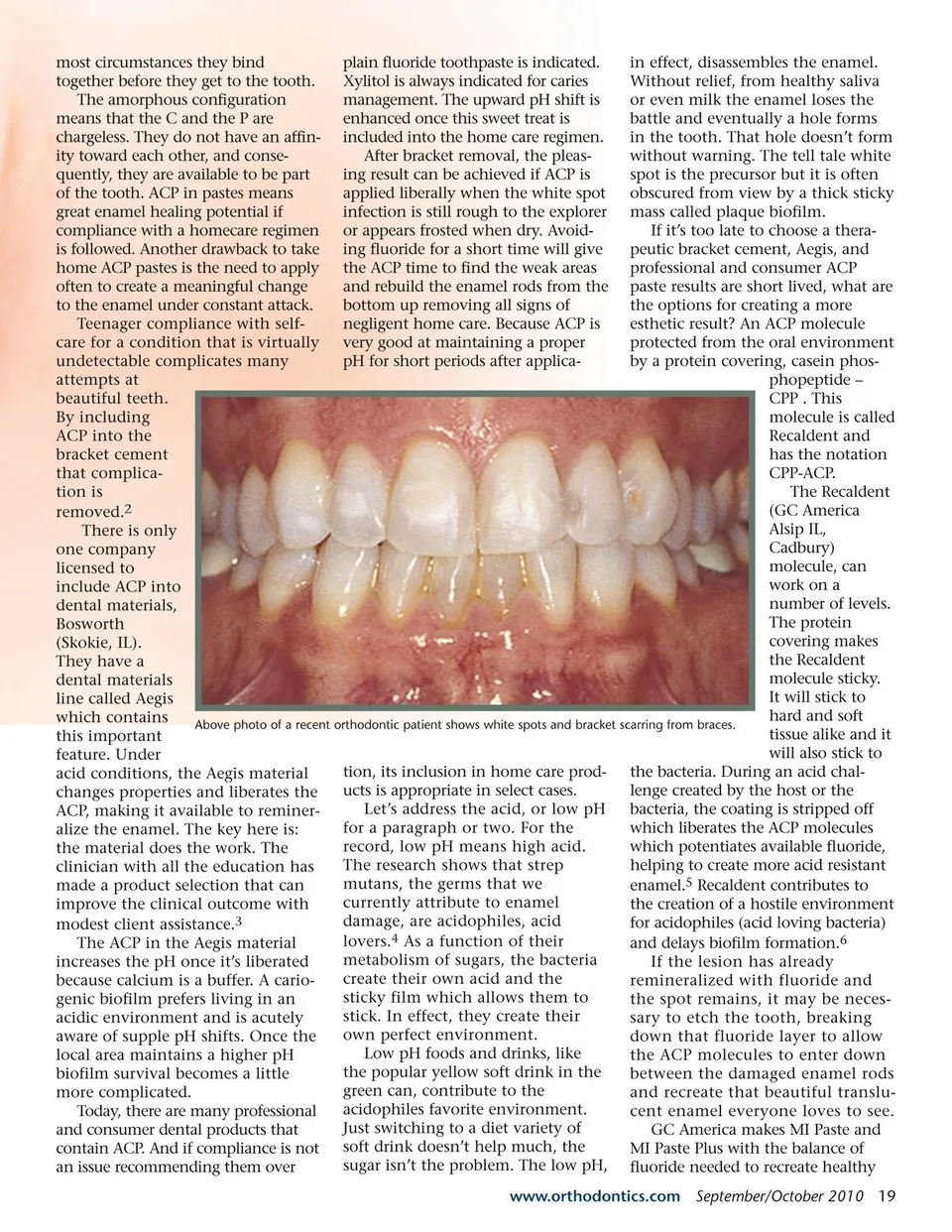
REHABBING ENAMEL AFTER BRACKET TREATMENT What Can Remove Bacteria In Patients Who Avoid Home Care? By Shirley Gutkowski, RDH, BSDH, FACE “Did you brush your teeth today?” the assistant asks the 14-year-old boy. “Yeah, but I had a doughnut in the car,” he answers. A hh, a day in the life of a dental assistant in the ortho office. Half truths, vague truths, occasional truths, and flat out lies are part of the game. The dental assistant in the ortho office walks the thin line between accepting a bold faced half-truth and calling the liar on it. Short of following the patient home or calling them three times a day to get another half truth, there’s little else any of the team members can do to help those soon-to-be-straight teeth healthy and sound. Or, is there? Bracket removal day is the poly-graph of the ortho/dental hygiene world. Squares or no squares, what’s it gonna be? And if the tell tale squares are there, will the patient know they are totally at fault? If they know they’re at fault, will they care? In the 18 September/October 2010 JAOS twisted minds of some teenagers, harming their own teeth is a way of exerting their independence. Fluoride is an awesome adjunct. Orthodontic practices, over and over again, are dismayed at the cosmetic result of applying large quantities of fluoride to the bracket scars. Although the surface of the enamel feels great under the light pressure of an explorer, the tell tale checkbox is still there. Fluoride binds with the top surface of enamel and makes the enamel more resistant to an acid challenge.1 An acid challenge can be from food, drink or a bath in the soup of bacterial waste. In order for fluoride to work as a remineraliza-tion aid, fluoride binds with the available calcium and phosphates that are usually supplied by healthy saliva which is in good supply in most ortho aged clients.1 The top surface is sealed and healed with fluoride. Underneath, the enamel is not sound causing a deflection of light that reveals the remnants of orthodontic treatment. Is there a secret formula to fewer bracket scars? Not any longer. Using bracket cements containing amor-phous calcium and phosphate (ACP) can make a difference and take compliance almost totally out of the picture. ACP is a configuration of calcium and phosphorous, the two main building blocks of enamel. What makes it special is the amor-phous configuration of the molecules. If you think back to chemistry class, you’ll remember that calcium is posi-tively charged, and phosphorous is negatively charged. These opposite charges attract one another and in
Journal of the American Orthodontic Society September-October 2010: Page 18