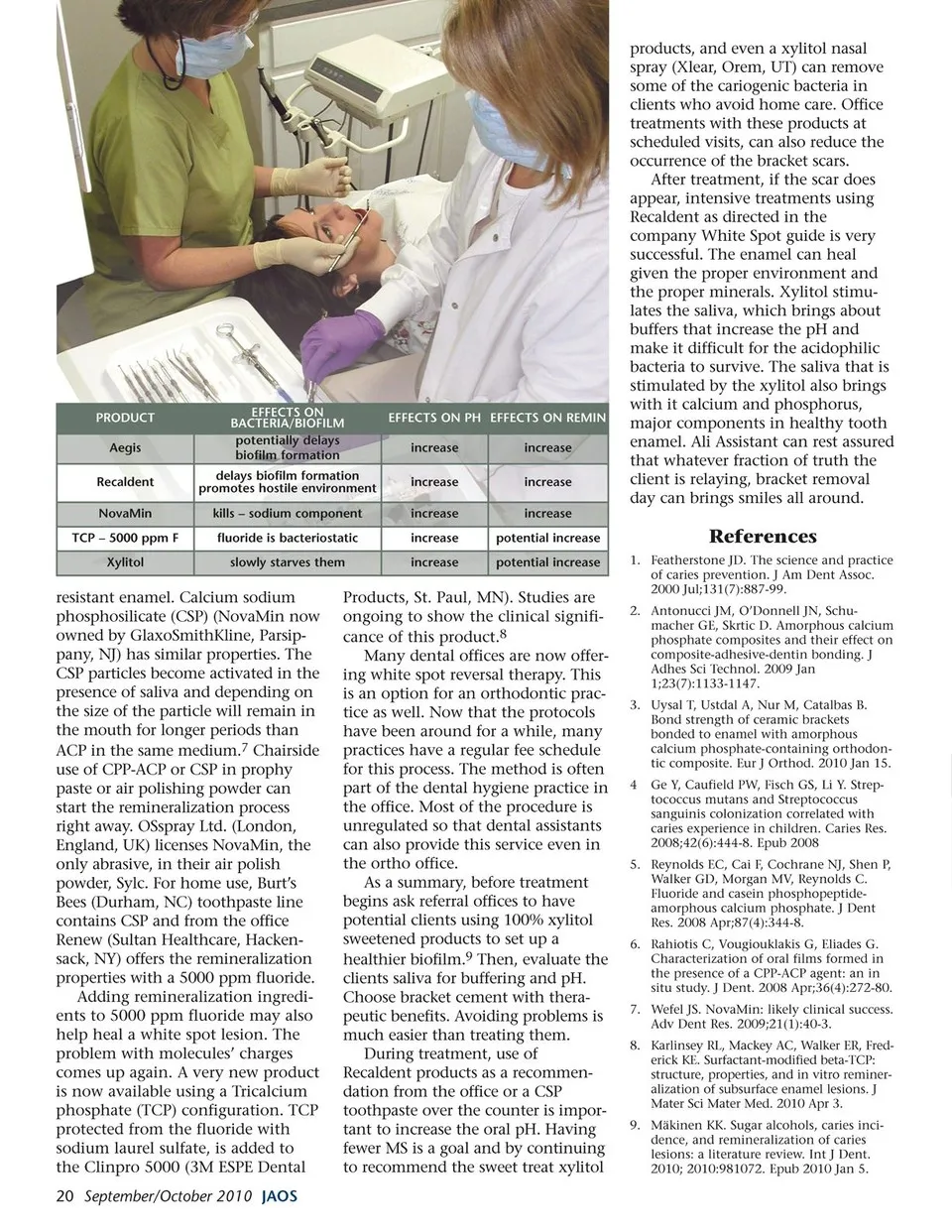
products, and even a xylitol nasal spray (Xlear, Orem, UT) can remove some of the cariogenic bacteria in clients who avoid home care. Office treatments with these products at scheduled visits, can also reduce the occurrence of the bracket scars. After treatment, if the scar does PRODUCT Aegis Recaldent NovaMin TCP – 5000 ppm F Xylitol BACTERIA/BIOFILM EFFECTS ON potentially delays biofilm formation delays biofilm formation promotes hostile environment kills – sodium component fluoride is bacteriostatic slowly starves them resistant enamel. Calcium sodium phosphosilicate (CSP) (NovaMin now owned by GlaxoSmithKline, Parsip-pany, NJ) has similar properties. The CSP particles become activated in the presence of saliva and depending on the size of the particle will remain in the mouth for longer periods than ACP in the same medium.7 Chairside use of CPP-ACP or CSP in prophy paste or air polishing powder can start the remineralization process right away. OSspray Ltd. (London, England, UK) licenses NovaMin, the only abrasive, in their air polish powder, Sylc. For home use, Burt’s Bees (Durham, NC) toothpaste line contains CSP and from the office Renew (Sultan Healthcare, Hacken-sack, NY) offers the remineralization properties with a 5000 ppm fluoride. Adding remineralization ingredi-ents to 5000 ppm fluoride may also help heal a white spot lesion. The problem with molecules’ charges comes up again. A very new product is now available using a Tricalcium phosphate (TCP) configuration. TCP protected from the fluoride with sodium laurel sulfate, is added to the Clinpro 5000 (3M ESPE Dental 20 September/October 2010 JAOS EFFECTS ON PH EFFECTS ON REMIN increase increase increase increase increase increase increase increase potential increase potential increase Products, St. Paul, MN). Studies are ongoing to show the clinical signifi-cance of this product.8 Many dental offices are now offer-ing white spot reversal therapy. This is an option for an orthodontic prac-tice as well. Now that the protocols have been around for a while, many practices have a regular fee schedule for this process. The method is often part of the dental hygiene practice in the office. Most of the procedure is unregulated so that dental assistants can also provide this service even in the ortho office. As a summary, before treatment begins ask referral offices to have potential clients using 100% xylitol sweetened products to set up a healthier biofilm.9 Then, evaluate the clients saliva for buffering and pH. Choose bracket cement with thera-peutic benefits. Avoiding problems is much easier than treating them. During treatment, use of Recaldent products as a recommen-dation from the office or a CSP toothpaste over the counter is impor-tant to increase the oral pH. Having fewer MS is a goal and by continuing to recommend the sweet treat xylitol References 1. Featherstone JD. The science and practice of caries prevention. J Am Dent Assoc. 2000 Jul;131(7):887-99. 2. Antonucci JM, O’Donnell JN, Schu-macher GE, Skrtic D. Amorphous calcium phosphate composites and their effect on composite-adhesive-dentin bonding. J Adhes Sci Technol. 2009 Jan 1;23(7):1133-1147. 3. Uysal T, Ustdal A, Nur M, Catalbas B. Bond strength of ceramic brackets bonded to enamel with amorphous calcium phosphate-containing orthodon-tic composite. Eur J Orthod. 2010 Jan 15. 4 Ge Y, Caufield PW, Fisch GS, Li Y. Strep-tococcus mutans and Streptococcus sanguinis colonization correlated with caries experience in children. Caries Res. 2008;42(6):444-8. Epub 2008 5. Reynolds EC, Cai F, Cochrane NJ, Shen P, Walker GD, Morgan MV, Reynolds C. Fluoride and casein phosphopeptide-amorphous calcium phosphate. J Dent Res. 2008 Apr;87(4):344-8. 6. Rahiotis C, Vougiouklakis G, Eliades G. Characterization of oral films formed in the presence of a CPP-ACP agent: an in situ study. J Dent. 2008 Apr;36(4):272-80. 7. Wefel JS. NovaMin: likely clinical success. Adv Dent Res. 2009;21(1):40-3. 8. Karlinsey RL, Mackey AC, Walker ER, Fred-erick KE. Surfactant-modified beta-TCP: structure, properties, and in vitro reminer-alization of subsurface enamel lesions. J Mater Sci Mater Med. 2010 Apr 3. 9. Mäkinen KK. Sugar alcohols, caries inci-dence, and remineralization of caries lesions: a literature review. Int J Dent. 2010; 2010:981072. Epub 2010 Jan 5. appear, intensive treatments using Recaldent as directed in the company White Spot guide is very successful. The enamel can heal given the proper environment and the proper minerals. Xylitol stimu-lates the saliva, which brings about buffers that increase the pH and make it difficult for the acidophilic bacteria to survive. The saliva that is stimulated by the xylitol also brings with it calcium and phosphorus, major components in healthy tooth enamel. Ali Assistant can rest assured that whatever fraction of truth the client is relaying, bracket removal day can brings smiles all around.
Journal of the American Orthodontic Society September-October 2010: Page 20