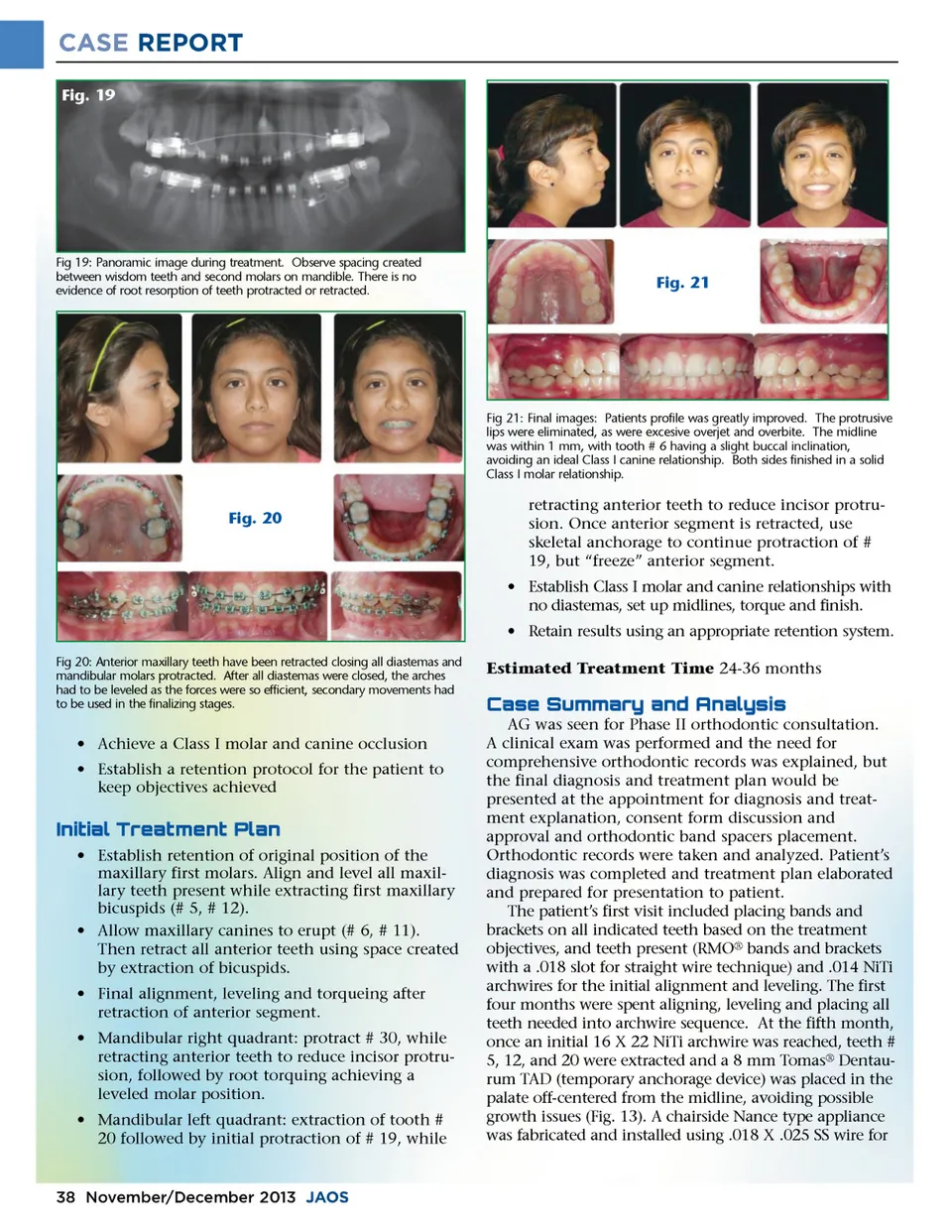
CASE REPORT the wire portion, and flowable composite used to bond the wire to the TAD, and secure the distal ends inside the lingual sleeves of the bands (Fig. 15). Power-chain was used to start protraction of the first mandibular molars # 19, 30 against the group composed of teeth # 21-28. This would allow slight retraction of the anterior segment while protracting the molars. No retraction was attempted in maxilla, while waiting for canines to erupt into the extracted premolar space and incorporated in the archwire set-up. At the eighth month of treatment, the mandibular first bicuspids and canines were in the desired Class I position. An 8mm TAD was then placed between teeth #21 and 22 to hold the position of #21, control the position of the segment of teeth #22-27, and help protract tooth #19 (Figs. 14, 16). At this time teeth #28 and 30 had been approximated, eliminating the diastema and the only remaining need was to mesialize roots of tooth #30. Power buttons were placed on the lingual of teeth #18 and 22 to complement the buccal forces with lingual forces for the protraction of teeth #18 and 19. A power button was used on tooth #6 to bring it into the arch-wire sequence. At the ninth month, the protraction mechanism was modified for tooth #19. An auxiliary arm was fabricated and inserted into the secondary arch-wire tube, allowing protraction with less crown inclina-tion, less binding and more bodily movement. The protraction and space closure had three compo-nents: power-chain from teeth #18 to 31, power-chain Fig. 22 Fig 22: Progression of smile appearance from start to finish. Vast improvement in the soft tissue appearance, the maxillary lip drape over the supporting teeth and the buccal corridors of the smile. from lingual of teeth #18 to 22, and power-chain from the buccal TAD to the auxiliary arm of tooth # 19 (fig 17). By this time, all mechanisms for protraction had been placed into action, and the only adjustments required were monthly changes of power-chains to complete the programed maxillary retractions of teeth # 6-11. At month eleven, tooth # 6 received a bracket and a .018 NiTi archwire was used to bring it down into the archwire. The cant was protected using the skeletal anchored Nance appliance (Figs. 14, 15). By month sixteen, mandibular protractions of teeth #18 and 19 and retraction of the anterior maxillary segment (#6-11) had www.orthodontics.com November/December 2013 39
Journal of the American Orthodontic Society November-December 2013: Page 39