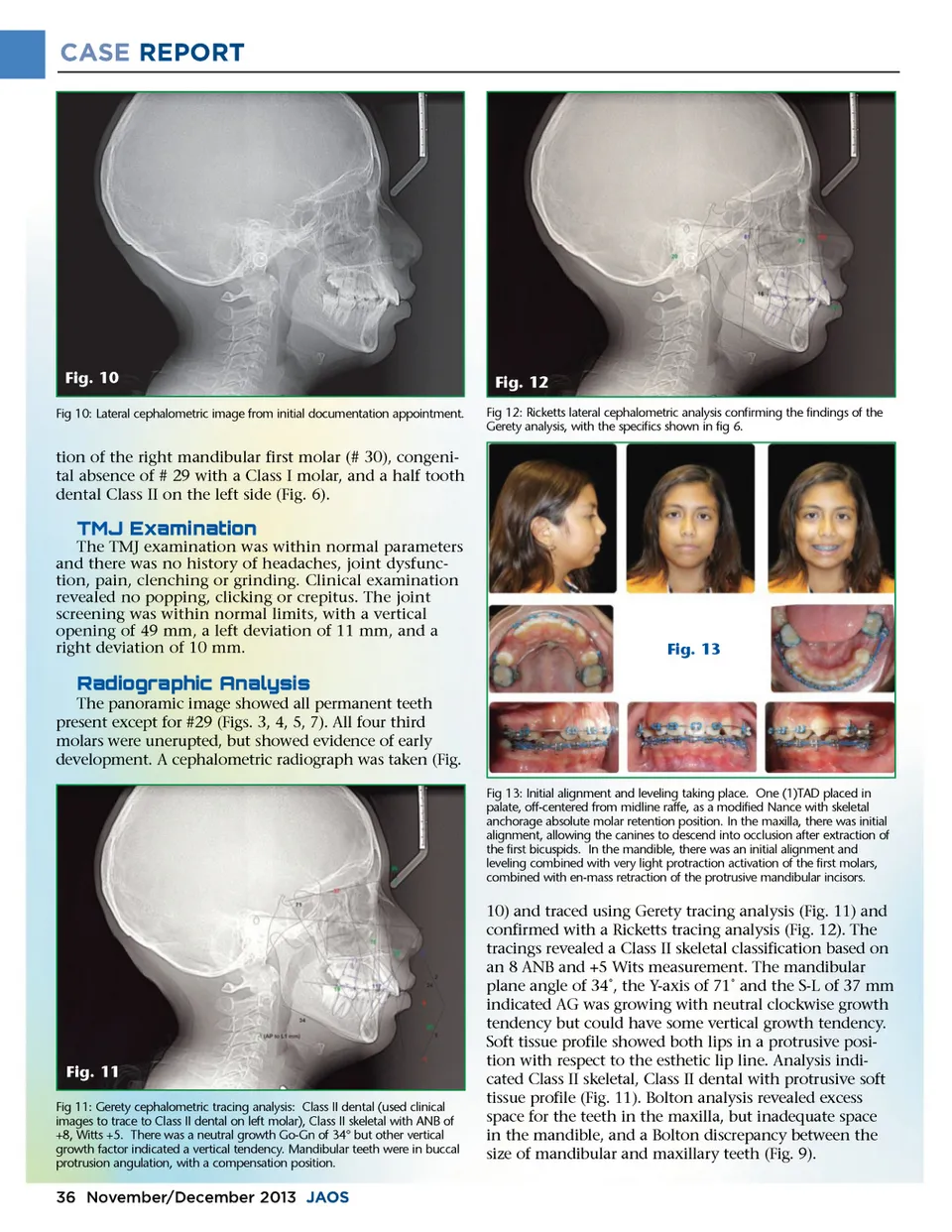
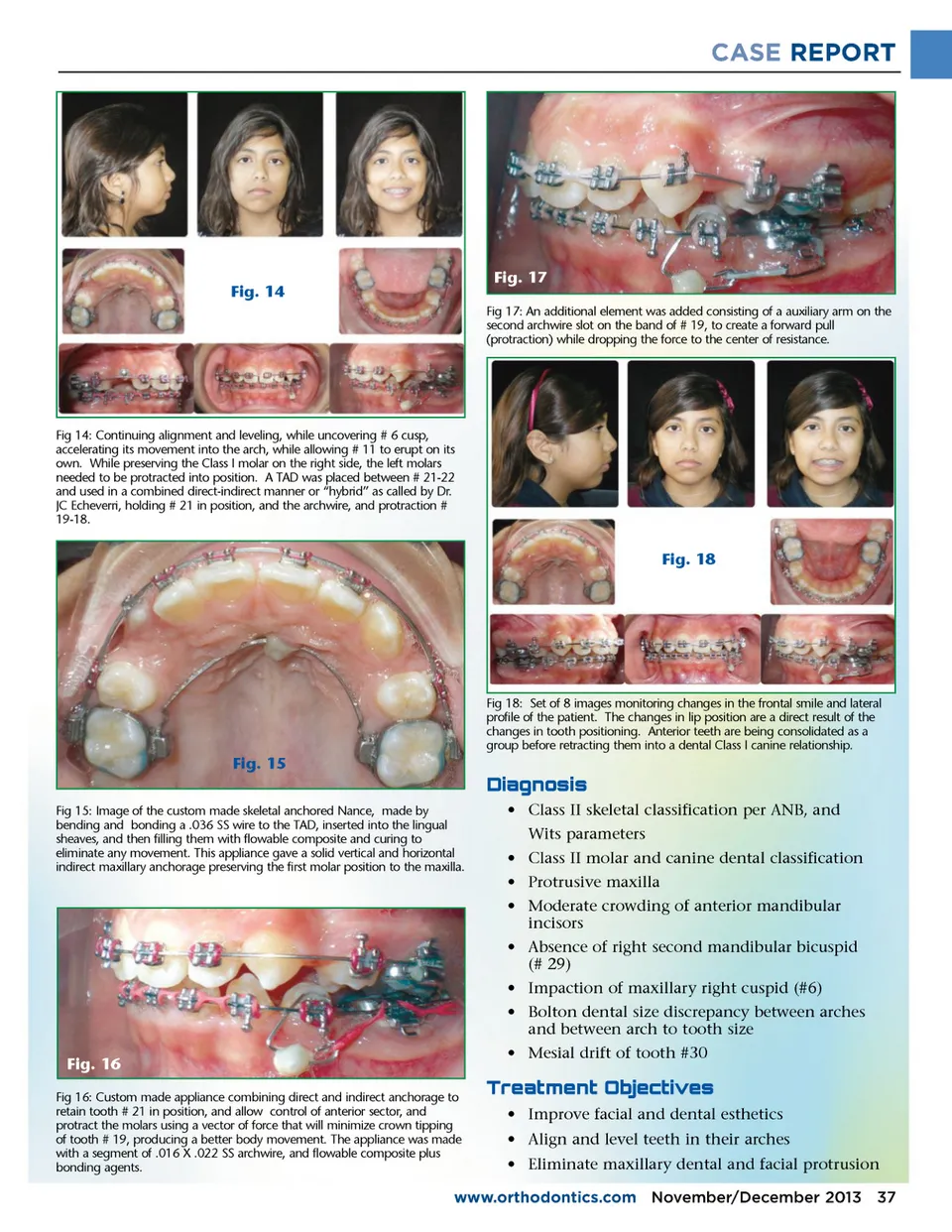
CASE REPORT Fig. 14 Fig. 17 Fig 17: An additional element was added consisting of a auxiliary arm on the second archwire slot on the band of # 19, to create a forward pull (protraction) while dropping the force to the center of resistance. Fig 14: Continuing alignment and leveling, while uncovering # 6 cusp, accelerating its movement into the arch, while allowing # 11 to erupt on its own. While preserving the Class I molar on the right side, the left molars needed to be protracted into position. A TAD was placed between # 21-22 and used in a combined direct-indirect manner or “hybrid” as called by Dr. JC Echeverri, holding # 21 in position, and the archwire, and protraction # 19-18. Fig. 18 Fig 18: Set of 8 images monitoring changes in the frontal smile and lateral profile of the patient. The changes in lip position are a direct result of the changes in tooth positioning. Anterior teeth are being consolidated as a group before retracting them into a dental Class I canine relationship. Fig. 15 #$�f;"c;e;#e; Fig 15: Image of the custom made skeletal anchored Nance, made by bending and bonding a .036 SS wire to the TAD, inserted into the lingual sheaves, and then filling them with flowable composite and curing to eliminate any movement. This appliance gave a solid vertical and horizontal indirect maxillary anchorage preserving the first molar position to the maxilla. • Class II skeletal classification per ANB, and Wits parameters • Class II molar and canine dental classification • Protrusive maxilla • Moderate crowding of anterior mandibular incisors • Absence of right second mandibular bicuspid (# 29) • Impaction of maxillary right cuspid (#6) • Bolton dental size discrepancy between arches and between arch to tooth size Fig. 16 Fig 16: Custom made appliance combining direct and indirect anchorage to retain tooth # 21 in position, and allow control of anterior sector, and protract the molars using a vector of force that will minimize crown tipping of tooth # 19, producing a better body movement. The appliance was made with a segment of .016 X .022 SS archwire, and flowable composite plus bonding agents. • Mesial drift of tooth #30 d;!$ a;!" f;�a;! #�c;!e; • Improve facial and dental esthetics • Align and level teeth in their arches • Eliminate maxillary dental and facial protrusion www.orthodontics.com November/December 2013 37
Journal of the American Orthodontic Society November-December 2013: Page 37